
Leverage trading allows crypto traders to control positions larger than their actual account balance by borrowing funds from an exchange. While this amplifies potential profits, it equally magnifies losses—sometimes wiping out entire accounts in minutes during volatile price swings.
The mechanics are straightforward: deposit collateral, borrow additional capital, and trade with the combined amount. A trader with $1,000 using 10x leverage controls $10,000 worth of cryptocurrency. If the price moves 5% in their favor, they gain $500 (50% return on their $1,000). Move 5% against them, and they lose the same amount—half their capital gone in one trade.
Understanding how leverage works, when positions get liquidated, and why most leveraged traders lose money requires looking beyond the marketing promises of “10x your gains.” The following sections break down the actual mechanics, hidden costs, and real risks that separate profitable leverage trading from expensive lessons.
Understanding Leverage in Crypto Trading
What is leverage in crypto trading? It’s borrowing power. Exchanges lend you capital to open positions larger than your account size, using your deposit as collateral. The leverage ratio describes this multiplier: 2x means you borrow an equal amount to your deposit, 10x means you borrow nine times your deposit, and so on.
A leverage ratio crypto traders choose determines both opportunity and risk exposure. At 2x leverage, a $5,000 account controls $10,000. At 50x, that same $5,000 controls $250,000. The appeal is obvious—small price movements generate substantial returns. A 2% price increase on a 50x leveraged position yields a 100% account gain.
The math works identically in reverse. That same 2% price drop at 50x leverage eliminates your entire account. The exchange automatically closes your position through liquidation before you can lose their borrowed funds.
Different exchanges offer different maximum leverage ratios. Some platforms cap futures trading at 20x, others allow 100x or even 125x on certain pairs. Higher leverage doesn’t mean better opportunities—it means faster liquidation and tighter margin requirements.
Leverage applies to both long positions (betting prices rise) and short positions (betting prices fall). The mechanics stay consistent: you’re controlling more capital than you own, amplifying every percentage point of price movement in either direction.
How Crypto Leverage Works in Practice
Opening a leveraged position involves several steps. First, you deposit collateral into a margin account—this might be USDT, USDC, BTC, or ETH depending on the exchange. Next, you select your leverage ratio and position size. The exchange calculates how much you’re borrowing and locks your collateral.
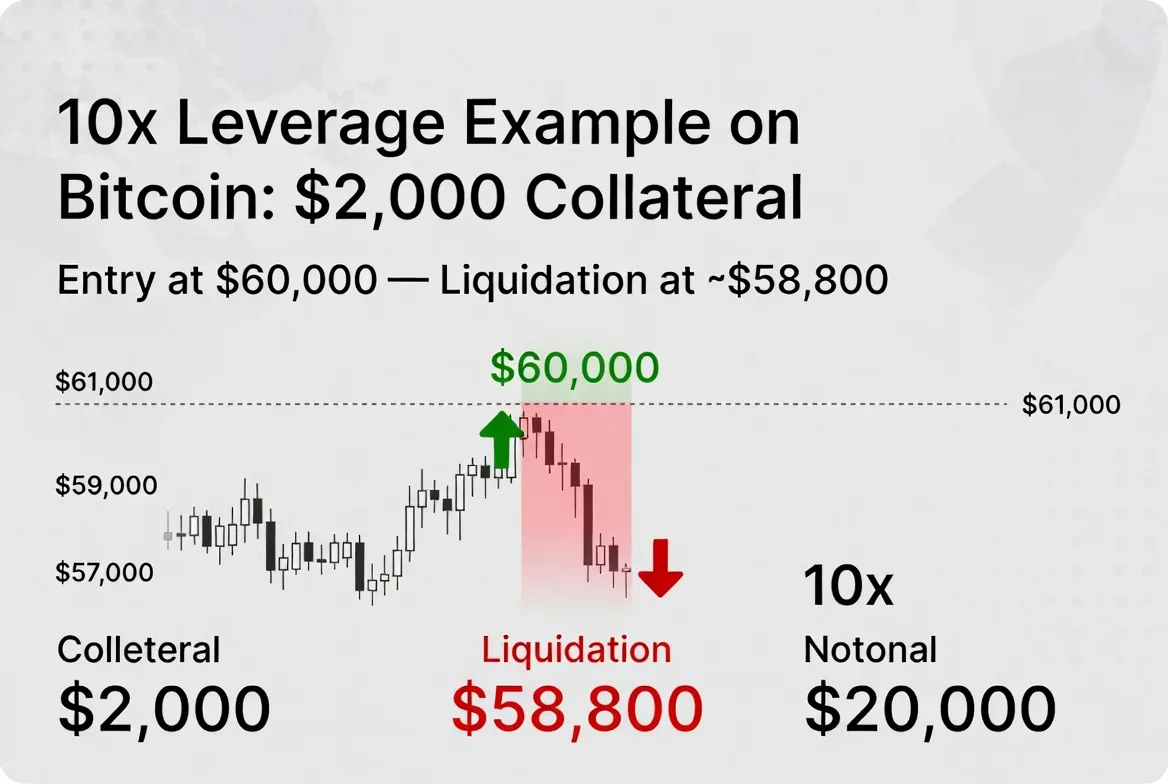
Here’s a concrete example of how crypto leverage works. You deposit $2,000 USDT and open a 10x leveraged long position on Bitcoin at $60,000. Your position size is $20,000, meaning you control 0.333 BTC. The exchange lends you $18,000.
If Bitcoin rises to $66,000 (10% gain), your position is now worth $22,000. Subtract the $18,000 loan, and you have $4,000—doubling your initial $2,000. Your actual return is 100% on a 10% price move.
If Bitcoin drops to $54,000 (10% loss), your position is worth $18,000. After repaying the loan, you have zero. Your $2,000 disappeared completely on a 10% price move.
The amplification works proportionally. At 5x leverage, that 10% Bitcoin gain yields 50% account growth. At 25x leverage, the same move generates 250% returns—or complete liquidation if prices move 4% against you.
Crypto trading with leverage also involves funding rates on perpetual futures contracts. These periodic payments (usually every eight hours) flow between long and short traders based on market conditions. When the market is bullish, longs pay shorts; during bearish periods, shorts pay longs. Rates typically range from -0.01% to 0.05% per funding period but can spike to 0.1% or higher during extreme volatility.
A $50,000 position paying 0.05% funding three times daily costs $75 per day—$2,250 monthly. These costs accumulate silently, eroding profits even when price predictions prove correct.
Margin Requirements and Collateral Rules
Crypto margin requirements determine how much collateral you need to open and maintain leveraged positions. Two key thresholds matter: initial margin and maintenance margin.
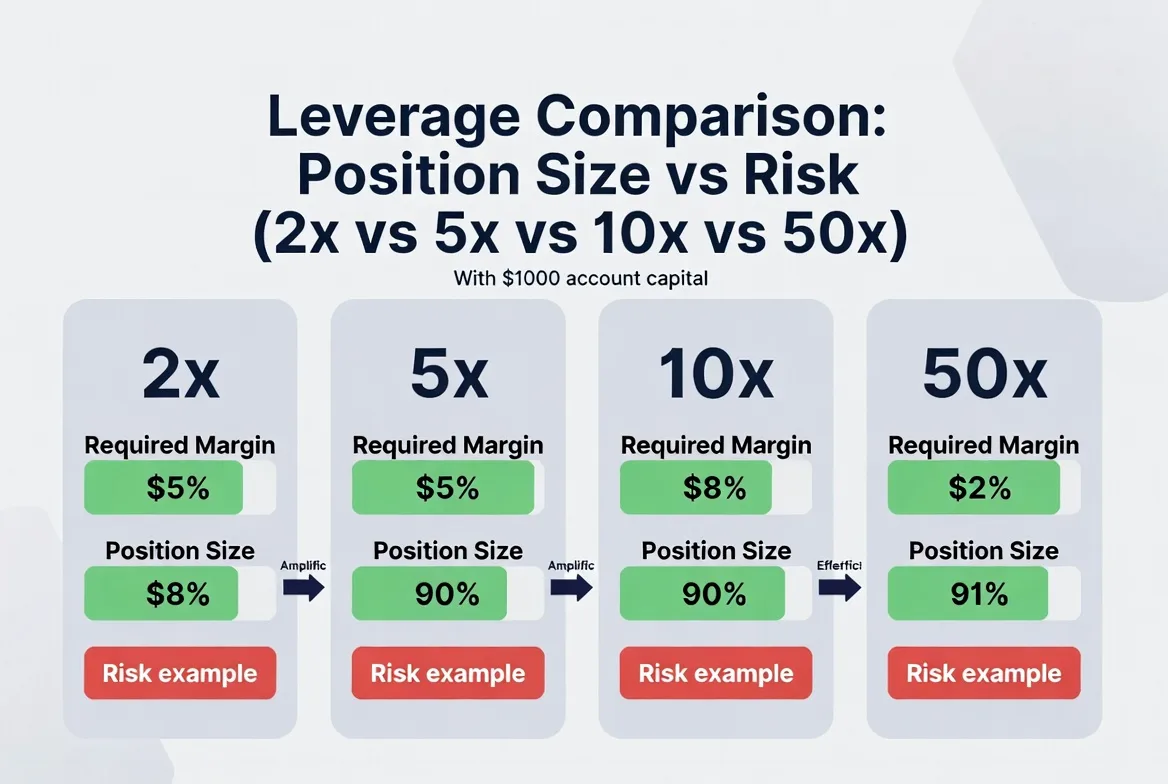
Initial margin is the collateral percentage required to open a position. At 10x leverage, initial margin is 10% (you provide $1,000 to control $10,000). At 50x leverage, initial margin drops to 2% ($400 controls $20,000).
Maintenance margin is the minimum collateral percentage needed to keep positions open. Exchanges typically set this at 50-80% of initial margin. For a 10x position, maintenance margin might be 5%. If your collateral drops to this level, liquidation triggers.
Here’s where it gets tricky. Your collateral value fluctuates with your position’s unrealized profit or loss. Open a $20,000 long position with $2,000 collateral (10x leverage). Bitcoin drops 5%, creating a $1,000 unrealized loss. Your effective collateral is now $1,000 ($2,000 minus $1,000 loss), representing 5% of your $20,000 position—right at the maintenance margin threshold.
Most exchanges use mark price rather than last traded price to calculate margin. Mark price is designed to prevent manipulation and reflects the broader market price through index calculations. During flash crashes or low liquidity events, mark price might differ significantly from the exchange’s spot price, triggering liquidations even when the spot chart shows your position is safe.
Cross margin and isolated margin represent different collateral approaches. Cross margin uses your entire account balance as collateral for all positions. One profitable trade can prevent liquidation on another losing trade. The risk: one bad position can liquidate your entire account.
Isolated margin restricts collateral to the amount allocated for each specific position. Maximum loss is limited to that position’s margin. You can run multiple isolated positions with different leverage ratios, and one liquidation doesn’t affect others. The tradeoff: you can’t use profits from one position to save another from liquidation.
Liquidation and Margin Calls Explained
Liquidation in leveraged crypto occurs when your collateral drops below maintenance margin requirements. The exchange forcibly closes your position to recover borrowed funds. Unlike traditional finance, crypto liquidations happen automatically without warning—no phone calls, no grace period.
The liquidation price is calculated when you open a position. For a 10x long position on Bitcoin at $60,000 with $2,000 collateral controlling $20,000, liquidation triggers around $58,800. That’s roughly a 2% price drop, accounting for the maintenance margin threshold and liquidation fees.
Higher leverage means tighter liquidation prices. At 50x leverage on the same $60,000 Bitcoin entry, liquidation occurs near $59,760—just 0.4% below your entry price. Normal market volatility can liquidate you within minutes.
A margin call in crypto differs from traditional margin calls. In stock trading, brokers contact you and request additional funds before liquidation. Crypto exchanges rarely offer this courtesy. Some platforms send notifications when your margin ratio approaches dangerous levels, but by the time you see the alert, liquidation may have already executed.
Partial liquidation occurs on some exchanges when only a portion of your position closes to bring your margin ratio back above maintenance requirements. Full liquidation closes the entire position. Partial liquidation can be worse—you pay liquidation fees multiple times as your position gets nibbled away during choppy price action.
Liquidation fees typically range from 0.02% to 0.5% of position size. On a $50,000 position, that’s $10 to $250 taken directly from your remaining collateral. During extreme volatility, when liquidation prices gap through your position, you might experience a loss exceeding your initial collateral if the exchange can’t close your position fast enough. Many exchanges have insurance funds to cover these losses, but not all platforms fully protect traders from negative balances.
Cascading liquidations amplify crypto volatility. When prices move sharply, highly leveraged positions hit liquidation thresholds. These forced closures create additional selling (or buying) pressure, pushing prices further and triggering more liquidations. The 2021 Bitcoin flash crash to $30,000 liquidated over $10 billion in leveraged positions within hours, with cascading liquidations accelerating the decline.
Risks of Trading Crypto with Leverage
Crypto leverage risks extend far beyond simple loss amplification. The volatility inherent to cryptocurrency markets makes leveraged trading particularly dangerous compared to traditional assets.
Bitcoin regularly experiences 5-10% daily swings. Ethereum and altcoins see even larger moves. A 15% drop—unremarkable in crypto—completely liquidates any position leveraged above 6x. During the 2024 market corrections, Bitcoin dropped 25% in three days, wiping out leveraged positions across all timeframes.
High leverage crypto dangers multiply during low liquidity periods. Weekend trading, Asian market hours, or holiday periods often see thinner order books. A moderate sell order can move prices 2-3% instantly, liquidating high-leverage positions before traders can react. Stop-loss orders provide no protection—liquidation executes at whatever price the exchange can fill, often well below your intended stop.
Exchange risk represents an often-overlooked danger. Platform outages during high volatility prevent you from managing positions. FTX’s 2022 collapse demonstrated how quickly exchange insolvency can lock up funds. Even reputable exchanges experience downtime—when you can’t access your leveraged positions during a market crash, liquidation proceeds automatically while you’re locked out.
Funding rates create hidden costs that erode leveraged positions. Holding a $100,000 leveraged position for 30 days with average 0.03% funding rates paid three times daily costs $2,700. Your price prediction must overcome this cost drag before generating profit. Traders focusing solely on price direction often miss these accumulating expenses.
Counterparty risk matters more in crypto than traditional finance. When you leverage trade, you’re trusting the exchange to honor your position, maintain adequate reserves, and process liquidations fairly. Smaller exchanges have occasionally manipulated liquidation prices, adjusted funding rates unfairly, or experienced “mysterious” outages during critical price movements.
Psychological pressure intensifies with leverage. Watching a position approach liquidation triggers stress responses that cloud judgment. Traders add more collateral to avoid liquidation (throwing good money after bad), close positions prematurely during temporary dips, or freeze entirely and watch liquidation happen. The emotional toll of losing months of gains in a single leveraged trade pushes many traders into revenge trading—attempting to recover losses quickly through even higher leverage.
Common Mistakes When Using Leveraged Positions

Overleveraging ranks as the primary mistake. New traders see 100x leverage as an opportunity for massive gains without calculating how little price movement triggers liquidation. Using maximum available leverage means any position becomes a coin flip—even correct predictions fail when normal volatility liquidates the position before the trend develops.
A practical rule: never use leverage that liquidates your position on a move smaller than the asset’s typical daily range. If Bitcoin averages 5% daily movement, leverage above 10x means random volatility can liquidate you regardless of your overall analysis.
Ignoring stop-losses or setting them too tight creates problems. Leveraged crypto positions without stops expose you to total loss during flash crashes or overnight gaps. Stops placed too close to entry guarantee getting shaken out by normal price noise. A reasonable approach: set stops at levels that invalidate your trade thesis, not at arbitrary percentage losses.
Failing to account for fees destroys profitability. Beyond liquidation fees and funding rates, exchanges charge trading fees to open and close positions. A round-trip trade might cost 0.1-0.2% in fees. At 10x leverage, that’s 1-2% of your collateral. Make ten trades, and fees alone consume 10-20% of your account even if you break even on price movements.
Misunderstanding how different order types execute on leveraged positions causes unexpected losses. Market orders on leveraged positions can experience severe slippage during volatility. Limit orders might not fill, leaving you without protection as prices move against you. Stop-market orders can execute far below your stop price during gaps.
Trading multiple highly correlated leveraged positions concentrates risk rather than diversifying it. Opening 10x long positions on Bitcoin, Ethereum, and several altcoins doesn’t spread risk—when Bitcoin drops, everything drops together. Your effective leverage becomes much higher than intended because all positions move in tandem.
Emotional trading intensifies with leveraged crypto positions. The combination of 24/7 markets, high volatility, and amplified gains/losses creates addictive psychological patterns. Traders check positions constantly, make impulsive adjustments, and let short-term price noise override their strategy. The dopamine hit from a successful leveraged trade encourages increasingly risky behavior.
Neglecting to adjust leverage based on market conditions is another common error. Using 20x leverage during low-volatility consolidation might work fine. Maintaining that same leverage when volatility expands guarantees liquidation. Successful leverage traders reduce their leverage ratios as volatility increases, preserving capital during uncertain periods.
Leverage is a tool that reveals whether a trader has genuine edge or is simply gambling. In my two decades analyzing derivatives markets, I’ve observed that consistent profitability in leveraged crypto trading requires position sizing discipline that most participants lack. The traders who survive use leverage ratios that seem conservative—3x to 5x maximum—and treat each position as one of hundreds they’ll make over years, not as their ticket to quick wealth. The irony is that lower leverage often produces better returns because you stay solvent long enough to benefit from your correct predictions.
Dr. Rebecca Chen, Quantitative Risk Analyst
Leverage Ratio Comparison
| Leverage Ratio | Required Margin | Profit on 10% Price Move | Loss on 10% Price Move | Approximate Liquidation Threshold |
|---|---|---|---|---|
| 2x | 50% | +20% | -20% | -40% price move |
| 5x | 20% | +50% | -50% | -16% price move |
| 10x | 10% | +100% | -100% (total loss) | -8% price move |
| 25x | 4% | +250% | -100% (total loss) | -3.2% price move |
| 50x | 2% | +500% | -100% (total loss) | -1.6% price move |
| 100x | 1% | +1000% | -100% (total loss) | -0.8% price move |
Note: Liquidation thresholds are approximate and vary by exchange based on maintenance margin requirements and liquidation fees. Actual liquidation may occur at slightly different levels.
FAQs
On most major exchanges, your maximum loss is limited to your deposited collateral due to automatic liquidation systems. However, during extreme volatility or flash crashes, prices can gap through your liquidation price before the exchange closes your position. If this happens, you could theoretically owe the exchange money, though many platforms have insurance funds to cover these negative balances. Some exchanges explicitly state they won’t pursue negative balances, while others reserve the right to collect. Always check your exchange’s policy on negative balance protection.
Beginners should start with 2x-3x leverage maximum, or avoid leverage entirely until they’re consistently profitable trading without it. These lower ratios allow you to learn how leverage affects position sizing, liquidation mechanics, and emotional responses without risking complete account loss on normal market movements. Many professional traders never exceed 5x leverage regardless of experience. Remember that lower leverage doesn’t mean lower profits—it means you survive long enough to develop actual trading skills.
At 50x leverage, a 2% price move against your position triggers liquidation—this can happen in seconds during volatile periods. Bitcoin has experienced 5% moves in under a minute during major news events. Even at more conservative 10x leverage, liquidation occurs around 8-10% adverse price movement, which Bitcoin and Ethereum accomplish multiple times monthly. The speed of liquidation depends on volatility, but highly leveraged positions can go from profitable to liquidated in the time it takes to refill your coffee.
No. Leverage limits vary significantly by exchange and jurisdiction. Binance offers up to 125x on certain futures contracts. Coinbase allows maximum 10x leverage. Kraken caps most pairs at 5x. US-regulated exchanges typically offer lower maximum leverage than offshore platforms due to regulatory restrictions. Additionally, exchanges may reduce available leverage for certain trading pairs, during high volatility, or for accounts with lower verification levels. Some exchanges dynamically adjust maximum leverage based on your position size—larger positions often require lower leverage ratios.
Isolated margin allocates a specific amount of collateral to each position. If that position gets liquidated, only the allocated collateral is lost—your remaining account balance stays safe. Cross margin uses your entire account balance as collateral for all positions. This prevents liquidation longer because profits from one position can offset losses on another, but a single bad trade can liquidate your entire account. Isolated margin offers better risk management for multiple positions, while cross margin provides more flexibility for traders running a single position or highly correlated positions they want to support with their full balance.
Leverage trading crypto amplifies both opportunity and risk in equal measure. The mechanics are simple—borrow funds to control larger positions—but the practical execution separates profitable traders from cautionary tales. Understanding liquidation thresholds, margin requirements, funding costs, and psychological pressures provides the foundation, but knowledge alone doesn’t guarantee success.
The data consistently shows that most leveraged crypto traders lose money. High leverage ratios above 10x serve primarily as marketing tools for exchanges, generating trading fees from rapid liquidations rather than creating sustainable trader profits. The survivors use conservative leverage, rigorous risk management, and position sizing that assumes they’ll be wrong frequently.
Before opening your first leveraged position, ask whether you’re consistently profitable without leverage. If not, adding leverage simply helps you lose money faster. If you are profitable, leverage should amplify an existing edge, not create one. Start small, use stop-losses, monitor funding rates, and never risk more than you can afford to lose completely.
The promise of 10x or 100x returns attracts traders to leverage. The reality is that sustainable profitability comes from preserving capital through dozens or hundreds of trades, not hitting a single jackpot. Treat leverage as a precision tool requiring skill and discipline, not a lottery ticket to quick wealth.