DeFi transformed crypto trading in ways most people didn’t see coming. Walk into any traditional exchange—Coinbase, Binance, Kraken—and you’ll find order books matching buyers with sellers. Post a buy order at $2,000 per ETH, wait for someone to accept it, done.
Decentralized exchanges threw that model out entirely. No order books. No waiting for matching orders. Just pools of tokens sitting in smart contracts, ready for instant swaps.
Here’s where it gets interesting: those pools don’t fill themselves. Real people—often regular crypto holders, not institutions—deposit their tokens to create the trading liquidity everyone else uses. These depositors are liquidity providers, and without them, most DEXs would grind to a halt within hours.
You deposit a token pair, collect fees from every trade that touches your pool, and hope the math works in your favor. Simple concept. Complex execution. The difference between profit and loss often comes down to understanding mechanics that most DeFi tutorials gloss over.
Understanding Liquidity Providers and Their Role in DeFi
Becoming a liquidity provider means locking two different tokens into a smart contract pool. Think of it as stocking a vending machine—you provide the inventory (tokens), customers make purchases (swaps), and you collect a percentage of each sale.
Most pools pair a volatile asset with something stable: ETH with USDC, WBTC with ETH, or various stablecoin combinations like USDC with DAI. A trader wanting to swap ETH for USDC doesn’t need to find another person willing to make the opposite trade. They just interact with your pool, taking USDC and leaving ETH behind.
You’re not holding these tokens in your wallet anymore once you deposit them. The smart contract has custody. In exchange, you receive liquidity provider tokens—let’s call them LP tokens—that function like a claim ticket. Deposit $1,000 into a $100,000 pool, and you own 1% of everything in there. Your LP tokens prove it.
Here’s what makes this model work: deep pools mean better prices. When someone swaps $10,000 worth of ETH in a pool holding $10 million total, the price barely moves. Same trade in a $100,000 pool? The slippage gets ugly fast, and traders get worse exchange rates. Your role as a provider isn’t just enabling trades—you’re stabilizing prices and making DEXs actually usable.
The catch? You need both tokens to participate. Can’t just dump in ETH and call it a day. Pools require equal values of both assets, so if you’re providing ETH/USDC liquidity, you’ll need $1,000 of ETH plus $1,000 of USDC to make a $2,000 deposit.

How Automated Market Makers Use Liquidity Pools
AMMs threw out everything we knew about exchange mechanics. No order matching. No bid-ask spreads. Just pure mathematics.
The most widely-used formula looks like this: x times y equals k. Those variables represent token quantities in a two-sided pool, and k stays constant. Let’s say a pool holds 100 ETH and 200,000 USDC. Multiply them: 100 × 200,000 = 20,000,000. That’s your constant.
Someone swaps 1 ETH into the pool. Now you’ve got 101 ETH on one side. The formula still needs to equal 20,000,000, so the USDC side adjusts automatically. 20,000,000 ÷ 101 = roughly 198,020 USDC remaining. The pool gave up about 1,980 USDC for that 1 ETH—slightly worse than the pre-trade ratio of 1:2000. That’s how pricing happens: algorithmically, instantly, no human involvement.
This creates arbitrage opportunities constantly. Pool price drifts below Coinbase’s ETH price? Arbitrage bots buy the cheap ETH from the pool, sell it on Coinbase for profit, and the pool price naturally corrects. No centralized oracle needed. Market forces handle it.

How Liquidity Pool Tokens Work
LP tokens aren’t some exotic instrument. They’re standard ERC-20 tokens (or equivalent standards on other blockchains) representing fractional pool ownership.
First person providing liquidity might receive 1,000 LP tokens for their deposit. Second person adding the same amount gets fewer because they’re joining a larger pool. The smart contract calculates proportional ownership: your deposit value divided by total pool value, then multiplied by existing LP token supply.
These tokens are transferable, which opens interesting possibilities. You could sell your LP tokens to someone else—though markets for this are thin—and they’d inherit your pool position. Some protocols built entire ecosystems around LP token utility, letting you use them as collateral for loans or stake them for additional rewards.
Want out? Return LP tokens to the smart contract. It burns them immediately and transfers your share of both underlying tokens back to your wallet. If the pool collected fees while you participated, you get those too. If impermanent loss hit hard, well, you’ll see that reflected in your withdrawal amount.
Providing Liquidity to a DEX Step-by-Step
Connect your Web3 wallet first. MetaMask, Rabby, Rainbow—doesn’t matter much, they all work. Navigate to the DEX’s liquidity section and browse available pools.
You’ll see options like ETH/USDC offering 12% APY, or some random meme coin pair advertising 300% APY. Ignore the flashy numbers for now. Focus on pools with actual trading volume—that’s where real fees come from.
Select your pool. The interface asks how much of Token A you want to deposit. Enter an amount, and it automatically calculates the required Token B quantity to maintain the pool’s current ratio. You need exactly equal dollar values of both.
Before depositing, you’ll approve token spending. Two separate transactions typically—one for each token—giving the smart contract permission to access your funds. Gas fees apply to each approval, so factor those costs in. Once approvals clear, you can deposit.
Review the transaction preview carefully. Check the estimated LP tokens you’ll receive and your projected pool ownership percentage. Confirm, pay the gas fee, wait for blockchain confirmation. LP tokens appear in your wallet within seconds to a few minutes depending on network congestion.
The biggest mistake? Chasing inflated APY numbers on sketchy pairs. A pool showing 250% returns probably has zero volume, and you’ll lose more to impermanent loss than you’ll ever earn in fees. Stick with established pairs until you understand the risks.
How Liquidity Providers Earn Returns
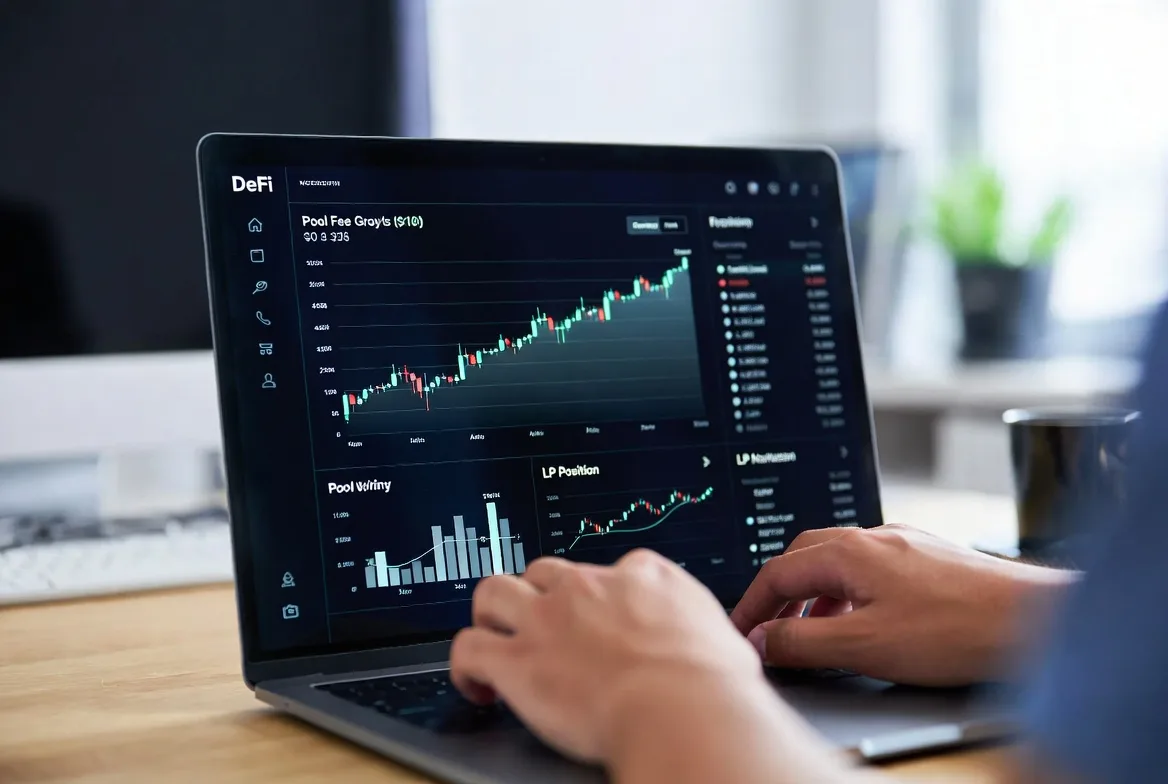
Trading fees are your primary income source. DEXs charge 0.25% to 0.3% per swap typically, though this varies. Every transaction in your pool generates a small cut that flows directly to liquidity providers.
Own 2% of a pool’s LP tokens? You earn 2% of all fees that pool collects. A pool processing $5 million daily volume with 0.3% fees generates $15,000 in daily fees. Your 2% share: $300 daily, roughly $110,000 annually. Not bad for a passive position—except it’s not really passive once you factor in impermanent loss and active management needs.
Here’s what confuses people: you don’t receive fee payments as separate transactions. The pool simply grows larger as fees accumulate. Same number of LP tokens, but they represent slightly more underlying value with each trade. When you eventually withdraw, you get your original deposit plus your proportional share of all collected fees.
Fee Distribution Mechanics
Picture a pool holding 100 ETH and 200,000 USDC. A trader swaps 10 ETH for USDC, paying a 0.3% fee—0.03 ETH. That fee doesn’t go to some separate address. It stays in the pool. Now you’ve got 110.03 ETH and whatever USDC remains after the swap.
Your LP tokens haven’t changed. You still own the same percentage of the pool. But the pool itself is bigger, so your tokens represent more value. This compounding effect accelerates in high-volume pools.
Uniswap V3 introduced concentrated liquidity—you specify a price range for your capital instead of providing liquidity across all possible prices. If ETH trades between $1,800 and $2,200, you can concentrate your entire position in that range. You’ll earn fees way faster than providing liquidity across $0 to $100,000. The downside? If prices leave your range, you stop earning entirely and face worse impermanent loss.
Additional Yield Opportunities
Trading fees alone aren’t the whole story anymore. Protocols distribute governance tokens to liquidity providers as incentives—called liquidity mining or yield farming.
You might earn 15% APY from trading fees, then an additional 35% APY paid in the protocol’s native token. Sounds incredible until you realize those reward tokens are often volatile. A pool advertising 100% APY could have reward tokens that crash 70% during your participation, turning impressive paper returns into actual losses.
Many platforms let you stake LP tokens in farming contracts. Instead of holding them in your wallet earning just trading fees, you deposit them into a staking contract that distributes bonus rewards. You’re adding another layer of smart contract risk, but potentially boosting returns by 20-50%.
Yield aggregators emerged to automate this complexity. Deposit your LP tokens into Yearn, Beefy, or similar platforms. They automatically harvest rewards, compound them back into your position, and rebalance across multiple protocols. Convenience costs though—aggregators take performance fees, usually 5-10% of your earnings.
Impermanent Loss and Other Risks for Liquidity Providers
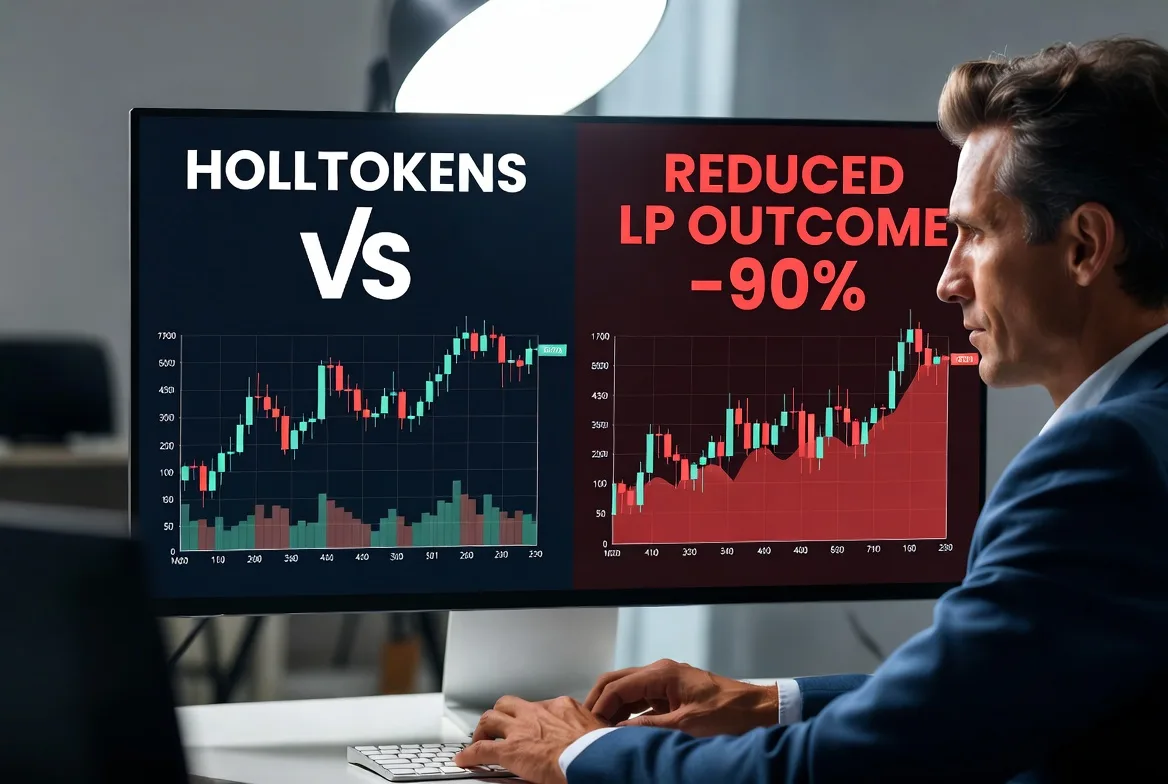
Call it opportunity cost, call it divergence loss—impermanent loss is what happens when you would’ve made more money just holding your tokens instead of providing liquidity.
Here’s the scenario everyone learns from experience: You deposit 1 ETH ($2,000) and 2,000 USDC into a pool. Total position value: $4,000. ETH doubles to $4,000 per coin. Great news, right?
Not exactly. Arbitrage traders immediately exploit the price gap between your pool and external markets. They buy discounted ETH from your pool, selling USDC into it until the ratio matches the new market price. The AMM formula means you end up with about 0.707 ETH and 2,828 USDC when you withdraw—total value roughly $5,656.
If you’d just held 1 ETH and 2,000 USDC separately, you’d have $6,000 ($4,000 + $2,000). The $344 difference? That’s impermanent loss. You made money overall but less than you should have.
The “impermanent” label is misleading. Sure, if prices revert to your entry ratio, the loss disappears. But most people withdraw at different prices, making the loss permanent. It’s only impermanent if you exit at the exact ratio where you entered—which rarely happens.
Calculating Impermanent Loss
The math follows a predictable curve based on how much prices diverge:
| Price Change | Impermanent Loss |
|---|---|
| 1.25x | 0.6% |
| 1.5x | 2.0% |
| 1.75x | 3.8% |
| 2x | 5.7% |
| 3x | 13.4% |
| 4x | 20.0% |
| 5x | 25.5% |
Direction doesn’t matter. ETH dropping 50% creates the same loss percentage as ETH doubling. You lose either way when prices move.
Stablecoin pairs like USDC/DAI dodge most of this problem because both tokens track the same peg. Price ratios stay tight, so impermanent loss rarely exceeds 0.1-0.2%. That’s why stablecoin pools offer lower APYs—they’re safer.
Pairs like ETH/random-altcoin face brutal impermanent loss. The altcoin crashes 80%? Massive loss. The altcoin moons 500%? Still massive loss. Volatile pairs need significantly higher fee generation to compensate.
Can fees offset impermanent loss? Sometimes. High-volume pools earning 25-40% APY in fees can overcome moderate price divergence. But if ETH triples while you’re providing liquidity, no realistic fee structure compensates for that loss.
Strategies to Minimize Loss Exposure
Experienced providers developed several defensive tactics:
Correlated pairs work best. WBTC and ETH tend to move together. So do different stablecoins. When both sides of your pair move in sync, price ratios stay relatively stable, limiting impermanent loss.
Higher fee tiers help. Some pools charge 1% per swap instead of 0.3%. You collect fees three times faster, giving you more cushion against impermanent loss. Volume might be lower on 1% pools, but each trade pays significantly more.
Set mental stop-losses. Decide beforehand: “If price divergence hits 2x, I’m out.” Lock in your loss before it accelerates. The impermanent loss curve gets steeper as prices diverge further.
Concentrate liquidity carefully. Uniswap V3’s range orders let you provide liquidity in tight price bands. If prices exit your range, your position converts entirely to one token, stopping additional impermanent loss—but also stopping fee earnings.
Check positions weekly minimum. Impermanent loss builds gradually, then suddenly. Price movements that seem minor day-to-day can create significant cumulative loss over weeks.
Liquidity provision isn’t passive income—it’s an active strategy that requires understanding price dynamics and risk management. The providers who treat it like a savings account often learn expensive lessons about impermanent loss.
Dr. Hayden Adams, who founded Uniswap
Smart contract exploits remain a constant threat. DeFi platforms have lost billions since 2020 to bugs, hacks, and poorly designed mechanisms. Even audited protocols can harbor hidden vulnerabilities. Diversifying across multiple platforms reduces single-point-of-failure risk, though it can’t eliminate it entirely.
Rug pulls mostly affect newer tokens with anonymous teams. Established DEXs like Uniswap and Curve use decentralized governance and time-locked contracts, making sudden fund theft nearly impossible. Still, always research before providing liquidity to pools featuring tokens you don’t recognize.
Removing Liquidity From a Pool
Withdrawal reverses your initial deposit. You submit LP tokens, the smart contract burns them, and both underlying tokens return to your wallet.
Navigate to your positions in the DEX interface. Click your active position, select “Remove Liquidity.” Most platforms let you withdraw partially—25%, 50%, 75%, or 100% of your position. The interface calculates exactly how many tokens you’ll receive based on the current pool composition.
Confirm the transaction, pay gas fees, wait for blockchain confirmation. Both tokens appear in your wallet within moments. If fees accumulated and impermanent loss stayed manageable, you’ll receive more value than you originally deposited.
Timing matters more than most people realize. Gas fees on Ethereum mainnet fluctuate wildly—$20 during quiet periods, $150+ when network demand spikes. A $50 gas fee on a $1,000 position eats 5% of your capital instantly. Weekends and late-night hours (UTC) typically see lower network activity and cheaper transactions.
Tax implications can’t be ignored. Most jurisdictions treat liquidity provision as multiple taxable events: depositing might trigger a taxable swap, earning fees counts as income, receiving reward tokens is taxable income at fair market value, and withdrawing creates another taxable event. You’ll need transaction records, token prices at various dates, and preferably professional tax advice.
Some providers panic-withdraw during temporary price swings, permanently locking in impermanent loss that might have reversed. If you believe the price ratio will revert toward your entry point—say ETH temporarily spiked but you expect it to settle—waiting can reduce or eliminate impermanent loss.
Comparing Top DEX Platforms for Liquidity Providers
Each DEX offers different trade-offs in fees, blockchain support, and user experience. Your choice should match your assets, position size, and risk tolerance.
| Platform | Fee Structure | Blockchain Networks | Typical APY Range | Notable Features |
|---|---|---|---|---|
| Uniswap | 0.05%, 0.3%, 1% (V3 allows range orders) | Ethereum, Polygon, Arbitrum, Optimism, Base | 5-40% | Highest volume, concentrated liquidity options, deep pools |
| SushiSwap | 0.25-0.3% | 15+ chains including Ethereum, Arbitrum, Polygon | 8-50% | Multi-chain routing, SUSHI token rewards stacking |
| PancakeSwap | 0.25% | BNB Chain, Ethereum, Aptos | 10-60% | Ultra-low gas fees on BNB, gamification layers |
| Curve | 0.04% (usually) | Ethereum, Polygon, Arbitrum, Optimism, Fantom | 3-25% | Stablecoin specialist, minimal impermanent loss |
Uniswap leads in raw trading volume and liquidity depth. If you’re deploying six figures, Uniswap’s established pools offer the most security and consistent fee generation. V3’s concentrated liquidity model suits active managers willing to adjust positions as prices move.
SushiSwap spreads across more blockchains than competitors and distributes SUSHI governance tokens to providers. Extra yield sounds attractive until SUSHI’s price volatility turns paper profits into real losses. Multi-chain support helps if you hold assets on various networks.
PancakeSwap dominates BNB Chain, where transaction costs run 5-10% of Ethereum’s fees. Providing $500 in liquidity makes economic sense on PancakeSwap, while Ethereum gas fees would destroy returns on a position that small. Security and liquidity depth can’t match Ethereum-based DEXs though.
Curve built its reputation on stablecoin swaps with minimal slippage. Low fee percentages (0.04% vs 0.3% elsewhere) work because stablecoin pairs carry almost no impermanent loss risk. Returns are lower but more predictable. If you want low-stress liquidity provision, Curve’s stablecoin pools are your best bet.
Transaction costs relative to position size determine platform choice as much as anything. A $1,000 position on Ethereum might generate $150 in annual fees but cost $100 to enter and exit, consuming two-thirds of your profit. Same position on Arbitrum costs $2 to enter and exit, preserving almost all returns. Layer-2 solutions offer Ethereum security at a fraction of the cost.
FAQs
No minimum exists technically, but economics matter. Ethereum mainnet transactions cost $15-100 in gas fees depending on network congestion. Provide $200 in liquidity, pay $50 entering and $50 exiting, and you’ve burned $100 before earning a dollar. Positions under $5,000 struggle to justify gas costs on Ethereum. Layer-2 networks flip this calculation—Arbitrum, Optimism, and Polygon cut gas fees by 90-95%, making $100-500 positions viable. BNB Chain goes even cheaper. Match your position size to your chosen network’s fee structure. Small positions belong on cheap networks; large positions can absorb Ethereum’s costs for better security.
They land in your wallet immediately after your deposit transaction confirms. LP tokens sit there like any other ERC-20 token—you can view them in Metamask, transfer them to cold storage, or stake them in yield farming contracts. The tokens themselves don’t generate returns automatically; they represent your claim on pool assets. Safeguarding them is critical because they’re your only withdrawal mechanism. Lose your wallet’s private keys or send LP tokens to the wrong address, and your deposited funds become permanently inaccessible. No customer service can retrieve them. Treat LP tokens with the same security you’d use for large amounts of crypto.
In the U.S. and most developed countries, yes—aggressively so. The IRS treats depositing tokens as a disposal triggering potential capital gains. Earning trading fees counts as ordinary income at fair market value when received. Protocol token rewards are taxable income the moment they’re distributed. Withdrawing liquidity creates another taxable event. You owe taxes on fair market values regardless of whether you convert to fiat currency. Multiple positions across various protocols create tracking nightmares. Modern tax software handles DeFi transactions better than it used to, but complex situations need professional guidance. Ignoring tax obligations invites penalties, interest charges, and potential audits down the line.
Liquidity provision offers ways to generate yield from crypto holdings beyond hoping prices go up. But it demands real understanding of AMM mechanics, fee economics, and impermanent loss dynamics. Providers who succeed treat it like an active investment strategy requiring monitoring and adjustments, not a “set it and forget it” income stream.
Start small with stablecoin pairs to learn the mechanics before risking significant capital on volatile pairs. Calculate whether your position size justifies gas fees on your chosen network—small positions need cheap networks to remain profitable. Track everything for tax purposes from day one. Never provide liquidity with funds you can’t afford to lose completely.
The DeFi ecosystem keeps evolving with new AMM designs and liquidity strategies emerging regularly. Concentrated liquidity, single-sided staking, and dynamic fee tiers weren’t options three years ago. Staying current on developments separates profitable providers from those learning expensive lessons. Education never stops if you’re serious about making liquidity provision work long-term.