Remember when trading crypto meant creating an account on Coinbase, uploading your driver’s license, waiting for approval, then depositing funds and hoping the platform wouldn’t freeze your withdrawal? That era feels like ancient history now.
Today’s reality looks completely different. Someone in Brazil can exchange Bitcoin for an Ethereum token in 15 seconds without telling anyone their name. A developer in Singapore can swap governance tokens for stablecoins at 3am without asking permission. These transactions happen wallet-to-wallet, with mathematical protocols handling everything automatically.
This shift didn’t happen by accident. Crypto swaps emerged from a simple question: why do we need companies to facilitate trades between consenting adults? Smart contracts can verify balances, execute exchanges, and transfer tokens following transparent rules visible to everyone.
But here’s the catch—convenience doesn’t mean simplicity. The difference between losing 0.3% to fees and losing 8% to slippage and front-running comes down to understanding what actually happens when you click “swap.” Let’s break down exactly how these systems work and where they can go wrong.
Understanding Crypto Swaps and Token Exchange Basics
When you execute a crypto swap, you’re trading one digital asset for another without touching fiat currency or letting a company hold your funds. Think of it as handing tokens directly to a vending machine programmed to give you different tokens back—no human intervention required.
Traditional exchanges work more like eBay. Someone lists ETH for sale at $2,500. You agree to buy. The platform matches you both, moves the money, takes a cut. This order book system breaks down fast when you’re trying to trade obscure tokens—what if nobody wants to sell?
Swaps sidestep this problem completely. Instead of matching individual buyers with sellers, these protocols maintain giant pools of tokens programmed to always offer a price. Want to trade Token A for Token B at 2am on Christmas? The pool doesn’t sleep, doesn’t take holidays, doesn’t care about market hours.
Here’s where it gets interesting: pricing happens through pure math rather than human negotiation. The smart contract looks at how many of each token sit in the pool, runs a formula, spits out an exchange rate. Your trade shifts the balance, which instantly changes the rate for the next person. Supply and demand expressed as code.
The custody aspect matters more than most people realize. Binance holds your crypto when you deposit—you’re trusting them not to get hacked, not to freeze your account, not to disappear with the funds. During a swap? Your private keys never leave your control. The protocol can’t confiscate anything because it never possesses anything. It just facilitates the exchange within a single transaction.
This explains why DeFi swaps hit $1.8 trillion in volume during 2025 despite their quirks and costs. People will tolerate higher fees and complexity for genuine ownership.
How Token Swaps Work Step by Step
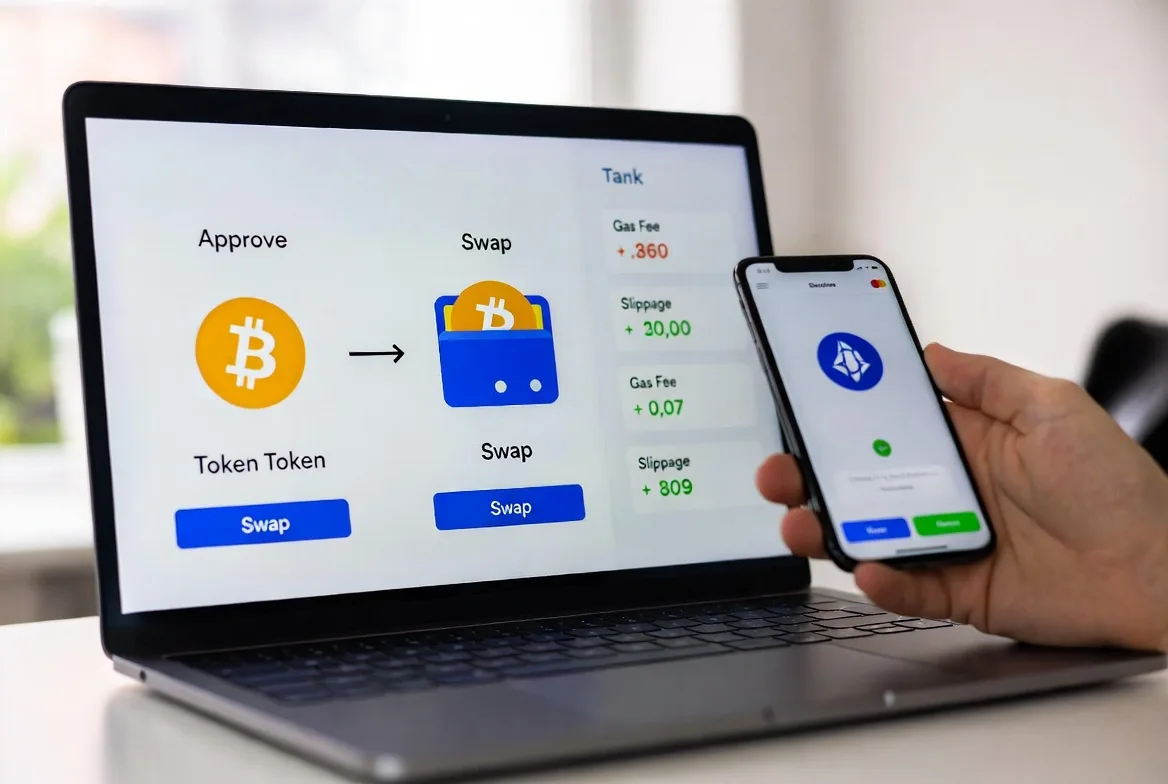
First, you connect your MetaMask or similar wallet to a swap interface like Uniswap. This doesn’t move money—think of it like showing your membership card at Costco. The interface can now see what tokens you own and submit transactions you’ll need to approve.
You pick what to trade. ETH → USDC, LINK → DAI, whatever combination exists. The interface queries the blockchain, checks current pool balances, runs the pricing formula, then displays a quote. This quote reflects right now—it’ll change in five seconds if someone else trades first.
Now comes the part that confuses newcomers. Before the swap itself, you often need to “approve” the smart contract to touch your tokens. This approval costs gas (sometimes $3-15 on Ethereum) and only happens once per token per protocol. Miss this detail and you’ll wonder why swapping costs twice what you expected.
After approval, you submit the actual swap. Your wallet pops up showing exactly what leaves (1 ETH) and what arrives (approximately 2,485 USDC). It estimates gas fees, shows your slippage tolerance, warns if anything looks suspicious. Sign the transaction and it enters the blockchain’s waiting area.
Miners or validators grab your transaction from the queue and include it in the next block they publish. The smart contract springs into action: checks you still own the input amount, verifies the exchange rate hasn’t shifted beyond your tolerance, pulls tokens from your wallet, deposits them in the liquidity pool, sends output tokens back to you. All of this either completes perfectly or fails entirely—there’s no halfway state where you lose tokens without getting the swap.
Block confirmation takes 12 seconds on Ethereum, 3 seconds on BNB Chain, 0.4 seconds on Solana. Your new tokens appear in your wallet the moment that block gets added to the chain.
The Role of Smart Contracts in Swap Execution
Think of swap contracts as vending machines that run themselves. You insert input (tokens), they verify you actually inserted it, calculate what you should receive based on their programmed rules, dispense output tokens, then update their internal inventory tracking. No employees, no managers, no office.
Most swaps use a specific pricing formula: multiply the quantity of Token X by the quantity of Token Y, and that product must stay constant. If the pool holds 100 ETH and 200,000 USDC (product = 20 million), and you deposit 1 ETH, the pool now has 101 ETH. To keep the product at 20 million, it can only hold 198,020 USDC. That means you receive 1,980 USDC for your 1 ETH.
This formula creates an automatic pricing mechanism. Large deposits shift the ratio dramatically, giving you worse rates. Small deposits barely move the needle. Arbitrage traders constantly watch for price differences between pools and centralized exchanges, buying low in one place and selling high in another until prices converge.
Security comes from two sources: the contract code lives permanently on the blockchain where anyone can audit it, and once deployed, most protocols can’t change the core logic. Uniswap V3’s main contracts? Immutable since May 2021. No administrator can modify how they calculate prices or seize funds.
Fees get collected automatically too. When you swap, 0.25% typically stays in the pool. Liquidity providers own shares of the pool, so they proportionally own those accumulated fees. Some protocols add extra fees—maybe 0.05% goes to the governance treasury for development funding.
Liquidity Pools and Automated Market Makers
A liquidity pool is two (or more) different tokens locked inside a smart contract, available for anyone to trade against. Instead of waiting for buyers and sellers to match, you trade with this pool directly—you’re always the buyer, the pool is always the seller, and vice versa.
Anyone can add liquidity by depositing both tokens in whatever ratio the pool currently holds. Deposit 10 ETH and 25,000 USDC into an ETH/USDC pool? You receive LP tokens representing your share of total liquidity plus your portion of future trading fees. Remove liquidity later by returning those LP tokens.
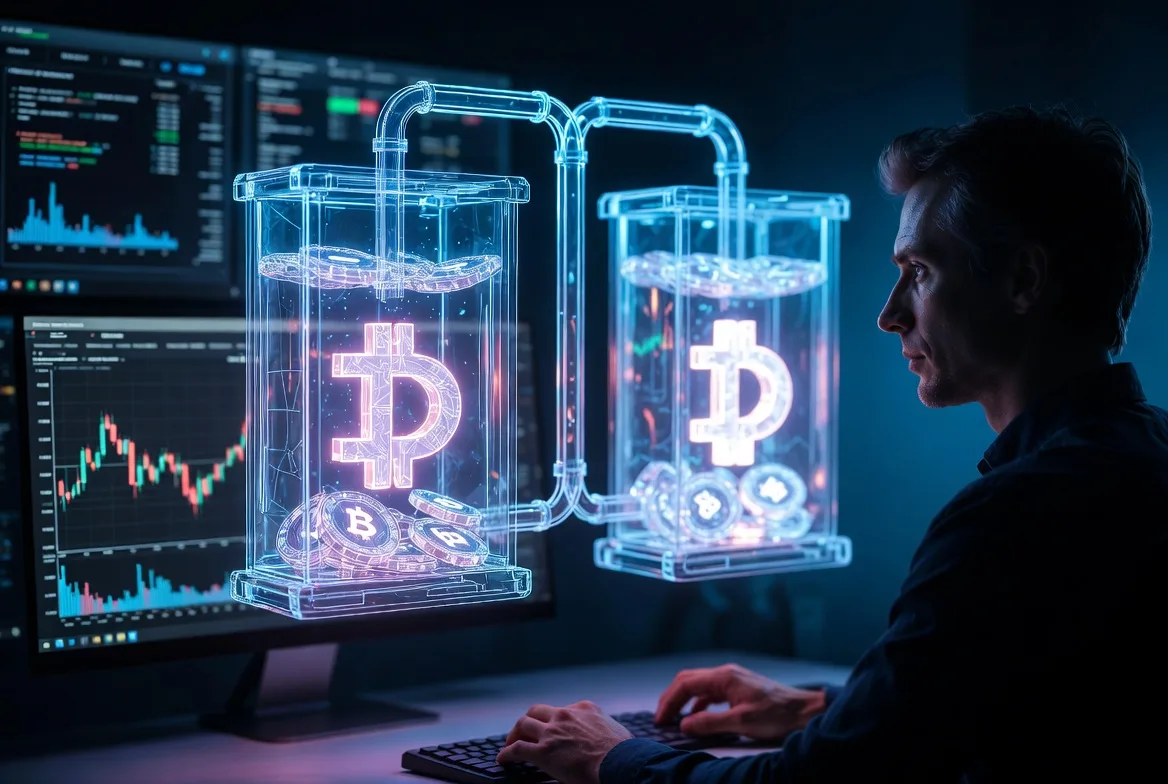
AMMs (automated market makers) are the algorithms that set prices based on pool composition. Different formulas optimize for different situations. That constant product formula (x × y = k) works great when both tokens swing wildly in price. Stableswap curves use a flatter formula better suited for USDC/USDT pairs that should trade near 1:1. Uniswap V3 introduced concentrated liquidity where you provide tokens only within specific price ranges—say, 1 ETH = 2,450-2,550 USDC—making your capital work harder.
Pool size determines swap quality dramatically. A pair with $50 million in liquidity can handle a $100,000 trade with maybe 0.3% slippage. That same trade in a $500,000 pool? Expect 5-8% slippage. This is why obscure tokens trade terribly—nobody’s provided enough liquidity to smooth out pricing.
Liquidity providers make money from fees but risk impermanent loss. Say you deposit 1 ETH and 2,500 USDC when ETH costs $2,500. Then ETH doubles to $5,000. Because the AMM rebalances the pool, you end up with less ETH than if you’d just held it. The fees you earned need to exceed this opportunity cost or you lost money compared to doing nothing.
Types of Crypto Swaps Explained
Not every swap uses the same mechanism. What works for exchanging tokens on Ethereum won’t work for trading Bitcoin for Solana tokens—different problems require different solutions.
Your standard Uniswap-style swap happens entirely within one blockchain. Trade any ERC-20 token for another ERC-20 token and you’re using this model. Fast, cheap (relatively), benefits from years of liquidity accumulation. This covers probably 85% of daily swap volume.
Then you’ve got specialized mechanisms for harder problems. Atomic swaps let you trade Bitcoin for Litecoin without bridges or wrapped tokens, using some clever cryptography. Cross-chain protocols move tokens between entirely different blockchains—Ethereum to Avalanche, for instance. Aggregators check prices across dozens of sources simultaneously to find the best route.
Choosing correctly saves money. Need to swap USDC for DAI on Ethereum? Basic AMM works perfectly. Want to move funds from Polygon to Arbitrum? You need a cross-chain solution, accepting slower speed and higher cost. Trading $50,000 of a token? An aggregator that splits your order across multiple pools might save thousands in price impact.
Atomic Swaps and Trustless Exchange
An atomic swap trades cryptocurrencies across separate blockchains without any middleman, no trusted party, no company taking custody. The “atomic” part means both sides complete or neither does—you can’t get stuck with one person receiving funds while the other gets nothing.
The mechanism uses hash time-locked contracts, which sound complicated but work elegantly. Both traders create contracts on their respective chains that require the same secret password to unlock. When one person reveals the password to claim their funds, the other person sees it publicly and uses it to claim theirs. If nobody reveals the password within (say) 24 hours, both contracts automatically refund everyone.

Here’s a real example: Alice has Bitcoin, Bob has Litecoin, they want to swap. Alice creates a contract on Bitcoin’s blockchain: “Lock 0.5 BTC. Bob can claim this if he provides the correct password within 24 hours. If 24 hours pass, refund me.” Bob verifies this contract exists, then creates his own on Litecoin: “Lock 50 LTC. Alice can claim this if she provides the correct password within 12 hours. If 12 hours pass, refund me.”
Notice Bob’s timeout is shorter—that’s crucial. Alice reveals the password to grab Bob’s 50 LTC. The moment she does, that password becomes visible on Litecoin’s blockchain. Bob copies it and immediately uses it to unlock Alice’s 0.5 BTC on Bitcoin’s chain. The 12-hour difference ensures Bob always has time to respond if Alice claims first.
These swaps remain niche in 2026. Both blockchains need compatible smart contract capabilities, which Bitcoin’s limited scripting makes difficult. They’re slower than modern bridges—that 12-24 hour window versus minutes for wrapped token bridges. Plus you need both parties online and coordinating. But the trustlessness is absolute: no multisig can rug you, no bridge can get hacked, no validator set can collude against you.
Cross-Chain Swaps Between Different Blockchains
Cross-chain swaps solve the problem of moving value between incompatible blockchains. You want to trade your Ethereum tokens for something on Polygon, or swap Avalanche assets for Fantom tokens. These networks don’t communicate natively.
The typical approach: bridges that lock your tokens on Chain A and mint wrapped versions on Chain B. You want to swap ETH for an Avalanche token? A bridge locks your ETH in an Ethereum smart contract, mints “wrapped ETH” on Avalanche, then that wrapped ETH gets swapped for your target token using a regular AMM on Avalanche.
This creates security dependencies. That locked ETH on Ethereum needs protection—usually from a validator set (10-100 people), a multisig wallet (5-of-9 signers), or an optimistic fraud proof system. If security fails, those wrapped tokens lose their backing. Ronin Bridge lost $625 million in March 2022 when attackers compromised validator keys. Wormhole lost $326 million a month earlier. These lessons pushed 2024-2026 bridge designs toward stronger security models with multiple validator sets and economic incentives for honest behavior.
Modern aggregators hide complexity. You tell it “swap my Ethereum USDC for Polygon MATIC.” Behind the scenes it bridges your USDC to Polygon, swaps for MATIC there, done. You pay gas on Ethereum for the bridge transaction plus gas on Polygon for the swap—typically $3-8 total on Layer 2s, but $20-60 on Ethereum mainnet during congestion.
Timing varies wildly. Simple bridges with low security might complete in 3-5 minutes. Optimistic bridges wait 7 days for fraud proof challenges (though they offer “fast withdrawal” services for fees). Average cross-chain swap? Budget 10-15 minutes and occasionally wait 30.
Decentralized Swap Mechanisms
A decentralized swap mechanism means no company, CEO, or admin team controls the exchange process. The category includes AMM protocols (Uniswap, PancakeSwap, TraderJoe), on-chain order books (dYdX, Serum), and peer-to-peer protocols for direct swaps.
AMM-based DEXs dominate the landscape. Uniswap pioneered this in 2018, now hundreds of forks operate across every blockchain. True decentralization means immutable smart contracts—once deployed, the code runs forever without modification. Anyone can provide liquidity without approval, anyone can swap without creating an account.
Order book DEXs like dYdX look more like traditional exchanges but keep settlement decentralized. You place limit orders, the protocol matches buyers with sellers, but trades settle on-chain or through decentralized validators. This gives better execution for sophisticated traders doing large orders, though it requires more active participation than passive AMM swapping.
Peer-to-peer protocols (like what Bisq does for Bitcoin) facilitate direct user-to-user swaps. Both parties must agree on terms and be online simultaneously. Useful for over-the-counter deals involving unusual amounts or tokens with terrible liquidity, but inconvenient for quick everyday swaps.
Decentralization exists on a spectrum. Some protocols retain admin keys that can pause trading during emergencies—arguably necessary, arguably a centralized vulnerability. Others use time-locked governance where any change requires a community vote and a 48-hour delay before execution. Uniswap V3 and Sushi’s core contracts? Totally immutable. No upgrade mechanism exists. Security through ossification.
Crypto Swap vs Trade: Key Differences
The words matter because they describe fundamentally different processes with serious implications for who controls your money.
Trading on Kraken or Binance requires depositing funds into their custody first. They credit your account, you place orders on their internal system, trades execute in their database, then eventually you withdraw. Between deposit and withdrawal, they control the actual tokens. You’re trading database entries representing tokens, not moving blockchain assets.
Swapping keeps everything on-chain and in your wallet. You connect, authorize a specific transaction, the smart contract executes it, tokens move atomically. No custody transfer happens—you maintain private key control start to finish. The protocol can’t freeze your funds because it never holds them.
Privacy diverges sharply. Coinbase knows your name, address, Social Security number, bank account, trading history, everything. They report large transactions to FinCEN. They cooperate with law enforcement. Swaps? The protocol sees a wallet address. Transactions are public on-chain, sure, but linking that address to your identity requires additional work. No KYC forms, no passport uploads, no selfie verification.
Control is the real dividing line. Exchanges can (and do) halt withdrawals during “maintenance,” delist tokens overnight, freeze accounts suspected of anything. When FTX collapsed in November 2022, customer funds vanished—they’d trusted a centralized entity. Swaps are autonomous code. If Uniswap’s website disappeared tomorrow, the contracts keep running. Nobody can prevent your swap if you’ve got gas money and the liquidity exists.
Fee structures look different too. Exchanges charge 0.1-0.5% on each trade (sometimes less for market makers) plus withdrawal fees when you move crypto off-platform. Swaps charge 0.25-0.30% protocol fees distributed to liquidity providers, plus blockchain gas fees ranging from $0.01 on Solana to $50 on Ethereum during peak congestion. For a $100 swap on Ethereum during high gas, you might pay $12 in fees. That same swap on Polygon? Maybe $0.50 total.
| Feature | Centralized Exchange | Decentralized Swap |
|---|---|---|
| Custody | Platform controls your assets | You hold keys entire time |
| KYC requirement | Required—upload ID, verify identity | None—connect wallet and trade |
| Fees | Trade fees 0.1-0.5% + withdrawal charges | Protocol fee 0.25-0.30% + gas costs |
| Speed | Instant on internal ledger | Depends on block time—3 seconds to 1 minute |
| Privacy | Full identity disclosure required | Pseudonymous wallet addresses |
| Token availability | Only listed tokens | Any token with existing liquidity |
| User control | Subject to platform policies | Autonomous smart contracts |
Swap Fees and Slippage: What You Need to Know
The interface might show 1 ETH = 2,500 USDC, but that’s rarely what you actually receive. Between protocol fees, blockchain costs, and market mechanics, the real number comes in lower.
Protocol fees are the easy part—a fixed percentage slice from every swap, usually 0.25-0.30%. This goes to liquidity providers as payment for locking up their capital. Curve charges 0.04% on stablecoin pairs. Uniswap V3 lets pools set 0.05%, 0.30%, or 1% tiers depending on volatility.
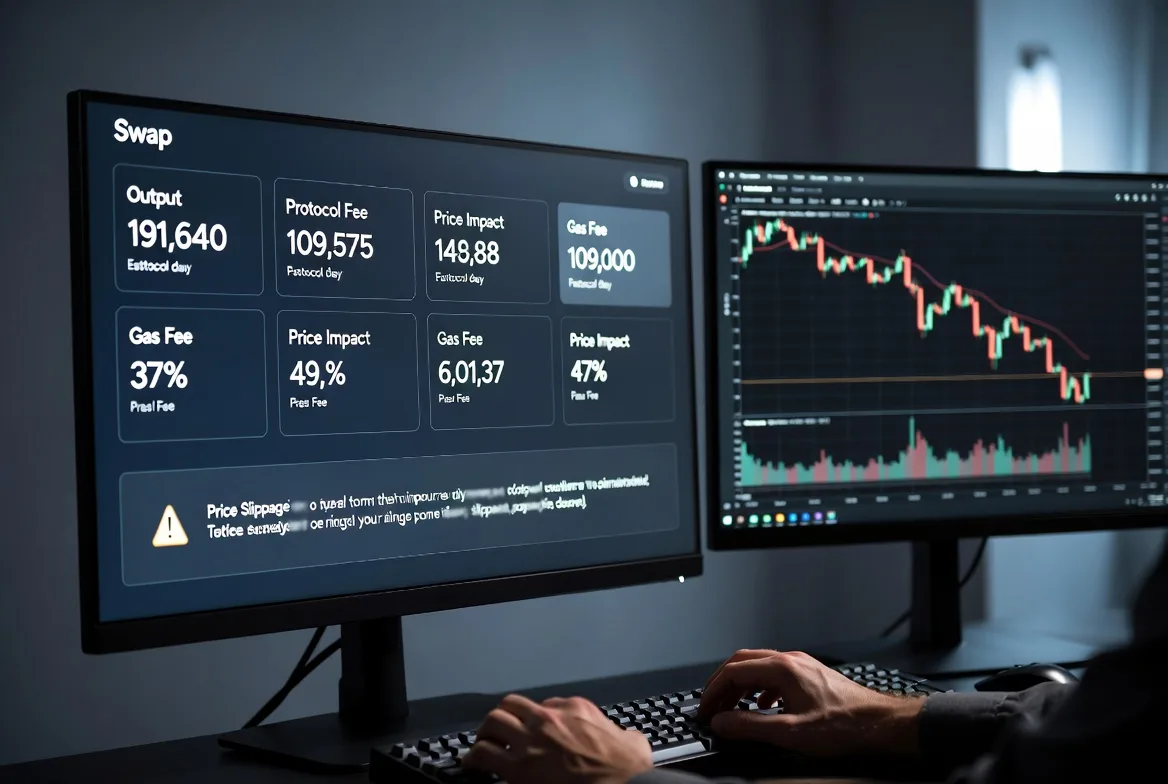
Gas fees are the chaotic variable. Ethereum swaps might cost $4 when nobody’s using the network (Sunday morning, 3am Pacific) or $80 during NFT mint frenzies and market crashes when everyone’s panic selling. Arbitrum and Optimism swaps typically run $0.30-1.50. Solana charges fractions of a penny. People constantly underestimate gas, especially when swapping small amounts where fees devour 10-20% of the trade value.
Price impact hits large swaps in small pools. When your $10,000 PEPE token purchase drains 15% of the liquidity pool, you move the price substantially against yourself. The first $1,000 might get a fair rate, but by $10,000 you’re paying 8% above where you started. The interface warns you—”Price Impact: 8.3%”—but many users ignore it.
Slippage tolerance is your maximum acceptable price movement before the transaction fails completely. Set it at 0.5% and the price moves 0.6% while your transaction waits? Failed transaction, you paid gas for nothing. Set it at 5%? You’re inviting sandwich attacks where bots see your pending transaction and manipulate prices to extract that full 5% from you.
Understanding Slippage in Crypto Swaps
Slippage is the gap between the price you see when clicking “swap” and the actual execution price when your transaction confirms. Two forces cause this: time delay and pool impact.
Market movement during confirmation creates time-based slippage. You submit a transaction swapping ETH for USDC at 2,500:1. Twelve seconds pass while miners include your transaction in a block. During those 12 seconds, ETH drops to 2,485. Your swap executes at the new price—you receive less USDC than expected.
Your trade’s effect on pool ratios creates impact-based slippage. Remember that constant product formula? When you swap, you’re literally shifting the pool’s composition. Small swaps shift it imperceptibly. $500 in a $10 million pool? Maybe 0.05% impact. $50,000 in a $200,000 pool? Easily 6-10% impact because you’re dramatically changing the ratio.
The slippage tolerance you set is a safety valve. Configure it to 1% and actual slippage would be 1.2%? Transaction reverts. You’re out gas fees but you avoided accepting a terrible rate. Most DEX interfaces default to 0.5-1% tolerance—reasonable for liquid pairs, potentially too tight for obscure tokens.
Illiquid tokens magnify slippage brutally. That meme coin with only $30,000 in liquidity? A $1,000 purchase might show 12% slippage before you even confirm. This isn’t a bug—it’s mathematics. Small pools can’t absorb meaningful order sizes without massive price movement.
Sandwich attack bots exploit generous slippage settings. They monitor the mempool (pending transactions), spot your swap with 5% slippage tolerance, then submit two transactions: one that buys before yours (raising the price), and one that sells after yours (profiting from the difference). They extract most of that 5% you authorized. Keeping tolerance tight—0.5-1% for normal pairs—limits this attack vector substantially.
How to Reduce Swap Fees
Several tactics cut costs without compromising security or decentralization.
Pick your blockchain strategically. Ethereum offers the deepest liquidity and most established protocols, but you’ll pay $5-50 per swap in gas. Arbitrum and Optimism provide nearly identical token selection for under $1 per swap. Polygon, BNB Chain, Avalanche go even cheaper—$0.10-0.50 typically—though sometimes with thinner liquidity. Solana swaps cost $0.002. Match the chain to your needs: small swaps warrant cheap chains, large swaps justify paying for Ethereum’s liquidity.
Time your swaps during low congestion. Ethereum gas fluctuates 10x based on demand. Weekday afternoons Eastern time (when US and Europe overlap)? Expensive. Saturday at 2am Pacific? Cheap. Wait a few hours for the right window and save 60-80% on gas for non-urgent swaps. Websites like Etherscan’s gas tracker and WenGas show real-time pricing and predictions.
Batch your activities together. Need to swap three different tokens? Do them in one session rather than three separate sessions on different days—you save on wallet connection overhead and can potentially consolidate approvals. Some advanced aggregators route multi-hop swaps (A→B→C) in a single transaction, cheaper than doing A→B and B→C separately.
Use aggregators for large amounts. Platforms like 1inch and Matcha split big orders across multiple liquidity sources automatically. Your $20,000 MATIC swap might route 45% through Uniswap V3, 30% through QuickSwap, 25% through SushiSwap, achieving 1.2% price impact instead of 3.8% on any single pool. Aggregators add a tiny fee (0.05-0.1%) but save far more in slippage reduction.
Consider providing liquidity instead of swapping. Need to rebalance from 50% ETH / 50% USDC to 30% ETH / 70% USDC? Depositing both into an ETH/USDC liquidity pool achieves similar exposure. You pay one deposit transaction rather than a swap, and you start earning fees from other traders. Works well if you’re not timing the market and understand impermanent loss risks.
Adjust slippage appropriately for conditions. Don’t mindlessly accept defaults. ETH/USDC, WBTC/ETH, major stablecoin pairs? You can safely use 0.3% slippage. Volatile altcoin pairs might need 1-2%. Never go above 5% unless you’re swapping something with genuinely catastrophic liquidity and you’ve consciously decided to eat the cost.
We used to think decentralized exchange was impossible at scale—the technology wasn’t there, users wouldn’t tolerate the complexity, liquidity would fragment hopelessly. Automated market makers proved everyone wrong. By replacing human market makers with algorithms and replacing order books with liquidity pools, we created something that’s simultaneously more accessible and more censorship-resistant than any centralized alternative. The next phase is cross-chain—making swaps between Bitcoin and Solana as seamless as swapping ERC-20 tokens.
Dr. Amara Chen, Director of DeFi Research, Blockchain Economics Institute
Common Mistakes When Swapping Crypto
Most expensive errors are completely preventable with basic awareness.
Swapping during gas spikes wastes money unnecessarily. Someone swaps $200 worth of tokens without checking current gas prices, pays $35 in fees. Five hours later, gas dropped 70%—that swap would’ve cost $10. Always check the gas estimate your wallet displays before confirming. If it seems high relative to your swap amount, consider waiting or switching to a cheaper network.
Cranking slippage up to 5-10% after transaction failures invites disaster. New users see “Transaction failed—increase slippage tolerance” and keep raising it until something works, not realizing this makes them prime targets for MEV extraction. The real solution? Usually the token has insufficient liquidity for your size, or network congestion is causing rapid price movement. Try smaller amounts or wait for calmer conditions.
Failing to verify token contracts enables scammers. Dozens of fake USDC contracts exist across various chains, named identically to the real thing. Swap $1,000 ETH for fake USDC and that money’s gone forever—blockchain transactions are irreversible. Always copy the official contract address from the project’s actual website (not Google results, not Twitter links) and verify it matches before swapping.
Approving tiny amounts repeatedly multiplies gas costs. Each approval transaction costs $3-15 on Ethereum. Some users approve exactly the amount they want to swap each time, paying approval fees on every swap. Better approach: approve unlimited (or a large maximum) once, then swap freely. Yes, there’s theoretical smart contract risk, but audited protocols on established chains are generally safe.
Routing through multiple intermediate tokens burns fees needlessly. The interface might show Token A → ETH → USDC → Token B as the best path. Each arrow represents a separate fee (0.25-0.30%) plus its share of gas. Three hops = 0.9% in fees minimum. Direct pairs, when they exist with decent liquidity, are always cheaper even if the rate looks slightly worse at first glance.
Ignoring the price impact warning costs you real money. The interface displays “Price Impact: 6.8%” before you confirm. Most users click through anyway. That 6.8% is money leaving your pocket—not going to fees or liquidity providers, just lost to moving the pool’s ratio. If impact exceeds 3-4%, seriously reconsider. Break the swap into smaller chunks over time, or accept you’re paying a premium for illiquidity.
Using unaudited new protocols courts disaster. That DEX offering 300% APY to liquidity providers launched three days ago? No security audit, anonymous team, code copied from Uniswap with modifications. Maybe it’s fine. Maybe there’s a backdoor that drains all funds. Stick to protocols with multiple audits (Certik, ConsenSys Diligence, Trail of Bits), long operational history (2+ years), and substantial locked value unless you genuinely understand the risk.
FAQs
Swaps through established protocols that have undergone professional audits generally work as intended without technical failures. Your main risks are user error—copying wrong token contracts, setting extreme slippage that enables sandwich attacks, approving malicious contracts. Front-running bots targeting high-value trades with loose slippage represent another threat. Low-liquidity pairs can experience temporary price manipulation. Using reputable protocols (Uniswap, Curve, PancakeSwap), double-checking token addresses against official sources, and setting reasonable slippage tolerance addresses most concerns. Cross-chain swaps add bridge security as an additional consideration.
Slippage correlates directly with available liquidity depth. Tokens with small liquidity pools experience dramatic price shifts from even modest-sized swaps because the pricing formula amplifies impact when pools are shallow. Swapping $1,000 worth of a token with $50,000 total liquidity moves prices far more than swapping the same amount in a $10 million pool. Newly launched tokens, low-cap projects, and tokens on smaller blockchains typically have thin liquidity. Some obscure tokens show 10-15% slippage on $500 purchases simply because there aren’t enough tokens in the pool to handle that size without drastically shifting the ratio.
On a single blockchain, swaps complete as soon as your transaction gets included in a block. Solana and BNB Chain typically confirm in 3-15 seconds. Polygon takes 2-5 seconds. Ethereum averages 12-15 seconds. During severe network congestion, confirmation can stretch to several minutes as your transaction waits in the mempool for inclusion. Cross-chain swaps involving bridges require significantly more time—typically 5-30 minutes total depending on which bridge service you use and how many confirmations it waits for on the source chain before minting wrapped tokens on the destination chain. Complex routes involving multiple hops across different protocols might occasionally take 45+ minutes.
Crypto swaps replaced centralized exchange infrastructure with autonomous protocols that execute trades through transparent algorithms rather than hidden order matching systems. The implications go beyond convenience—when you maintain private key custody throughout an exchange, you’re engaging with finance that fundamentally cannot be frozen, censored, or confiscated by intermediaries.
Understanding the technical mechanics matters practically. Smart contracts calculate prices using mathematical formulas that shift with every trade. Liquidity pools enable instant swaps by maintaining reserves of both assets. Gas fees and slippage represent real costs that vary wildly based on network congestion and pool depth. Knowing how these elements interact lets you avoid the expensive mistakes that plague newcomers.
Different swap types solve different problems. Standard AMM swaps on Uniswap or PancakeSwap handle 90% of use cases perfectly—fast, relatively cheap, benefiting from deep liquidity on major pairs. Atomic swaps offer maximum trustlessness across blockchains at the cost of complexity and time. Cross-chain bridges enable moving assets between ecosystems despite introducing validator dependencies. Matching mechanism to need optimizes both cost and security.
The custody trade-off defines the core value proposition. Centralized exchanges offer customer support, easy fiat on-ramps, sometimes better execution on large orders. Swaps offer genuine ownership—nobody can freeze your account, require additional verification, or prevent withdrawals. Your keys, your coins, enforced by code rather than corporate policy.
Practical costs come from multiple sources. Protocol fees remain stable at 0.25-0.30% typically. Blockchain gas fluctuates dramatically—$0.01 on Solana, $50 on Ethereum during peak demand. Price impact and market slippage affect large trades and illiquid pairs disproportionately. Setting appropriate slippage tolerance, timing transactions strategically, and verifying token contracts prevent most expensive errors.
As cross-chain technology matures and Layer-2 solutions scale, swapping will likely become even more seamless and affordable while maintaining the core advantage of non-custodial exchange. Understanding how these systems actually work—rather than just clicking buttons—positions you to use them effectively while managing their unique risks consciously.