
Large cryptocurrency trades present a fundamental problem: public exchanges weren’t built for them. Try selling $3 million in Bitcoin on Coinbase during a typical trading day, and you’ll watch your average execution price deteriorate with each filled order. Every trader on the platform sees your order sitting there, ready to be front-run.
That’s where over-the-counter desks enter the picture. These specialized services handle big transactions privately—no public order books, no visible market impact, no broadcasting your strategy to algorithmic traders waiting to exploit your position.
Whether you’re running institutional capital, managing a mining operation’s treasury, or simply holding more crypto than you can exit cleanly on regular platforms, understanding OTC mechanics matters. The difference between exchange execution and negotiated settlement can mean hundreds of thousands of dollars on a single trade.
What Is an OTC Crypto Trading Desk?
Think of an OTC crypto trading desk as a private matchmaker for large cryptocurrency transactions. Instead of posting orders where everyone can see them, you contact the desk directly, negotiate a price, and execute—all behind closed doors.
The over-the-counter crypto meaning comes from traditional finance, where securities sometimes trade directly between parties rather than on formal exchanges. In crypto, this concept solves a specific pain point: executing size without moving the market against yourself.
Here’s how it works in practice. You call up an OTC desk wanting to buy $5 million in Bitcoin. The desk’s trader checks current market prices across multiple exchanges, adds their spread, and quotes you a single firm price—say, $95,200 per Bitcoin when the exchange mid-market shows $95,000. You accept, confirm the details, and settle. No order book consumption, no partial fills across twenty different price levels, no three-hour saga watching your position get picked apart.
The desk makes money on that spread. You save money by avoiding slippage. Everyone wins.
Professional traders at these desks either match your order with someone on the opposite side (they’re buying, you’re selling) or trade directly from the desk’s own inventory. Large operations maintain substantial cryptocurrency holdings specifically to provide immediate liquidity when clients need it.
The institutional market has matured significantly. Clients now expect the same level of service they receive in traditional asset classes—dedicated relationship managers, competitive pricing, and settlement certainty. OTC desks have evolved to meet those expectations while navigating the unique custody and regulatory challenges of digital assets.
Michael Chen, Head of Institutional Sales
Who actually uses these services?
Hedge funds and asset managers moving seven-figure positions regularly. When you’re deploying $50 million into crypto, you can’t just market-buy on Binance and hope for the best.
Family offices managing generational wealth increasingly include digital assets in their portfolios. These entities value the white-glove service and relationship-based execution that OTC desks provide.
Wealthy individuals who accumulated Bitcoin early and now face the challenge of converting positions worth millions into fiat currency. Selling gradually on exchanges takes weeks and reveals your intentions. One conversation with an OTC desk solves the problem.
Crypto mining companies generating new coins daily need reliable buyers. Many established miners maintain standing arrangements with OTC desks to convert production into operational cash flow predictably.
Blockchain project treasuries managing nine-figure token holdings use OTC channels for buybacks, strategic investments, or converting to stablecoins for operational expenses.
Here’s what separates this from regular exchange trading: visibility. Post a $2 million buy order on Kraken, and sophisticated market participants immediately see it. High-frequency trading algorithms adjust. Other large players might front-run. Your execution quality suffers before you’ve filled half the order.
OTC transactions stay completely private. No one knows about your trade except you, the desk, and your counterparty (if it’s an agency trade).
How OTC Crypto Trading Works
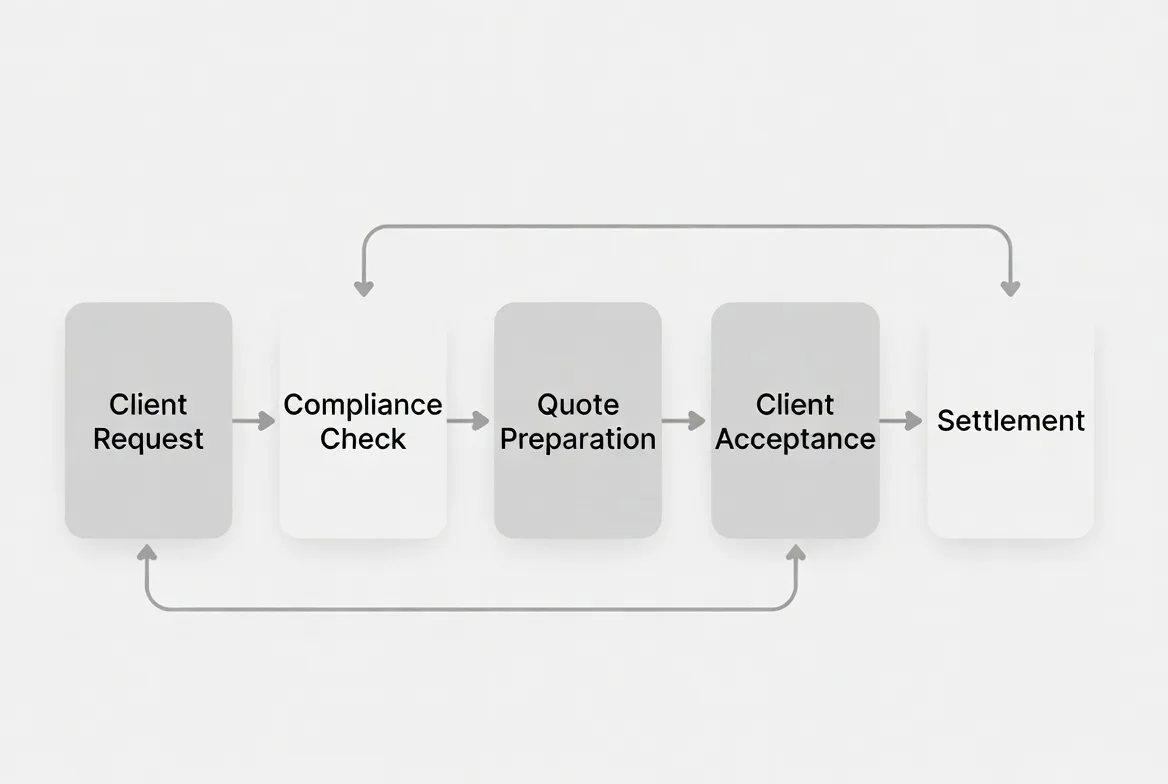
Let’s walk through an actual trade from start to finish. The process follows a sequence that’s become standardized across professional desks.
You initiate contact through a dedicated relationship manager—either someone you’ve worked with before or a new contact if you’re establishing the relationship. Most desks won’t quote you immediately. First comes compliance.
Identity verification happens upfront and follows know-your-customer requirements similar to opening a bank account. Expect to provide government ID, proof of address, and information about fund sources. Institutions submit corporate documentation, beneficial ownership details, and sometimes audited financials. This process takes anywhere from a few hours to two business days depending on your entity structure and the desk’s compliance workload.
Once approved, you request a quote. “I want to buy 100 Bitcoin” is enough to start, though specifying your settlement preferences and timing helps. The desk’s trader immediately checks multiple data sources—Coinbase, Binance, Kraken, possibly derivatives markets—to establish the current mid-market price.
The quote comes back usually within 60 seconds during normal markets, potentially faster for standard pairs like BTC/USD. “We’ll sell you 100 Bitcoin at $95,200 each, good for 30 seconds.” That’s a firm quote. Accept within the time window, and the desk must honor it regardless of what happens to market prices in the next minute.
This differs completely from exchange limit orders where you hope to get filled at your price but might not. Here, you’re receiving a guaranteed execution price before committing.
You accept verbally (recorded lines) or through the desk’s trading portal. They immediately send trade confirmation documentation: exact quantity, unit price, total amount, settlement instructions, expected timeline. This creates a legally binding contract.
Now the interesting part begins: settlement.
The Role of OTC Brokers and Market Makers
Not all desks operate the same way. The model matters because it affects your execution quality and who’s taking risk during the transaction.
Agency model desks act as middlemen. You want to buy 100 Bitcoin; they find someone wanting to sell 100 Bitcoin. The desk connects both parties, facilitates settlement, and collects a commission—maybe 0.3% from each side. They’re not using their own capital or taking market risk. Their value comes from client networks and the ability to source counterparties quickly.
This works brilliantly when they have deep client relationships. A desk handling $2 billion monthly volume usually has buyers and sellers they can match efficiently. The downside? If they can’t find a counterparty for your specific size and timing, execution gets delayed or doesn’t happen.
Principal trading desks operate differently. You’re buying directly from the desk itself or selling directly to them. They maintain inventory—maybe $200 million across Bitcoin, Ethereum, and major altcoins—specifically to provide immediate liquidity. When you call wanting to sell 50 Bitcoin right now, they buy it from you at their quoted price, add it to inventory, and deal with offsetting that position later.
Principal desks take market risk. Between buying your 50 Bitcoin and finding someone else to sell it to (or hedging through derivatives), Bitcoin’s price might move against them. They compensate for this risk through wider spreads or by hedging immediately on derivatives exchanges.
Most large operations blend both approaches. Standard-sized trades up to maybe $5 million? They’ll trade as principal, using inventory. Unusually large positions or illiquid altcoins? They’ll work it on an agency basis, finding specific counterparties and charging a commission.
Market makers within these desks constantly adjust inventory based on order flow. If they’re seeing heavy selling pressure in Ethereum all day, they’ll widen their buy-side quotes (offering less attractive prices to sellers) to avoid accumulating too much ETH. Conversely, they might tighten sell-side quotes (better prices for buyers) to reduce inventory.
Settlement and Custody Process
This is where trades actually happen—cryptocurrency changes hands, payment flows, everyone walks away satisfied. The mechanics depend heavily on custody arrangements.
Best case scenario: both parties use the same qualified custodian. You and your counterparty both have accounts at Coinbase Custody. Settlement happens as an internal ledger transfer—no on-chain movement required, completes in under an hour, zero blockchain fees. The custodian simultaneously moves Bitcoin from the seller’s account to the buyer’s while transferring USD the opposite direction.
More complex scenario: different custodians or self-custody. Now you need on-chain transfers, which introduce timing variables. Bitcoin confirmation times, network congestion, withdrawal processing at the sender’s custodian—all add friction. Most professional desks use delivery-versus-payment mechanisms to ensure atomic settlement: neither party can receive their side without the counterparty receiving theirs.
Fiat settlement timing depends entirely on banking infrastructure. Domestic US wires initiated before 3 PM Eastern typically settle same-day. International wires might take two to three business days. Some desks offer stablecoin settlement (USDC, USDT), which settles in minutes and avoids traditional banking delays entirely.
Established clients with pre-funded accounts at the desk can achieve T+0 settlement—trade and settle within the same day, sometimes within hours. New clients coordinating wire transfers and custody setup should expect one to two business days.
How OTC Bitcoin trading handles these logistics has improved dramatically. In 2020, multi-day settlement windows were standard. By 2024, same-day settlement became table stakes for competitive desks, with the best operations offering hour-scale execution for premium clients.
OTC Trading vs Exchange Trading
Choosing the right execution venue isn’t complicated once you understand the tradeoffs. Size drives most of the decision, but several factors matter.
| Feature | OTC Trading | Exchange Trading |
|---|---|---|
| Minimum trade size | Usually $50,000 to $100,000+ | Can trade $5 or less |
| Price impact | Near zero; desk absorbs impact | Significant above ~$500K for BTC |
| Privacy | Completely confidential | Every order visible publicly |
| Speed | 15 minutes to hours (negotiation + settlement) | Seconds (instant market execution) |
| Best for | Six-figure trades, institutions, privacy needs | Retail amounts, immediate execution needs |
| Fees | 0.1% to 1% spread or commission | 0.05% to 0.5% maker/taker |
| Liquidity source | Desk inventory or matched clients | Public order book from all users |
| Counterparty | Known entity (the desk or matched party) | Anonymous exchange users |
The impact difference becomes critical once you’re moving real size. Let’s say you want to buy $2 million in Ethereum. Check any major exchange’s order book—you’ll see maybe $300K in sell orders at the current best ask, another $400K fifty cents higher, another $500K a dollar above that. Your order consumes multiple levels, and your average fill price ends up 1.5% to 2% above where you thought you were buying.
An OTC desk quotes a single price, maybe 0.3% above mid-market. You save 1.2% to 1.7% on a $2 million trade. That’s $24,000 to $34,000 in avoided slippage minus the desk’s fee. Even accounting for their spread, you’re tens of thousands ahead.
Exchange trading wins decisively below roughly $50,000 for Bitcoin or $25,000 for Ethereum. The overhead of contacting a desk, waiting for quotes, and coordinating settlement makes no sense when exchange execution provides instant fills with minimal slippage.
Privacy cuts both ways. Maybe you’re a known crypto figure, and your exchange trades would generate speculation. OTC makes sense even for smaller amounts. Or perhaps you’re executing a multi-week accumulation strategy and can’t afford telegraphing your intentions. Again, OTC wins despite higher per-trade costs.
Dark pool crypto trading refers specifically to platforms offering non-displayed liquidity—you submit orders that don’t appear in any order book until after execution. This sits somewhere between traditional OTC desks and public exchanges. True dark pools in crypto remain relatively rare compared to traditional finance, with most “dark pool” activity actually happening through standard OTC desks.
The key distinction: exchanges show orders before execution, revealing your intentions. OTC and dark pools don’t.
When to Use an OTC Crypto Desk

Certain situations practically demand OTC execution. Others make it optional but beneficial. A few scenarios have no business near an OTC desk.
Trade size creates the clearest dividing line. Here’s a practical framework: calculate your intended trade as a percentage of the asset’s 24-hour exchange volume. Above 1% to 2% of daily volume? You should probably use OTC. Below 0.5%? Exchange execution almost certainly works better.
For Bitcoin at $2 billion daily exchange volume, that 1% threshold equals $20 million. Most traders will never approach it. But for a smaller altcoin doing $10 million daily volume, that same 1% threshold is just $100,000—a perfectly reasonable trade size for a modestly successful investor.
Another useful heuristic: if your exchange market order would consume more than the top five price levels in the order book, OTC makes sense.
Large order execution through OTC prevents you from becoming your own worst enemy. Every time you buy aggressively on an exchange, you push the price against yourself. The first Bitcoin costs $95,000, the last one in your order costs $96,200, and you’ve simultaneously telegraphed to the entire market that someone’s buying size. Professional traders see this and might front-run your remaining orders if you’re executing a multi-day accumulation.
OTC desks absorb this impact. They quote one price for your entire size. Yes, that price includes a spread reflecting the desk’s cost to hedge or source liquidity, but it’s typically tighter than the slippage you’d experience executing the same size publicly.
Institutional OTC crypto needs extend beyond execution quality into operational requirements. Regulated entities need detailed trade documentation for audits. Retirement accounts or trust structures require qualified custodians and formal settlement procedures. Public companies buying Bitcoin for corporate treasuries need auditable transaction records with clearly identified counterparties.
OTC desks provide all of this. Exchanges? Not so much. Good luck explaining to your auditor that you market-bought $10 million in Bitcoin across 200 separate trades with anonymous counterparties on Binance.
Privacy requirements drive OTC usage even at smaller sizes. Consider a scenario: you’re a crypto project founder holding substantial token positions subject to vesting schedules. You need to sell $500,000 worth for personal expenses—completely legitimate, fully disclosed to your community. But if you dump it on an exchange, Twitter speculation explodes within hours. “Founder dumping!” Price craters on fear regardless of your innocent intentions.
One quiet OTC trade solves the problem. You get your cash, buyers get their tokens at negotiated prices, no one panics.
Specific scenarios where OTC excels:
A corporation wants to add $15 million in Bitcoin to its treasury over three weeks without creating market chatter about their buying program. They establish an OTC relationship, execute programmatically, and maintain complete confidentiality.
Mining operations converting production to fiat face this constantly. Generating 20 Bitcoin weekly, they need reliable liquidation without market impact. A standing OTC arrangement provides predictable execution and potentially better pricing than flooding exchange order books every Friday.
Estate liquidations after someone passes away require professional handling, documentation for probate, tax basis determination, and sensitivity to family circumstances. OTC desks offer white-glove service for these emotionally charged situations.
Slippage avoidance becomes paramount during volatile markets. When Bitcoin’s moving 5% hourly, exchange order books turn into Swiss cheese. Liquidity providers pull bids, spreads widen from $10 to $500, and executing size becomes nearly impossible without horrendous prices. OTC desks with strong liquidity relationships often provide better pricing during chaos than fragmented exchange markets.
Conversely, don’t use OTC for trades under $50,000 unless you’ve got specific privacy concerns overriding cost considerations. The juice isn’t worth the squeeze. Exchange execution costs less, settles faster, and provides adequate liquidity for normal-sized positions.
OTC Crypto Desk Services and Fee Structures
Modern OTC operations offer significantly more than simple trade execution. Think of them as full-service cryptocurrency brokerages for institutional clients.
Spot trading forms the core service—buying and selling cryptocurrency at current market prices with immediate settlement. Every major desk handles Bitcoin and Ethereum with tight spreads (0.1% to 0.3% for standard sizes). Top-20 coins by market cap? Usually available with reasonable spreads around 0.3% to 0.5%. Venture into smaller altcoins, and spreads widen to 1% to 3% reflecting the desk’s difficulty sourcing liquidity.
Algorithmic execution lets you spread large orders across time to minimize market footprint. Instead of buying $10 million in Ethereum instantly (even through OTC, a challenging size), the desk executes it over five days using time-weighted average price algorithms. You get better overall execution, the desk manages their risk more easily, and market impact stays negligible.
Custody coordination connects execution with secure storage solutions. Most institutional clients use qualified custodians like Coinbase Custody, BitGo, or Anchorage Digital rather than managing private keys internally. OTC desks integrate with these custodians, enabling seamless settlement without clients touching private keys during transactions. Some desks offer custody services directly, though many prefer partnering with specialized custody providers.
Crypto-backed lending provides liquidity without triggering taxable sales. Say you’re holding 100 Bitcoin with substantial unrealized gains, and you need $2 million for a business investment. Rather than selling (and owing capital gains tax), you borrow USD using your Bitcoin as collateral. When you repay the loan, you get your Bitcoin back—no taxable event occurred.
Derivatives and structured products serve sophisticated institutional strategies. Some desks offer options contracts, customized futures, or exotic derivatives unavailable on retail platforms. Want to sell a covered call on your Bitcoin position? Some OTC desks will structure it.
Market color and intelligence separates premium services from transactional relationships. Your dedicated relationship manager shares insights based on order flow they’re seeing. “We’ve handled more selling in Solana this week than the previous month—institutions seem to be reducing exposure before the token unlock.” This information has value beyond the trades themselves.
Fee structures vary substantially based on your volume, relationship depth, and negotiating leverage:
Spread-based pricing embeds compensation in the bid-ask spread. The desk quotes Bitcoin at $94,800 bid / $95,200 ask when exchanges show $95,000 mid-market. They’re earning $200 per Bitcoin on round-trip transactions (buying from one client, selling to another). Spreads typically run 0.1% to 1% depending on trade size, market conditions, and asset liquidity.
Explicit commission models charge transparent fees on top of mid-market execution. The desk executes your Bitcoin purchase at $95,000 and bills a 0.25% commission separately. You pay $95,237.50 all-in. This approach provides clearer cost visibility but doesn’t change total economics much versus spread-based pricing.
Fixed monthly fees apply to relationships involving substantial ongoing volume. A client consistently trading $50 million monthly might negotiate a flat $15,000 monthly fee covering unlimited transactions. Cost per trade becomes extremely efficient at this scale.
Volume-based tiers reduce marginal costs as you trade more. First $1 million per month incurs 0.5% fees, amounts from $1M to $5M drop to 0.3%, above $5M you’re paying 0.15%. These tiers reward loyalty and volume.
Everything’s negotiable at sufficient scale. A client committing to $200 million annually receives substantially better pricing than someone executing a single $500,000 trade with no promise of future volume.
Hidden costs include opportunity cost during negotiation. If you request a quote, spend ten minutes deciding, and Bitcoin rallies $500 during your deliberation, you’ve implicitly paid that cost versus immediate execution. Conversely, if Bitcoin drops during negotiation, you’ve benefited from the delay.
Price Discovery in OTC Crypto Markets

OTC pricing doesn’t happen in a vacuum disconnected from public markets. Understanding how desks determine quotes matters when evaluating whether you’re receiving competitive execution.
Reference pricing starts with exchange data. When you request a Bitcoin quote, the trader checks current prices across Coinbase, Binance, Kraken, Bitstamp, and potentially five to ten other liquid venues. They’re calculating a volume-weighted average: where is Bitcoin “actually” trading right now across the entire market?
Let’s say Coinbase shows $95,020, Binance shows $94,980, and Kraken shows $95,010. Volume-weighted, Bitcoin’s trading around $95,000. That becomes the reference midpoint.
The desk then adds their spread based on several factors:
Your trade size relative to available liquidity influences spreads significantly. Buying $100,000 in Bitcoin? That’s trivial for any professional desk—you might get quoted 0.15% over mid-market. Buying $50 million? Now you’re talking about a position the desk needs to carefully manage, hedge through derivatives, or source from multiple counterparties. Spread might hit 0.5% to 0.8%.
Current market volatility widens spreads protectively. When Bitcoin’s moving 2% hourly, desks face real risk during the minutes between quoting you a price and hedging their exposure. They compensate with wider spreads—maybe 0.4% during calm markets expanding to 0.8% during chaos.
The specific asset matters enormously. Bitcoin and Ethereum trade with razor-thin spreads around 0.1% to 0.2% for normal sizes because desks can easily hedge positions using liquid derivatives markets. Cardano or Polygon might see 0.5% spreads. A small-cap altcoin outside the top 50? You’re looking at 1% to 3% spreads because the desk has limited hedging options and might struggle to offset the position.
Your relationship history affects pricing. Established clients who consistently settle on time and generate regular volume receive preferential spreads. The desk knows your risk profile, trusts your settlement, and values the ongoing relationship. New clients get wider spreads reflecting uncertainty and higher risk.
Directional order flow creates temporary price adjustments. If a desk receives ten sell orders in Ethereum between morning and lunchtime, they’re accumulating inventory. They might widen their buy-side spreads (offering sellers less attractive prices) to slow the accumulation while tightening sell-side spreads (offering buyers better prices) to reduce inventory. This inventory management influences intraday pricing.
Dark pool dynamics in crypto differ from traditional equity markets in important ways. In stocks, dark pools match institutional orders without pre-trade transparency but must report executed trades publicly afterward. Crypto OTC trades in most jurisdictions remain completely private—no trade reporting requirement, no public data feed, nothing.
This creates genuine information asymmetry. Exchange data shows maybe $2 billion daily Bitcoin volume. OTC volume? Estimates range from $1 billion to $3 billion daily, but nobody knows precisely because it’s all private. Industry observers generally believe 30% to 50% of Bitcoin trading activity happens OTC, but these figures are educated guesses.
Transparency remains a contentious topic. Large traders argue they deserve confidential execution without broadcasting their strategies. Retail advocates counter that hidden volume distorts price discovery and creates unfair advantages for institutions.
The relationship between OTC prices and exchange prices stays tight through arbitrage. If OTC desks consistently quote Bitcoin $500 above exchange prices, clients would simply buy on exchanges instead. If OTC prices fall below exchanges, arbitrageurs buy OTC and immediately sell on exchanges, capturing the spread until prices converge.
Temporary dislocations happen during extreme conditions. March 2024 saw several instances where OTC desks quoted prices 1% to 2% away from exchange mid-markets as they struggled to hedge amid exchange outages and liquidity withdrawal. These dislocations typically resolve within minutes to hours as markets stabilize.
FAQs
Professional desks typically set floors between $50,000 and $100,000, though this varies by desk and relationship. The minimum exists because negotiating, documenting, and settling trades costs roughly the same whether you’re trading $25,000 or $2 million—the operational overhead doesn’t justify smaller amounts when exchanges handle them perfectly well. Some boutique desks targeting wealthy individuals accept $25,000 minimums, especially for established clients. If you’re trading less than $50,000, exchange execution almost always provides better total economics once you account for time and fees.
No, not in most jurisdictions. Unlike regulated stock exchanges that publish real-time trade data to consolidated tapes, crypto OTC transactions stay private between counterparties. This confidentiality represents a core value proposition for institutional traders who don’t want their activity visible to the broader market. There’s a caveat: on-chain settlement transfers are visible on public blockchains, so observers can see that Bitcoin moved from address A to address B. However, the economic terms—the price you paid—remain private. Some regulatory proposals suggest future reporting requirements for large OTC trades as part of market surveillance frameworks, but these haven’t been implemented in most jurisdictions yet.
Timeline varies based on whether you’re an established client and how complex settlement looks. Existing clients with custody relationships already established can execute and settle trades within one to three hours for standard amounts. New clients need KYC approval first, which takes 24 to 48 hours minimum. The actual price negotiation and trade confirmation typically happens in five to fifteen minutes once you’ve contacted the desk. Settlement timing depends on payment method: stablecoin payments settle in minutes to an hour, domestic wires complete same-day if initiated before banking cutoffs, international wires might take two to three business days, and coordinating between different custodians can add another 12 to 24 hours. Premium clients needing urgent execution can sometimes settle within 30 minutes for extra fees.
Yes, completely legal when conducted through properly licensed entities. Reputable OTC desks operate under money transmitter licenses, maintain FinCEN registration, and comply with Bank Secrecy Act requirements including comprehensive KYC and anti-money laundering programs. Some desks hold broker-dealer registrations with FINRA for certain products. The regulatory landscape continues evolving with increased scrutiny on custody practices and customer fund protection. Using established desks with clear regulatory compliance provides substantially more legal protection than informal peer-to-peer OTC arrangements or offshore entities with questionable licensing. If the desk can’t clearly explain their US regulatory status, that’s a red flag.
Not at all. High-net-worth individuals use OTC desks regularly without any institutional affiliation. While desks prefer institutional clients for their higher volumes and ongoing relationships, they welcome individuals meeting minimum trade sizes. You’ll complete the same KYC process whether you’re trading personally or representing an entity—expect to provide government ID, proof of address, and source of funds information. Some desks specifically target family offices and wealthy individuals, offering personalized service similar to private banking relationships. Your trading volume and relationship quality matter far more than whether you’re an institution. One individual consistently trading $500,000 monthly receives better service than a small fund trading $200,000 once.
OTC crypto trading desks solve a specific problem: how to move substantial cryptocurrency positions without broadcasting your intentions to the entire market or suffering severe slippage from thin order books. For trades exceeding roughly $100,000, the private negotiated execution these desks provide typically outperforms public exchange trading despite higher nominal fees.
The decision point comes down to trade size more than anything else. Below $50,000, exchanges almost always win. Between $50,000 and $250,000, it depends on the specific cryptocurrency and current market conditions. Above $250,000, OTC execution generally provides better net results once you account for slippage avoidance and privacy benefits.
Modern OTC operations extend far beyond simple trade execution into comprehensive service offerings: custody integration, algorithmic execution for large orders over time, lending facilities, derivatives access, and market intelligence from relationship managers who see order flow daily.
Price discovery in OTC markets stays anchored to public exchanges through arbitrage, though spreads vary based on trade size, asset liquidity, volatility, and relationship quality. The private nature of OTC volume creates some information opacity, but competitive dynamics among desks generally ensure reasonable pricing relative to visible markets.
For institutions, mining companies, and wealthy individuals transacting regularly in cryptocurrency, establishing relationships with multiple reputable OTC desks provides execution optionality that translates directly into better pricing and reduced market impact. The key lies in understanding when OTC advantages justify the typically higher per-trade costs versus exchange execution—and for most six-figure trades, they absolutely do.