
- What Is Crypto Day Trading and How Does It Work
- Essential Technical Analysis Tools for Crypto Day Trading
- Proven Day Trading Strategies for Cryptocurrency Markets
- Risk Management Rules Every Crypto Day Trader Must Follow
- Psychology and Discipline in Crypto Day Trading
- Tax Implications of Day Trading Cryptocurrency in the US
- Common Mistakes That Destroy Crypto Day Trading Accounts
The cryptocurrency market runs around the clock—literally. You can wake up at 3 AM and execute a Bitcoin trade with the same ease as ordering coffee at noon. This constant availability creates a unique environment for day traders who close all positions within a single 24-hour cycle, hunting profits from rapid price swings.
Why do people do this? Bitcoin routinely moves 5-8% during active sessions. Smaller altcoins? They can rocket 15-20% before lunch. These violent price movements mean potential profits—but they cut both ways.
The goal is straightforward: capture small gains repeatedly throughout your trading session. Compound those wins while avoiding the nightmare scenario of holding positions overnight. Nothing ruins sleep quite like going to bed with open positions and waking up to news that China banned crypto mining again, or some exchange got hacked, or Elon tweeted something ridiculous.
Here’s what makes this different from other approaches: swing traders hold for days or weeks, position traders for months. Day traders? Everything closes before you log off. Zero overnight exposure. Zero anxiety about what happens while you’re unconscious.
What Is Crypto Day Trading and How Does It Work
When you day trade crypto, you’re making multiple trades during one session, attempting to profit from short-term price movements in digital assets. You’ll need to watch markets constantly, make quick decisions, and stick to your planned entry and exit points without exception.
Traditional stock markets shut down at 4 PM Eastern. The NYSE literally stops processing orders. Crypto exchanges never stop—they process trades every hour of every day, including Christmas. This creates distinct patterns throughout the global day.
Asian trading hours (roughly 7 PM to 2 AM Eastern) see heavy volume in certain tokens, particularly those with strong Asian community adoption. European morning sessions (3 AM to 9 AM Eastern) often bring volatility as traders react to overnight developments. US trading hours (9 AM to 5 PM Eastern) typically show the highest overall volume, especially when institutional players are active.
Volatility works differently here. A “boring” Bitcoin day might still see 2-3% swings—enough for experienced scalpers to profit multiple times. Lower market cap altcoins can move violently on modest volume. You might see a token jump 8% in twenty minutes, then give it all back in the next fifteen.
The actual mechanics are simple: identify your setup, enter the position, place your stop-loss and profit target, then exit when price hits either level. Rinse and repeat throughout your session. The hard part? Executing with discipline when your emotions scream at you to do something different.

Essential Technical Analysis Tools for Crypto Day Trading
Technical analysis works the same way in crypto as traditional markets, but everything happens faster. Most day traders focus on 5-minute, 15-minute, and 1-hour charts. The 4-hour chart provides useful context, but you’ll make decisions based on shorter timeframes.
Popular indicators include moving averages—many traders swear by the 9 and 21 exponential moving averages for quick trend identification. RSI helps spot overbought and oversold extremes. MACD catches momentum shifts before they become obvious on price charts.
Volume deserves your full attention. A breakout accompanied by decreasing volume? It’ll probably fail. Strong volume during an uptrend? That trend has legs. This sounds basic, but you’d be amazed how many traders ignore volume entirely and wonder why their breakout trades keep reversing.
Bollinger Bands show when volatility expands and contracts. Watch for the “squeeze”—when the bands narrow significantly. This compression typically precedes a significant price move, though it won’t tell you which direction. Wait for confirmation before entering.
Fibonacci retracement levels work surprisingly well in crypto markets. The 0.618 and 0.786 retracement levels frequently act as strong support or resistance, possibly because institutional algorithms place orders at these mathematical levels.
Reading Crypto Order Books for Entry and Exit Signals
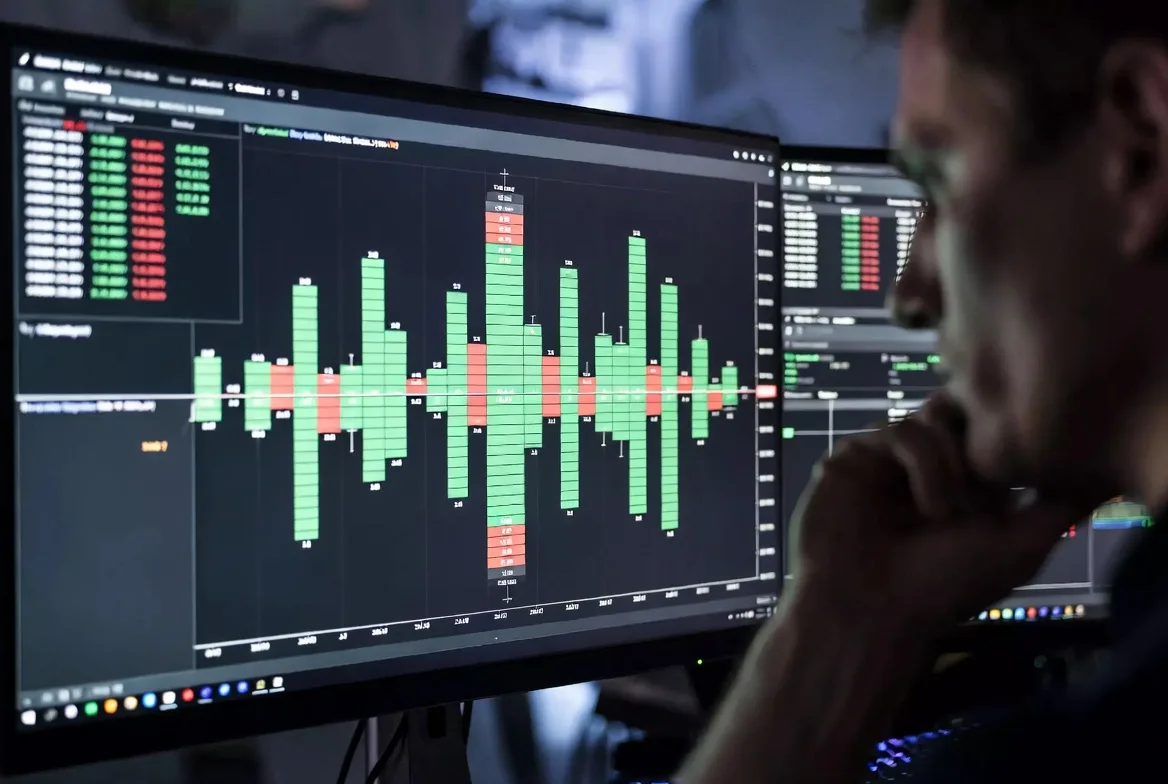
The order book shows all pending buy and sell orders at different price levels. Learning to read this data separates amateurs from professionals who understand what’s happening beneath the surface of price charts.
You’ll see “walls”—large clusters of buy orders below current price or sell orders above it. A massive buy wall suggests institutional accumulation at that level. A sell wall indicates distribution pressure. But here’s the catch: these walls can vanish instantly. Some are real, some are spoofing (fake orders meant to manipulate perception).
Watch how price behaves approaching a wall. Does it bounce decisively? Or does the wall get pulled right before price reaches it? That tells you whether the orders were genuine.
Order book imbalance gives actionable signals. When buy orders significantly outweigh sell orders in the near-term price levels (within 0.5-1% of current price), you’re seeing accumulation pressure building. The inverse suggests imminent selling pressure. Heatmap visualizations make these imbalances easier to spot at a glance.
Iceberg orders complicate this analysis. Large players hide their true order size by breaking one massive order into many small visible chunks. You’ll notice repeated small orders appearing at the same price level after previous orders fill. That pattern suggests someone accumulating or distributing a large position without moving price dramatically.
Most Reliable Chart Patterns for Intraday Moves
Certain chart patterns repeat constantly in crypto markets, though they complete faster than traditional markets. Bull flags and bear flags are foundational—a sharp directional move followed by tight consolidation typically precedes continuation in the original direction. These patterns often complete within 30 minutes to 2 hours during active crypto sessions.
Head and shoulders patterns signal reversals, but they require patience. The right shoulder should form on declining volume, and you want volume confirmation when price breaks the neckline. In crypto’s accelerated environment, these patterns sometimes compress into 2-3 hour formations rather than the multi-day versions common in stock trading.
Double tops and bottoms work exceptionally well at psychological price levels. Think $30,000 Bitcoin or $2,000 Ethereum. Traders cluster stop orders just beyond these round numbers, creating liquidity pools that smart money deliberately targets. When price decisively breaks these levels, the stops trigger and accelerate the move.
Triangles—both ascending and descending—offer clear entry points with measurable profit targets. Take the height of the triangle at its widest point and project that distance from the breakout level. In crypto, these measured moves hit their targets more reliably than traditional markets, possibly because algorithmic trading is less dominant and retail psychology more predictable.
Proven Day Trading Strategies for Cryptocurrency Markets
Effective crypto day trading strategies must account for extreme volatility, occasional liquidity gaps in smaller assets, and the absence of circuit breakers that pause trading during crashes. These approaches work across different market conditions when applied appropriately.
Range trading suits consolidation phases. You identify obvious support and resistance boundaries, buy near the bottom of the range, sell near the top. Place stops just outside the range—when price breaks through decisively, you exit quickly with a controlled loss. This approach works beautifully during sideways markets, common in crypto during summer months or after major rallies exhaust themselves.
Momentum trading captures strong directional moves. When Bitcoin clears a major resistance level with heavy volume, momentum traders pile in, riding the move until momentum indicators diverge or volume disappears. This requires quick reflexes and tight stops—crypto momentum can reverse with frightening speed.
Scalping Crypto Explained
Scalping means taking dozens of tiny profits throughout your session, holding positions for minutes rather than hours. Scalpers target 0.3-0.8% gains per trade, executing anywhere from 20 to 50 trades daily. This approach demands intense concentration and low-fee exchanges—otherwise, transaction costs devour your edge.
You need liquid markets for successful scalping. Bitcoin, Ethereum, and the top ten altcoins by market cap provide the tight spreads and sufficient volume for quick entries and exits. Trying to scalp a low-volume altcoin typically results in slippage that eliminates any profit potential.
Technical setups for scalping are deliberately simple. Many successful scalpers use only support and resistance levels combined with volume analysis. They enter when price bounces off a level with confirming volume. They exit at the next resistance level or when volume declines, whichever occurs first.
The psychological demands are brutal. You will have losing trades—sometimes five or six in a row. Scalping demands you completely reset emotionally after each trade, approaching the next setup with fresh eyes and zero baggage from what just happened. Tilt (emotional trading after losses) destroys scalping accounts faster than any technical error.
Momentum and Breakout Strategies
Breakout strategies focus on entering when price moves beyond established ranges. The critical skill is distinguishing real breakouts from false ones (fakeouts). Volume provides your clearest confirmation—a breakout on 2-3 times average volume has significantly higher success probability than one on declining volume.
Wait for the retest. Price frequently breaks through resistance, pulls back to test that level as new support, then continues higher. Entering on the retest rather than the initial breakout improves your risk-reward ratio dramatically. Your stop-loss sits just beneath the retested level, while your profit target extends to the next significant resistance.
News-driven momentum creates powerful intraday moves. When Coinbase announces a new listing, or a protocol reveals a major partnership, momentum can persist for hours. However, these setups carry high risk—news sometimes gets priced in faster than expected, or contradictory information emerges mid-trade, reversing everything instantly.
Combining momentum with broader market structure improves results significantly. If Bitcoin breaks out while the overall crypto market shows strength (measured by total market cap increasing and multiple altcoins rallying), that breakout has higher success probability. Isolated breakouts during broader market weakness frequently fail.
Risk Management Rules Every Crypto Day Trader Must Follow
Risk management determines whether you survive long enough to become profitable. The volatility that creates opportunity also destroys accounts that ignore position sizing and stop-losses.
The foundational rule: never risk more than 1-2% of trading capital on any single trade. With a $10,000 account, your maximum loss per trade should be $100-200. This requires working backwards from your stop-loss distance to determine position size. If your stop sits 5% below entry, your position size should be $2,000-4,000—ensuring a 5% loss equals your predetermined $100-200 risk.
Daily loss limits prevent catastrophic drawdowns. Establish a maximum daily loss (typically 3-5% of capital), and when you hit it, stop trading immediately. Continuing to trade while frustrated and down money leads to revenge trading—aggressive, poorly-planned trades attempting to recover losses quickly. This behavior accelerates account destruction.
Leverage multiplies both gains and losses. A 10x leveraged position means a 10% adverse move liquidates your entire position. Crypto exchanges advertise leverage up to 125x—a marketing gimmick serving the exchange (liquidations generate fees) rather than traders. Experienced day traders use minimal leverage (2-5x maximum) or trade spot markets exclusively.
Position correlation matters more than most realize. Holding five different altcoin positions isn’t diversification when they all move 0.9 correlated with Bitcoin. When Bitcoin dumps 7%, your entire portfolio suffers. True diversification in day trading means limiting total exposure rather than spreading it across highly correlated assets.

Psychology and Discipline in Crypto Day Trading
Crypto day trading psychology separates consistently profitable traders from the majority who destroy accounts. Technical skills are learnable through practice. Emotional control? That’s harder to develop and requires brutal self-honesty.
FOMO (fear of missing out) drives catastrophic decisions. You see Solana pumping 12% and jump in without a plan, desperately hoping to catch the remaining move. Usually, you buy near the peak, then watch helplessly as your position bleeds while momentum fades. The solution: trust your system completely and accept missing some moves. Chasing trades outside your defined strategy consistently leads to losses.
FUD (fear, uncertainty, doubt) causes premature exits from winning trades. You’re up 2% on a solid position when someone tweets about potential regulatory action. You panic-sell immediately, then watch price continue higher without you. Fix: establish your stop-loss and profit target when entering the trade, then honor them regardless of external noise. If news genuinely invalidates your setup, exit according to predefined rules, not emotional impulses.
Maintaining a detailed trading journal transforms results over time. Record every trade: entry price, exit price, reasoning behind the trade, emotional state during execution, and outcome. Review weekly to identify patterns in your behavior. You might discover you’re consistently profitable during morning sessions but give back gains in afternoon trades—a signal to stop trading after lunch.
Overconfidence follows winning streaks predictably. After five consecutive profitable trades, you feel invincible and increase position size or ignore your stop-loss rules. Then the market humbles you with a loss erasing days of gains. Treat each trade as an independent event—past success provides zero predictive value for future outcomes.
Tax Implications of Day Trading Cryptocurrency in the US
Tax implications of crypto day trading in the US are complex and widely misunderstood. The IRS classifies cryptocurrency as property rather than currency, creating reporting obligations for every single trade you execute.
Every trade creates a taxable event. When you sell Bitcoin for USDT, that’s taxable. When you use that USDT to buy Ethereum, that’s another taxable event. Day traders executing 50 trades daily create 50 taxable events, each requiring cost basis calculation and gain or loss determination.
Assets held less than one year face short-term capital gains taxation. These gains are classified as ordinary income, potentially facing tax rates up to 37% depending on your total income. This differs dramatically from long-term capital gains (assets held over one year), which max out at 20% for high earners.
The wash sale rule currently doesn’t apply to cryptocurrency, though proposed legislation could change this. In traditional markets, selling a stock at a loss and repurchasing within 30 days prevents you from claiming that loss. Crypto traders can currently sell at a loss and immediately repurchase, harvesting the tax loss while maintaining exposure. This loophole may close in future legislation.
Record-keeping requirements are substantial and non-negotiable. You must track the cost basis of every purchase, proceeds from every sale, dates, times, and specific units sold (using FIFO, LIFO, or specific identification methods). Most exchanges provide transaction histories, but you need specialized crypto tax software to compile this into IRS-compliant reports.
You’ll report capital gains and losses using Form 8949 and Schedule D. With hundreds or thousands of transactions, this becomes unwieldy quickly. The IRS permits summary reporting in certain cases, but you must maintain detailed records in case of audit. Many active day traders hire CPAs specializing in cryptocurrency to ensure compliance and avoid penalties.
Common Mistakes That Destroy Crypto Day Trading Accounts
Overtrading ranks as the number one account killer. The constant market movement tempts traders to maintain a position continuously, even when quality setups are absent. Every trade incurs fees and exposes you to risk. Sometimes the smartest position is cash—particularly when markets are choppy or your strategy isn’t working.
Ignoring fees compounds damage quickly. A 0.1% maker fee and 0.15% taker fee means you’re paying 0.25% round-trip on each trade. Execute 30 trades daily, and you’ve paid 7.5% in fees alone—requiring 7.5% gains just to break even before considering losses. Fee structures vary dramatically across exchanges, and choosing the wrong platform can make profitability mathematically impossible.
Poor platform choice extends far beyond fee considerations. Some exchanges experience slow order execution during volatile periods, causing your entry or exit to slip by 0.5-1%. Others lack advanced order types (OCO orders, trailing stops) that help automate risk management. Research exchange reliability during high-volume events—the platform working fine during calm markets might crash precisely when you need it most.
Lack of strategy testing leads to trading without an edge. You cannot know if your approach works without backtesting historical data and forward-testing with small positions. Many traders jump into day trading with real money immediately, learning expensive lessons that simulation would have revealed for free. Paper trading or using minimal capital ($100-500) during the learning phase saves thousands in tuition paid to the market.
| Strategy | Time per Trade | Risk Level | Best Market Conditions | Skill Level Required |
|---|---|---|---|---|
| Scalping | 2-10 minutes | Medium-High | High volatility with tight spreads | Advanced |
| Range Trading | 1-4 hours | Low-Medium | Sideways consolidation periods | Intermediate |
| Momentum Trading | 30 min – 3 hours | High | Strong directional trends | Intermediate-Advanced |
| Breakout Trading | 1-6 hours | Medium-High | Consolidation followed by expansion | Intermediate |
| News Trading | 5-60 minutes | Very High | Major announcements and listings | Advanced |
Failing to adapt to changing market conditions destroys otherwise solid strategies. A scalping approach that worked beautifully during 2025’s volatility might fail completely in a low-volatility environment. Markets cycle through trending phases, ranging phases, and choppy conditions. Profitable traders recognize which phase is active and adjust their strategy accordingly—or sit out phases that don’t suit their approach.
Day trading cryptocurrency requires the same discipline as trading traditional assets, but with 10x the volatility and none of the market closures to force reflection. Most traders would benefit from the market occasionally being closed—it would prevent them from overtrading and give them time to analyze mistakes.
Sarah Chen, Cryptocurrency Market Analyst at Digital Asset Research
FAQs
Technically, you could start with $100, but realistic capital for sustainable day trading is $2,000-5,000 minimum. This allows proper position sizing while risking only 1-2% per trade. Smaller amounts leave you vulnerable to fees consuming profits and insufficient capital to properly diversify risk across multiple positions.
Day trading cryptocurrency is completely legal throughout the US. Unlike stock markets where pattern day trader rules require $25,000 minimum for frequent trading, crypto has no such restrictions. You can execute unlimited trades with any account size. However, you must comply with tax reporting requirements and use exchanges that serve US customers in compliance with regulations.
Currently, wash sale rules don’t apply to cryptocurrency because the IRS classifies it as property rather than securities. You can sell crypto at a loss and immediately repurchase it while still claiming the tax loss. However, proposed legislation may change this, so avoid building long-term tax strategies assuming this loophole remains open indefinitely. Consult a tax professional familiar with current crypto regulations.
Day trading cryptocurrency offers genuine profit potential for those willing to develop skills, manage risk rigorously, and maintain emotional discipline. The 24/7 markets and extreme volatility create opportunities absent in traditional assets, but these same characteristics punish unprepared traders mercilessly.
Success requires mastering technical analysis, developing a tested strategy, and implementing strict risk management. You’ll need to understand order book dynamics, recognize reliable chart patterns, and execute trades with consistency regardless of emotional state. The tax implications demand attention—profitable trading means nothing if you’re unprepared for the tax bill.
Start small, prioritize education, and treat early trades as tuition rather than profit opportunities. Most day traders lose money initially—your goal is losing less while learning more. Keep detailed records, review every trade critically, and refine your approach based on data rather than feelings.
The traders who survive and eventually thrive share common traits: they risk small amounts per trade, they maintain clear entry and exit rules, they stop trading when those rules aren’t working, and they treat trading as a business requiring continuous improvement. Crypto markets will continue offering opportunities to those prepared to capture them systematically and professionally.