Traditional crypto exchanges ask you to trust them with your money. You send Bitcoin or Ethereum to their platform, hope they safeguard it properly, and cross your fingers they’ll honor withdrawal requests when you need your funds back. Decentralized exchanges flip this model completely—trades happen wallet-to-wallet through code that runs automatically on blockchains. Nobody takes possession of your assets during the swap. That architectural difference creates ripple effects across everything from trading costs to security risks to whether you can access certain tokens at all.
What Are Decentralized Exchanges?
A decentralized exchange lets you swap one cryptocurrency for another without handing control to any company or institution. Your wallet connects directly to smart contracts living on blockchains like Ethereum or Solana. These contracts check your token balances, calculate swap amounts, and transfer assets between participants—all without requiring you to create accounts, pass identity checks, or deposit funds into someone else’s custody.
Here’s what makes this different: when you trade on Coinbase, you’re really just updating numbers in their internal database. The actual blockchain transaction only happens when you withdraw. With a DEX, every single trade is a blockchain settlement. Your MetaMask wallet (or Phantom, or Rainbow, or any compatible option) signs a transaction that directly interacts with the exchange’s code. Either the swap completes fully or it fails completely. There’s no middle ground where your money gets stuck waiting for manual processing.
The non-custodial setup means you keep your private keys through the entire process. Nobody can freeze your account because… well, you don’t have an account. There’s no username to lock, no customer support to plead with, and no terms of service that give a platform the right to restrict your trading activity. You’re interacting with immutable code that treats everyone identically.
Most DEXs operate on public blockchains where anyone can inspect the code, audit transaction histories, or verify how much capital sits in various liquidity pools. Ethereum hosts the majority of DEX activity through platforms like Uniswap and SushiSwap. BNB Chain became popular for traders seeking lower fees. Solana attracts users wanting faster confirmation times. The blockchain choice affects your costs and speed, but the core principle stays consistent—you control the keys, therefore you control the coins.
DEX vs Centralized Exchange: Key Differences
Centralized platforms work like traditional brokerages. Kraken, Gemini, Coinbase—they all maintain order books, hold customer deposits in omnibus wallets, and match buyers with sellers through their proprietary systems. You’re trusting them to maintain adequate reserves, implement proper security, and process your withdrawal requests promptly. Sometimes that trust is well-placed. Other times you get situations like FTX, where executives allegedly misused $8 billion in customer funds.
DEXs remove that trust requirement entirely. Your tokens never leave your wallet until the exact moment a swap executes. The smart contract pulls tokens from your address, sends you what you’re buying, and updates liquidity pools—all in one atomic transaction. If any step fails, everything reverts. There’s no corporate entity holding a pile of everyone’s crypto in a vault somewhere.

| Feature | Decentralized Exchange | Centralized Exchange |
|---|---|---|
| Who controls assets | You maintain private keys continuously | Platform holds deposits in their wallets |
| Identity verification | Zero documentation required | Government ID plus address proof for most services |
| Typical liquidity | Varies wildly; thin for obscure pairs | Generally deeper for mainstream tokens |
| What you pay | Swap fees 0.05–0.3% plus gas (sometimes $1, sometimes $40) | Trading commission 0.1–0.5% plus fixed withdrawal charges |
| Security model | Smart contract bugs risk permanent loss | Platform hacks might trigger insurance coverage or reimbursement |
| Account restrictions | Impossible—no accounts exist | Support can suspend access during investigations |
| Getting started | Connect any compatible wallet immediately | Application review, sometimes multi-day approval waits |
The custody arrangement creates the biggest practical split. When Binance or Kraken gets hacked, customers might recover funds through company reserves or insurance policies. When you mess up your seed phrase or send tokens to a wrong address on a DEX? That money is simply gone. Forever. No password reset email will save you. No customer service representative can reverse the transaction. You get absolute sovereignty over your assets, which includes absolute responsibility for not screwing up.
Centralized exchanges handle forgotten passwords through email recovery. They investigate suspicious transactions. Some even maintain insurance for specific breach scenarios. DEXs offer none of these safety nets. What you gain in censorship resistance and privacy, you sacrifice in error forgiveness and guided support.
How DEX Trading Works: Order Books vs AMMs
Two competing approaches power decentralized trading. They both enable peer-to-peer swaps, but the mechanics underneath couldn’t be more different.
Traditional Order Book DEXs
Some DEXs recreate the limit order system that stock traders have used for decades. You place an order to buy ETH at $2,400 or sell at $2,410. Your order joins a list of competing offers at various price levels. When someone submits a market order, the protocol matches it against the best available price and settles on-chain.
Projects like dYdX took this route, though they keep order books off-chain to avoid overwhelming Ethereum with transaction costs. Only matched trades actually hit the blockchain. Serum built something similar on Solana, where higher throughput makes on-chain order books more feasible. The advantage? Prices form through familiar supply-and-demand mechanics. Professional market makers can deploy sophisticated strategies. The downside shows up quickly on illiquid pairs—if nobody’s posting competitive bids and offers, your order sits unfilled just like on any low-volume market.
Automated Market Makers Explained
AMMs threw out order books completely and replaced them with algorithmic pricing based on token ratios. Instead of matching buyer and seller orders, these platforms maintain reserves (called liquidity pools) containing token pairs. Anyone can deposit matching values of both tokens to become a liquidity provider. When you trade, you’re swapping against this pooled liquidity, not against another trader’s specific order.
Here’s why this mattered: early DEXs struggled with a chicken-and-egg problem. Traders won’t use platforms lacking liquidity. Market makers won’t provide liquidity to platforms lacking traders. AMMs solved this by letting passive capital providers earn fees without needing to actively manage orders or monitor markets constantly. You deposit tokens, collect a share of trading fees, and withdraw whenever you want.
When executing an AMM trade, the smart contract recalculates the exchange rate based on how your swap affects the pool’s balance. Buy a bunch of ETH, and you’re removing ETH while adding USDC—which automatically makes the remaining ETH more expensive. The next trader encounters a slightly different price. This creates constant price discovery without requiring traditional market makers.
The Constant Product Formula in AMMs
Uniswap popularized the elegantly simple constant product model: x × y = k. The x represents how much of the first token sits in the pool. The y represents the second token quantity. The k is a fixed number that only changes when someone adds or removes liquidity (not during regular trades).
Let’s say a pool contains 50 ETH and 100,000 USDC. Multiply them: 50 × 100,000 = 5,000,000. That’s your k value. The current implied exchange rate is 2,000 USDC per ETH, derived from the ratio 100,000 ÷ 50.
Someone wants to buy 5 ETH from this pool. After removing 5 ETH, the pool holds 45 ETH. Now the formula requires: 45 × y = 5,000,000. Solving for y gives you 111,111 USDC. The trader must deposit 11,111 USDC to maintain the constant k value. They’re paying 2,222 USDC per ETH on average—higher than the initial 2,000 rate because their trade shifted the balance significantly.
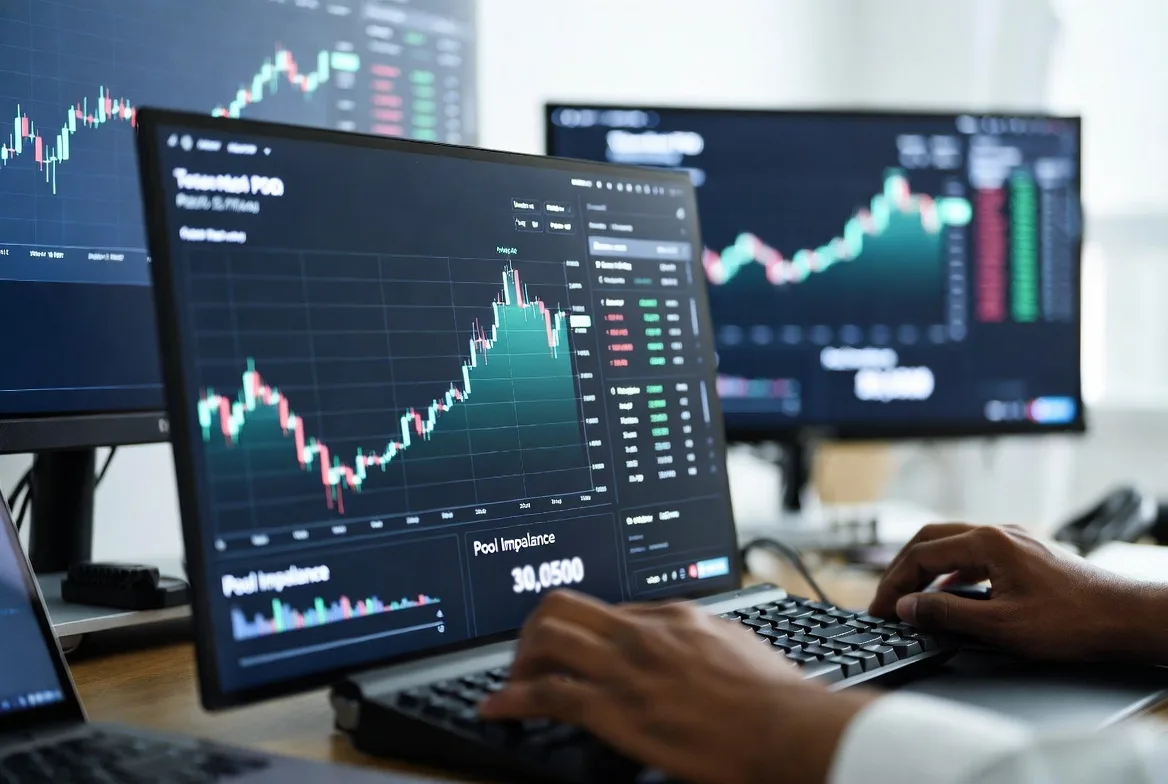
That’s the curve in action. Small trades relative to pool size barely budge the ratio and execute near quoted prices. Massive trades that substantially deplete one side of the pool hit progressively worse prices as they go. This inherent slippage (covered in detail below) is a mathematical necessity, not a platform fee.
The formula ensures pools technically never run completely dry. Want to buy all the ETH? The required USDC amount approaches infinity as you get closer to zero ETH remaining. In practice, prices become so terrible that nobody attempts to drain pools entirely.
Curve Finance modified this approach for tokens that should trade at roughly equal values—USDC, USDT, and DAI stablecoins, for instance. Their formula creates a flatter price curve that minimizes slippage when token values stay close. Balancer allows pools with three, four, or more tokens at customizable weight ratios. But Uniswap’s x × y = k remains the foundational innovation that proved AMMs could actually work.
AMMs fundamentally changed who gets to earn market-making profits. Previously, you needed sophisticated infrastructure and constant monitoring to provide liquidity on exchanges. Uniswap let anyone with $1,000 become a market maker and earn the spread. That democratization reshaped liquidity provision completely.
Dr. Amara Chen
Understanding Slippage and Trading Fees on DEX Platforms
People new to DEXs often confuse slippage with fees. They’re separate costs that hit your trades in different ways.
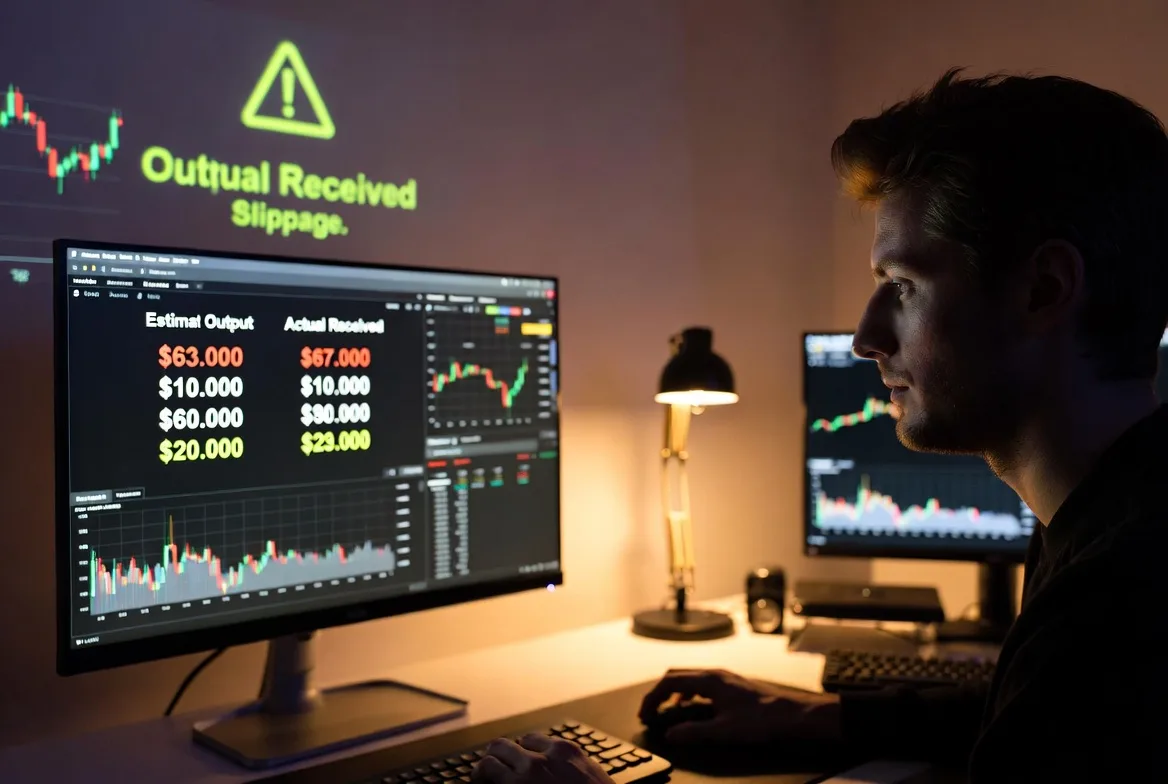
Slippage measures the gap between the price quoted when you click “swap” and the actual rate you receive. On AMM platforms, this stems directly from how your trade rebalances the pool. That constant product formula guarantees your transaction moves the price—the only question is how much. A $500 swap in a pool holding $5 million in total value? You’ll barely notice slippage. That same $500 in a pool with just $25,000? The price impact becomes very noticeable because you’re consuming a meaningful chunk of available liquidity.
Consider a real scenario: You want to buy $10,000 worth of a newer DeFi token. Pool A holds $200,000 in liquidity. Pool B holds $2 million. In Pool A, your trade represents 5% of total depth, triggering substantial slippage—maybe 3-4% price impact or higher. In Pool B, you’re only 0.5% of depth. Your slippage might stay under 0.3%. The displayed exchange rate matters less than the final amount you actually receive after price impact.
DEX interfaces let you set slippage tolerance—usually 0.5%, 1%, or a custom value. Set it too tight, and your transaction fails if the pool composition shifts between when you submit and when miners confirm it (this gap creates opportunities for frontrunning bots, but that’s another topic). Set it too loose, and you might accept terrible execution unnecessarily. Finding the right balance depends on market volatility and how urgently you need the trade to execute.
The liquidity depth available for any trading pair becomes critical information. Check the total value locked in a pool before trading. Most interfaces display this prominently. Swapping a four-figure amount in a pool with only five figures of liquidity virtually guarantees painful slippage. Wait for deeper liquidity to develop, or split your trade across multiple smaller transactions over time.
Trading fees break down differently than slippage. You’re paying for several distinct services:
Swap fees go directly to liquidity providers as compensation for depositing their capital. Uniswap v2 charges 0.3% per swap. Uniswap v3 introduced tiers (0.05% for stablecoin pairs, 0.3% for standard pairs, 1% for exotic/volatile pairs). This percentage is taken from your received amount, making it easy to calculate—swap $1,000, and $3 goes to LPs if the fee is 0.3%.
Network fees (gas) compensate validators for processing your transaction on the blockchain. This cost fluctuates wildly depending on which network you’re using and how congested it is at that moment. Ethereum mainnet might cost anywhere from $5 during quiet periods to $50+ when network activity spikes. Arbitrum or Optimism (Ethereum layer-2 networks) typically stay under $1. Polygon often costs a few cents. Solana usually charges fractions of a penny. Gas fees are the same whether you’re swapping $100 or $100,000—it’s a flat transaction cost, not a percentage.
Protocol fees occasionally take an additional cut that goes to the DEX’s treasury rather than to liquidity providers. Not every platform implements these. When they exist, they’re usually a small fraction (like 0.05%) added to the LP fee.
The fee structure creates interesting dynamics. Trading $50 on Ethereum mainnet makes no sense when gas alone might eat $12 of your capital. Trading $50,000, though? You pay 0.3% ($150) plus maybe $10 gas, totaling $160. Compare that to a centralized exchange charging 0.2% ($100) plus withdrawal fees that could add another $25. For larger trades, DEX fees often win despite the gas costs. For smaller trades, centralized platforms typically come out ahead because their per-transaction costs don’t include expensive blockchain settlements.
Advantages of Using Decentralized Exchanges
The benefits extend beyond ideological preferences about decentralization. Several practical advantages affect day-to-day trading decisions.
Censorship resistance means nobody can block your market access. Centralized exchanges delist tokens regularly due to regulatory pressure, business decisions, or compliance requirements. They restrict users by geography—New York residents famously face limitations on numerous platforms. They freeze accounts suspected of violating terms of service. Smart contracts don’t care about any of that. If you have the right tokens and pay the gas fees, the trade executes. Period. No KYC checks, no country restrictions, no account suspension during “routine review” that lasts weeks.
Privacy comes from avoiding identity documentation requirements. You’re not truly anonymous—blockchain transactions are publicly visible, and sophisticated analysis can sometimes link addresses to identities. But you’re pseudonymous, trading from wallet addresses without submitting passport scans, selfies, or proof of residence. For people living under authoritarian governments or those who simply value financial privacy, this matters substantially. Nobody’s collecting your personal information and storing it in databases that might get breached later.
Asset access vastly exceeds centralized listings. Any token using standard protocols (ERC-20 on Ethereum, SPL on Solana, etc.) can have a liquidity pool created by anyone within minutes. New projects launch on DEXs immediately, sometimes gaining substantial trading volume before any centralized exchange even considers listing them. Want to trade an obscure governance token from a new DAO? Good luck finding it on Kraken. On Uniswap, anyone can deploy a pool.
This cuts both ways. DEXs give you access to legitimate early-stage projects before they hit mainstream platforms. They also expose you to obvious scams, rug pulls, and worthless tokens that would never survive centralized exchange vetting. You gain opportunity with zero gatekeeping, but you lose the protective screening that centralized platforms provide.
Single points of failure disappear when custody gets distributed. Centralized exchanges create attractive targets for sophisticated attackers. Mt. Gox lost 850,000 Bitcoin. Bitfinex got hacked for 120,000 Bitcoin. FTX imploded spectacularly (through fraud rather than hacking, but the custody risk proved catastrophic regardless). DEXs don’t aggregate everyone’s funds in central honeypot wallets. Your tokens stay in your personal address until the instant a swap processes. Attackers who want to steal from DEX users need to compromise individual wallets one at a time rather than breaching one platform and accessing millions simultaneously.
Permissionless access eliminates approval processes entirely. No application to fill out. No minimum deposit requirements. No waiting days for account verification. Connect a wallet, and you’re trading immediately. This seems trivial until you’re traveling internationally and your centralized exchange account gets restricted due to geographic login detection. Or until you’re trying to access markets from a country where centralized platforms don’t operate. DEXs work for anyone with internet access and a compatible wallet—full stop.
Risks and Limitations of DEX Trading
The decentralized architecture introduces distinct hazards that don’t exist on centralized platforms.
Smart contract vulnerabilities represent the primary security threat. Code bugs can drain funds permanently. The Poly Network attack in August 2021 exploited a contract flaw to extract $611 million (the attacker eventually returned it, surprisingly). Wormhole lost $325 million in February 2022 through a bridge contract vulnerability. These weren’t platform failures where companies could cover losses—they were code exploits that resulted in irreversible theft.
Even professionally audited contracts sometimes harbor subtle vulnerabilities that take months or years to discover. Unlike centralized exchanges where the company might reimburse hack victims, smart contract exploits typically mean permanent loss. The code executes exactly as written, even when what’s written contains critical flaws. Sticking to established protocols with extensive security track records reduces this risk but doesn’t eliminate it entirely.
Impermanent loss affects anyone providing liquidity to AMM pools. The term confuses people, so here’s a concrete example: You deposit $10,000 ($5,000 in ETH and $5,000 in USDC) into a liquidity pool when ETH trades at $2,500 per token. Over the next month, ETH rallies to $3,500. The AMM automatically rebalances, selling your ETH as traders arbitrage the price difference between this pool and the broader market. When you withdraw, you end up with less ETH and more USDC than you deposited initially.
Had you simply held the two tokens separately, you’d have gained more from ETH’s appreciation. The “loss” only crystallizes when you withdraw—if prices return to original ratios, it vanishes (hence “impermanent”). But for volatile pairs, impermanent loss often exceeds the trading fees you earned by providing liquidity, making it a money-losing proposition despite the collected fees.
Liquidity limitations plague countless trading pairs. While ETH/USDC or WBTC/ETH pools on Uniswap hold hundreds of millions in liquidity, obscure tokens frequently have pools measured in thousands or low tens of thousands of dollars. Trying to trade these thin markets generates extreme slippage. You face a paradox: DEXs theoretically provide access to any token, but trading many of those tokens efficiently requires liquidity levels they don’t yet possess.
The learning curve intimidates newcomers. Managing seed phrases securely. Understanding gas fee dynamics. Verifying contract addresses to avoid fake tokens. Calculating slippage impacts. Navigating multiple blockchain ecosystems. Setting proper approvals. Recognizing phishing attempts. These skills take time to develop. One mistake—like copy-pasting a wrong contract address and swapping for a worthless imitation token—can vaporize your capital instantly. Centralized platforms hold your hand through these complexities. DEXs assume you know what you’re doing.
Transaction finality eliminates protective mechanisms. Send funds to an incorrect address? They’re permanently stranded there. Fall for a scam promising token airdrops if you “validate” your wallet? You just authorized a malicious contract to drain your holdings. Get frontrun by MEV bots that sandwich your transaction? That’s just how the system works—no customer service will reverse it. This permanence provides settlement certainty and eliminates intermediary control, but it ruthlessly punishes errors and offers zero protection against scams.

FAQs
Safety depends on multiple variables rather than a simple yes/no answer. Established protocols like Uniswap, Curve, and PancakeSwap have processed billions in volume without suffering protocol-level breaches. Their smart contracts underwent extensive auditing and battle-testing. That doesn’t guarantee future safety—code vulnerabilities can lurk for years before discovery—but it provides reasonable confidence.
Your personal security practices matter more than protocol security. Are you verifying contract addresses through multiple sources before trading? Are you using hardware wallets for significant holdings? Have you tested transactions with small amounts before moving serious capital? The platform can’t protect you from clicking a phishing link, approving a malicious token contract, or losing your seed phrase. Those risks lie entirely with you. Start small, use test transactions liberally, and never invest more than you can afford to lose completely.
High slippage warnings typically indicate insufficient liquidity depth relative to your trade size. You’re trying to swap an amount that represents a substantial percentage of the available pool—maybe 5%, 10%, or even more. The constant product formula guarantees this rebalances the pool significantly, resulting in poor execution prices.
Check the total value locked in the pool before confirming. If you’re swapping $5,000 and the pool only holds $30,000, expect painful slippage of 3-5% or worse. Solutions include: trading smaller amounts, waiting for deeper liquidity to develop, splitting your order across multiple DEXs that have separate pools for the same pair, or accepting that this particular token lacks sufficient DEX liquidity and might trade better on a centralized platform that aggregates order flow.
Run the math for your specific trade size and chosen blockchain. For substantial trades above $10,000, DEXs frequently win despite gas costs—swapping $50,000 at 0.3% costs $150 in swap fees plus maybe $10-15 in Ethereum gas (or under $1 on layer-2 networks), totaling around $165. A centralized exchange at 0.2% charges $100 in trading fees but might add $25 in withdrawal fees when you move tokens off-platform later, reaching $125 total. The DEX costs more here, but not dramatically.
For smaller trades under $1,000, centralized platforms usually deliver better economics. Swapping $300 on Ethereum mainnet might cost 0.3% ($0.90) plus $12 gas, totaling $12.90—that’s over 4% in total costs. The same trade on Binance at 0.1% costs $0.30 with minimal withdrawal fees for many assets. Layer-2 solutions and alternative blockchains with lower gas dramatically improved DEX competitiveness for smaller amounts. Swapping that same $300 on Arbitrum costs $0.90 in swap fees plus $0.50 gas, totaling $1.40 (less than 0.5% in total costs).
Yes, and this trips up many DEX users who assume decentralization means tax invisibility. The IRS treats every cryptocurrency swap as a taxable disposal event—you’re selling one asset and acquiring another, triggering capital gains or losses. This applies to all trades regardless of whether they happened on Coinbase or Uniswap. You must report each transaction, calculate your cost basis versus fair market value at the swap moment, and pay appropriate taxes on gains.
Blockchain transparency actually makes DEX trades more traceable than many people realize. Your wallet address and transaction history are permanently public. The IRS has contracted with blockchain analytics firms that can track flows between exchanges, DEXs, and individual wallets. Many traders use specialized tax software (CoinTracker, Koinly, CoinLedger) that imports DEX transaction histories and generates tax forms automatically, since manually tracking hundreds of swaps becomes unrealistic quickly.
Decentralized exchanges evolved from risky experiments into legitimate infrastructure handling daily volumes in the billions. Removing custodial intermediaries and settling trades through smart contracts creates an entirely different trading experience—one that prioritizes your control and open access while demanding technical competence and complete personal responsibility.
Understanding these mechanics helps you pick the right tools for specific situations. AMMs and order books solve different problems. The constant product formula elegantly enables passive liquidity provision while creating inherent slippage based on pool depth. Evaluating custody models, fee structures, and security trade-offs reveals that neither centralized nor decentralized platforms universally dominate across all scenarios.
If you value privacy, censorship resistance, and early access to emerging tokens, DEXs deliver capabilities no centralized platform can match. If you prioritize convenience, customer support safety nets, and better economics on small trades, centralized exchanges remain practical choices. Many experienced users strategically employ both approaches, selecting the optimal platform based on specific transaction requirements. As blockchain technology advances and layer-2 scaling reduces network costs further, the practical advantages of decentralized exchanges will likely reach broader user populations while preserving the foundational principle driving their adoption: your keys, your crypto, your control.