
Think of DeFi adoption as measuring how many people have actually ditched—or at least supplemented—their traditional bank accounts with blockchain-based financial tools. We’re talking about real usage: someone swapping tokens on Uniswap, lending stablecoins on Compound, or earning yield through liquidity provision.
Here’s why this matters beyond the crypto bubble. A Filipino overseas worker sends money home through a DeFi protocol. They pocket an extra 6-8% that would’ve gone to Western Union, and the funds arrive in minutes instead of three days. That’s not theoretical—it’s happening right now at scale. Or consider the Ohio-based contractor who couldn’t get a business loan from their local bank. They locked up $15,000 in crypto collateral on Aave and borrowed $10,000 instantly. No credit check. No two-week approval process. Just code executing exactly as programmed.
This shift redistributes who controls financial infrastructure. Each new wallet, each liquidity deposit, each peer-to-peer loan chips away at the assumption that you need a bank’s permission to access financial services. Right now in 2026, we’re watching this transition accelerate as regulators figure out the rules, interfaces get easier to navigate, and major institutions quietly start moving real money into protocols that were science experiments in 2019.
Current State of DeFi User Statistics and Growth
About 18.3 million wallet addresses interact with DeFi protocols each month—way up from 4.2 million back in 2021. But here’s the catch: those numbers need serious context. Power users run five or six wallets. Trading bots inflate the metrics. Some addresses haven’t touched DeFi in months but still get counted.
The geographic breakdown surprises most people. North America moves the most money (28% of transaction volume), but Southeast Asia has the most users (34% of active wallets). Latin America exploded 340% since 2023, driven almost entirely by people fleeing peso and lira devaluation. In Argentina and Turkey, holding USDC beats watching your savings evaporate by 8% monthly.
Age-wise, 62% of users fall between 25-44. Education skews higher than average—73% finished college. But income? That stereotype about DeFi being only for wealthy tech bros falls apart when you see that 41% of users earn under $75,000 yearly. These aren’t all Silicon Valley engineers. They’re regular people looking for better returns than their savings account’s pathetic 0.5% APY.

Total Value Locked Trends
TVL measures the total dollar value sitting in DeFi protocols. Think of it like “assets under management” but for decentralized systems.
We hit $247 billion in early 2026. That’s up from the $180 billion low point in late 2024, but still below the crazy $312 billion peak from 2021 when everything was going vertical. The composition changed dramatically, though. Ethereum still dominates with 58%, but Layer 2 solutions (Arbitrum, Optimism, Base) now hold $41 billion combined. Solana grew its DeFi ecosystem to $23 billion. Newer chains like Sui and Aptos collectively grabbed $8 billion.
Stablecoins make up 64% of everything locked in DeFi protocols. USDC leads with 47%, USDT follows at 31%, DAI takes 12%. This tells you people want utility over speculation—they’re using DeFi to earn yield on dollars, not just gambling on which token pumps next.
Retail vs Institutional Participation Rates
Individual users own 94% of the wallets but control only 38% of the money. Your average retail position sits around $4,200. Institutional wallets? They average $2.8 million each.
Institutions went from basically zero DeFi exposure in 2020 to controlling 62% of TVL in 2026. Family offices jumped in first. Hedge funds followed. Now corporate treasuries are getting involved—about 340 publicly traded companies hold some DeFi exposure, either directly or through wrapped products.
The split varies by protocol type. Decentralized exchanges see 71% retail trading volume. Lending protocols flip that—68% institutional dominance. Yield aggregators attract both groups roughly equally, which suggests the simplified interfaces actually work for bridging the sophistication gap.
Who Actually Uses DeFi Today
Let’s break down who’s actually clicking these buttons and signing these transactions.
Crypto natives (31% of users) grew up financially in this ecosystem. They never had traditional brokerage accounts before they had MetaMask wallets. These folks juggle 5-7 protocols monthly, read smart contract code before depositing funds, and consider $50 gas fees an annoying but manageable cost of doing business. They provide the liquidity backbone and stress-test new protocols.
Retail investors (48% and growing fast) treat DeFi like another investment option alongside their 401(k) and Robinhood account. They stick to 2-3 trusted protocols—usually Coinbase Wallet connecting to Aave or Compound. A typical retail user parks $5,000 in USDC earning 6% while keeping their paycheck in a traditional bank. They want better yields without learning Solidity.
Institutional players (3% of wallets, massive capital control) include hedge funds executing arbitrage strategies, family offices chasing yield, and corporate treasuries managing cash more efficiently. They don’t download MetaMask. They use Fireblocks or Anchorage—custodial solutions with insurance and compliance features. They access DeFi through institutional-grade interfaces that look nothing like what retail users see.
Developers and builders (6% of users) constantly test new protocols, file bug reports, build integrations, and collect token incentives for early adoption. They overlap heavily with crypto natives but focus more on infrastructure than investment returns. They’re the ones who’ll try a new protocol on testnet before risking real money.
Emerging market users (12% but growing 290% since 2023) use DeFi for dollar access and survival, not speculation. A construction worker in Caracas gets paid in USDC, keeps it in a yield-earning wallet, and spends it through a crypto debit card without ever converting to bolivars. For them, DeFi solves today’s problems, not theoretical future ones.
Most users start with one protocol—usually a DEX or lending platform—then expand slowly. Average timeline to add a second protocol? Eight months. Portfolio composition stays conservative: 67% of users keep at least 40% of their DeFi holdings in stablecoins.

Barriers Preventing Mainstream DeFi Adoption
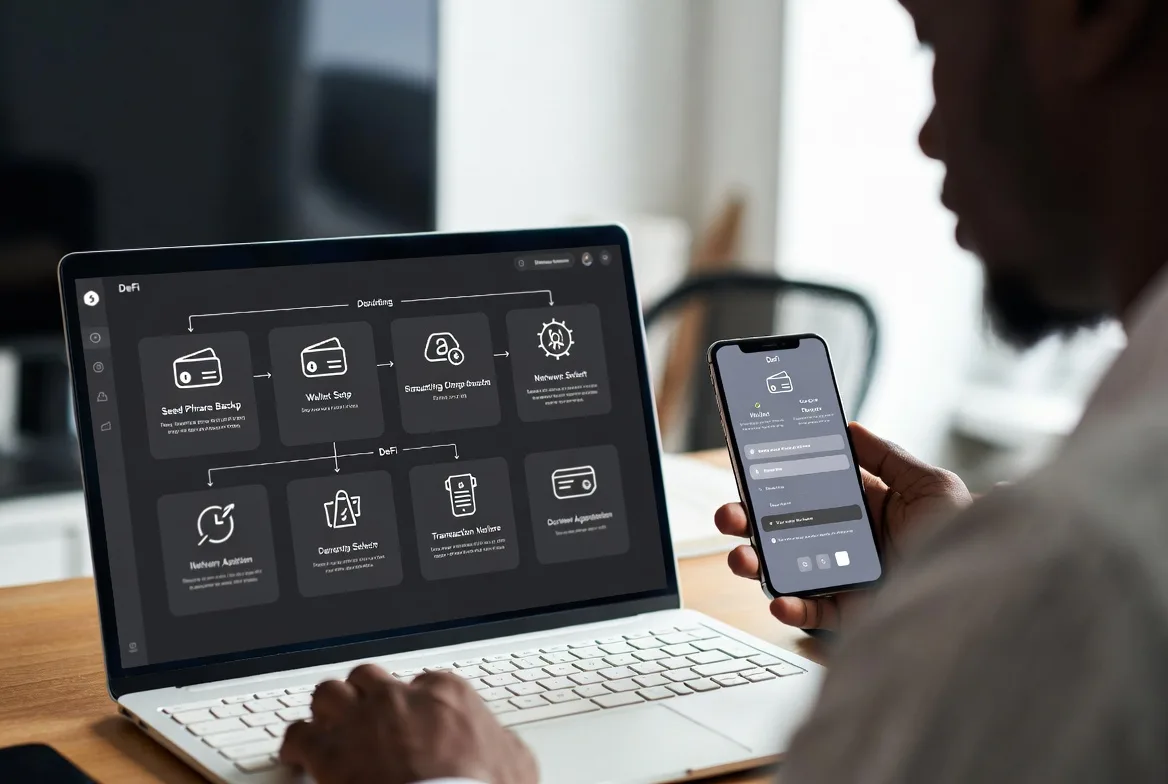
Technical complexity stops people cold before they even start. You need to download a wallet app, write down 12 random words in perfect order, buy crypto on an exchange, withdraw to your wallet (pick the right network or lose everything), maybe bridge between chains, connect to a protocol, approve spending limits, then finally execute while paying gas fees. Miss one step or click one wrong button? Your money’s gone forever. No password reset. No customer service. Just gone.
Compare that to opening a Chime account: email, phone number, done in 90 seconds.
Regulatory fog keeps both users and builders nervous. Is this token a security? The SEC says maybe. What about the tax treatment on yield farming—is it interest, capital gains, or something else entirely? Your accountant probably doesn’t know. Corporate compliance officers can’t approve activities they can’t properly categorize in their systems. This ambiguity particularly freezes institutional adoption.
Security fears are completely justified. DeFi protocols lost $1.2 billion to exploits in 2025. Smart contract bugs. Bridge hacks. Oracle manipulation. These aren’t theoretical risks—they’re monthly headlines. Audited code still gets drained. Your bank account has FDIC insurance. Your DeFi wallet has… nothing.
The user experience punishes mistakes. Gas fees spike to $100 during network congestion for a simple swap. Transactions fail but still burn your gas fee. Error messages say “execution reverted” without explaining what you did wrong or how to fix it. Mobile apps crash. Wallet connections timeout. It feels like using the internet in 1997.
Most people don’t understand the foundational concepts. What’s a blockchain? How do smart contracts work? Why does decentralization matter? Without that base knowledge, DeFi looks needlessly complicated compared to Venmo. The learning curve feels steep for uncertain payoff, especially when your bank already works fine.
The psychological shift feels uncomfortable. Trusting code instead of institutions requires rewiring decades of consumer protection assumptions. When your bank screws up, you call them. When a DeFi protocol gets exploited, you post angry tweets into the void. No manager to escalate to. No FDIC to file a claim with. That lack of recourse violates everything we’ve learned about how money should work.
How DeFi Compares to Traditional Finance Systems
| What You’re Comparing | DeFi Systems | Traditional Banks |
|---|---|---|
| How fast transactions clear | Seconds to a few minutes depending on the network | 1-5 business days for most settlements |
| What you’ll pay in fees | Anywhere from a penny to $50+ when networks get congested | Usually $0-35 per transaction plus percentage cuts |
| Who can get access | Anyone with internet and a wallet—no permission needed | Need bank account, pass credit checks, provide documentation |
| When you can transact | Anytime, day or night, holidays included | Business hours only, closed weekends |
| Who handles your transaction | Smart contracts execute automatically | Banks, clearinghouses, payment processors |
| Can others see your activity | Every transaction lives permanently on public blockchains | You see your transactions, nobody else does |
| Regulatory oversight | Minimal and still being figured out by jurisdiction | Comprehensive, decades-old frameworks |
| Requirements to open account | Nothing—just create a wallet instantly | Identity verification, minimum deposits, credit history |
This isn’t about one system beating the other. It’s trade-offs all the way down.
Speed matters most when time is money. Swap tokens on Uniswap? Done in 15 seconds. Wire money internationally through your bank? Check back Wednesday. But that DeFi speed comes with permanent finality—send to the wrong address and it’s just gone.
Fees favor DeFi for large amounts but punish small transactions. Moving $10,000 internationally costs maybe $2 in gas fees versus $45 plus 3% through traditional rails. But sending $20 might cost $3 in gas—a 15% hit that makes zero economic sense.
DeFi’s strongest advantage? Access. Anyone with a phone and internet can create a wallet right now and access global financial markets. No minimum balance. No credit check. No branch visit. Traditional banking excludes 1.4 billion people worldwide. Geographic barriers, economic barriers—DeFi doesn’t care. You’re either connected or you’re not.
Operating 24/7 seems minor until you actually need it. Send money at 2 AM on Sunday. Execute a trade on Christmas. Work with someone in Tokyo from your New York office without worrying about market hours. That constant availability particularly helps international transactions across time zones.
Transparency cuts both ways. Anyone can audit reserves, track fund flows, verify protocol behavior. Want to know if a DeFi protocol actually has the collateral it claims? Check the blockchain. But this same transparency means your transactions are public forever. Sophisticated analysis can link addresses to identities despite pseudonymity—creating privacy problems traditional banking’s opacity avoids.
Traditional finance’s regulatory protections prevent many disasters DeFi users face regularly. Deposit insurance covers your first $250,000 if your bank fails. Fraud reversal protects you if someone drains your account. Legal recourse exists when things go wrong. When a DeFi protocol gets exploited, you typically lose everything with zero compensation.
Enterprise and Institutional DeFi Use Cases
Companies moved past experimenting to actually using DeFi for specific operational functions where it beats traditional alternatives.
Treasury management leads institutional adoption. Companies park stablecoins in lending protocols earning 4-7% yields on cash reserves—way better than the 2-3% from money market accounts. About 180 publicly traded companies now allocate 5-15% of treasury to DeFi strategies. They treat it like enhanced cash management, not speculation.
Cross-border payments found real product-market fit. A manufacturer paying Southeast Asian suppliers settles invoices in hours using stablecoin transfers instead of waiting 3-5 days for wires while paying $35-50 per transaction plus FX spreads. Mid-sized importers save around $47,000 annually versus traditional payment rails.
Real-world asset tokenization moved from PowerPoint slides to actual implementation. Real estate funds tokenize property shares enabling fractional ownership and 24/7 trading. Equipment financing companies tokenize machinery loans, creating liquid markets for previously illiquid assets. Tokenized securities hit $38 billion in 2026, projected to reach $400 billion by 2028.
Payroll for remote teams works especially well. Paying contractors across 30 countries through traditional banking means managing multiple accounts, currency conversions, varying settlement times. Stablecoin payments settle instantly with minimal fees. Over 2,400 companies now pay at least some workers through DeFi rails.
Real examples show practical implementation. One mid-sized e-commerce company holds $3 million in USDC across Aave and Compound, earning roughly $180,000 annually while maintaining liquidity for operational needs. A logistics firm uses DeFi payment rails to settle with carriers within hours of delivery confirmation, improving cash flow management on both sides. A real estate investment trust tokenized a $45 million property portfolio, letting investors trade shares continuously instead of waiting for quarterly redemption windows.
The institutional infrastructure supporting these use cases matured significantly. Custodial services like Anchorage and Fireblocks provide institutional-grade security with insurance coverage. Specialized tax software tracks DeFi transactions for compliance reporting. Legal frameworks for tokenized securities clarified in major jurisdictions. Professional service firms offer DeFi integration consulting—you don’t need blockchain expertise in-house anymore.

But limitations remain real. Institutional adoption clusters around specific use cases rather than replacing entire financial operations. Regulatory uncertainty still prevents most banks from direct DeFi participation. Accounting treatment varies by jurisdiction, complicating financial reporting. Most enterprises use hybrid approaches—DeFi for specific functions while maintaining traditional banking relationships for regulated activities.
What the DeFi Ecosystem Expansion Means for Users
The 2026 DeFi landscape barely resembles the experimental chaos of 2021. Infrastructure improvements, new protocol categories, and better interoperability create a more mature, genuinely usable environment.
Layer 2 scaling solutions effectively solved Ethereum’s congestion nightmare. Networks like Arbitrum, Optimism, and Base process transactions for $0.01-0.05 with sub-two-second confirmations. This makes DeFi economically viable for small transactions that were previously absurd. You can now swap $50 worth of tokens for pennies instead of paying $15 in gas.
Cross-chain interoperability improved through better bridges and abstraction layers. Users increasingly access multiple networks through unified interfaces without understanding the underlying technical gymnastics. Hold assets on Ethereum, Solana, and Polygon through one wallet with automatic bridging handled invisibly. Friction drops. Opportunities expand.
New protocol categories emerged beyond basic lending and swapping. Decentralized insurance protocols offer smart contract coverage protecting against hack losses. Real-world asset protocols enable investing in tokenized commodities, real estate, and private credit. Social trading platforms let you automatically copy successful traders’ strategies. The expanding categories serve broader use cases beyond crypto-native activities.
User interfaces improved dramatically. Mobile apps now rival traditional fintech apps in polish and ease of use. Seed phrase recovery options through social recovery and multi-party computation reduce permanent loss risk. Fiat on-ramps integrate directly into DeFi apps, eliminating separate exchange steps. Gas fees get increasingly abstracted or sponsored by protocols, removing a major pain point.
The next 2-3 years will likely bring continued infrastructure improvements and mainstream integration. Predictions include: major banks launching DeFi-integrated products, regulatory clarity enabling broader institutional participation, and user counts growing to 50+ million active wallets globally. The technology will probably fade into the background as interfaces improve—making “DeFi” invisible to end users who simply access better financial services.
But expansion brings challenges. Regulatory scrutiny intensifies as DeFi grows systemically important. Centralization pressures emerge as users gravitate toward convenient custodial solutions, potentially undermining core decentralization principles. Competition from central bank digital currencies may reduce DeFi’s appeal for basic transactions. The ecosystem must balance growth with the values that made decentralized finance compelling initially.
For users, expansion means more choices, better experiences, broader utility. Protocols that survive will solve real problems rather than existing as technical demonstrations. Financial services will increasingly blend DeFi and traditional elements, creating hybrid systems combining the best aspects of both approaches.
The next wave of DeFi adoption won’t be crypto enthusiasts abandoning banks for protocols. It’ll be traditional financial services quietly integrating DeFi rails behind user-friendly interfaces. Most people using DeFi in 2028 won’t even know they’re using DeFi—they’ll just notice their remittances cost less and their savings accounts pay actual yields.
Dr. Sarah Chen
FAQs
DeFi activities are legal for individuals—using DEXs, lending protocols, yield farming. The gray area involves specific tokens potentially classified as securities, making their trading subject to SEC oversight. Tax reporting is mandatory for all DeFi transactions treated as taxable events. The legal landscape keeps evolving with new guidance emerging regularly. Work with a tax professional who actually understands crypto—don’t guess on compliance.
Smart contract exploits top the list—code bugs can permanently drain funds. Protocol insolvency happens when collateral values crash suddenly. Liquidity providers face losses when token prices move in opposite directions. User mistakes like sending funds to incorrect addresses mean permanent loss. Regulatory changes could impact protocol operations or token valuations. Rug pulls and scams target inexperienced users constantly. These risks are serious—never put in money you can’t afford to lose completely.
Mainstream adoption probably needs another 5-8 years minimum. Current trajectory suggests hitting 50 million active users by 2028 and 100+ million by 2030—still well below traditional finance’s billions of users. Mainstream status requires better interfaces, clear regulations, improved security, and compelling use cases for average consumers beyond “it’s decentralized.” The tech advances rapidly, but cultural adoption, regulatory clarity, and infrastructure development take time. DeFi may never fully replace traditional finance but will likely coexist as an alternative system serving specific needs.
Not completely, though basic understanding prevents costly mistakes. You don’t need to grasp blockchain’s technical details any more than you need to understand SWIFT networks to use your bank. But you should understand: wallet security and seed phrase importance, transaction finality and irreversibility, gas fees and network congestion, and basic smart contract concepts. Many users successfully navigate DeFi with minimal technical knowledge, relying on trusted interfaces and starting small while learning. Education significantly reduces risk, but perfect technical understanding isn’t required for participation.
DeFi adoption in 2026 shows a financial system mid-transition. The technology matured beyond experimental status while remaining far from mainstream ubiquity. Roughly 18 million people actively use decentralized finance protocols, with institutional participation growing but retail users still dominating by wallet count.
Barriers to broader adoption—technical complexity, regulatory fog, security risks—remain significant but are gradually being addressed through better interfaces, clearer regulations, and improved infrastructure. The comparison with traditional finance reveals trade-offs rather than a clear winner, with DeFi excelling at speed and accessibility while traditional systems offer consumer protection and established trust.
Enterprise use cases demonstrate practical utility beyond speculation, with companies using DeFi for treasury management, cross-border payments, and asset tokenization. The ecosystem continues expanding with new protocols, better scaling solutions, and increased interoperability making DeFi more accessible and useful.
The path forward likely involves hybrid systems combining DeFi’s efficiency with traditional finance’s protections. Most users in coming years may interact with DeFi without realizing it, as the technology becomes invisible infrastructure behind familiar interfaces. Whether you’re considering DeFi for investment, payments, or simply understanding financial evolution, the system offers both opportunities and risks requiring careful evaluation.
Success in DeFi demands education, caution, and realistic expectations. Start small, understand the risks, and recognize this technology serves specific needs rather than replacing entire financial systems. The adoption curve keeps climbing, but mainstream integration remains years away and may never fully arrive in the form early advocates envisioned.