
Crypto markets swing harder than any traditional asset class. You’ll see fortunes built during wild bull runs, then watch billions evaporate overnight when crashes hit. The difference between investors who stick around for the next cycle and those who rage-quit permanently? They actually understand how these downturns work, what history teaches us, and which tactics keep portfolios alive.
What Is a Cryptocurrency Market Crash?
When digital asset prices tank fast and hard across every major coin, you’re watching a market crash unfold. Traditional stock markets hit circuit breakers and pause trading when things get ugly. Crypto? It never sleeps. Markets run every hour of every day, so panic sellers can dump holdings at 3 AM on Sunday with nobody to stop the bleeding.
We’re talking about Bitcoin and major altcoins shedding anywhere from 30% to 80% of their value. Sometimes this happens over a few brutal weeks. Other times it grinds down across several months.
The damage goes beyond your portfolio balance. Here’s what makes crashes so vicious: overleveraged traders get liquidated automatically, which forces more selling, which triggers more liquidations. It feeds on itself. Meanwhile, exchanges crash from traffic surges right when you desperately want to place orders. And since crypto traders live on Twitter and Telegram, fear spreads globally in real-time.
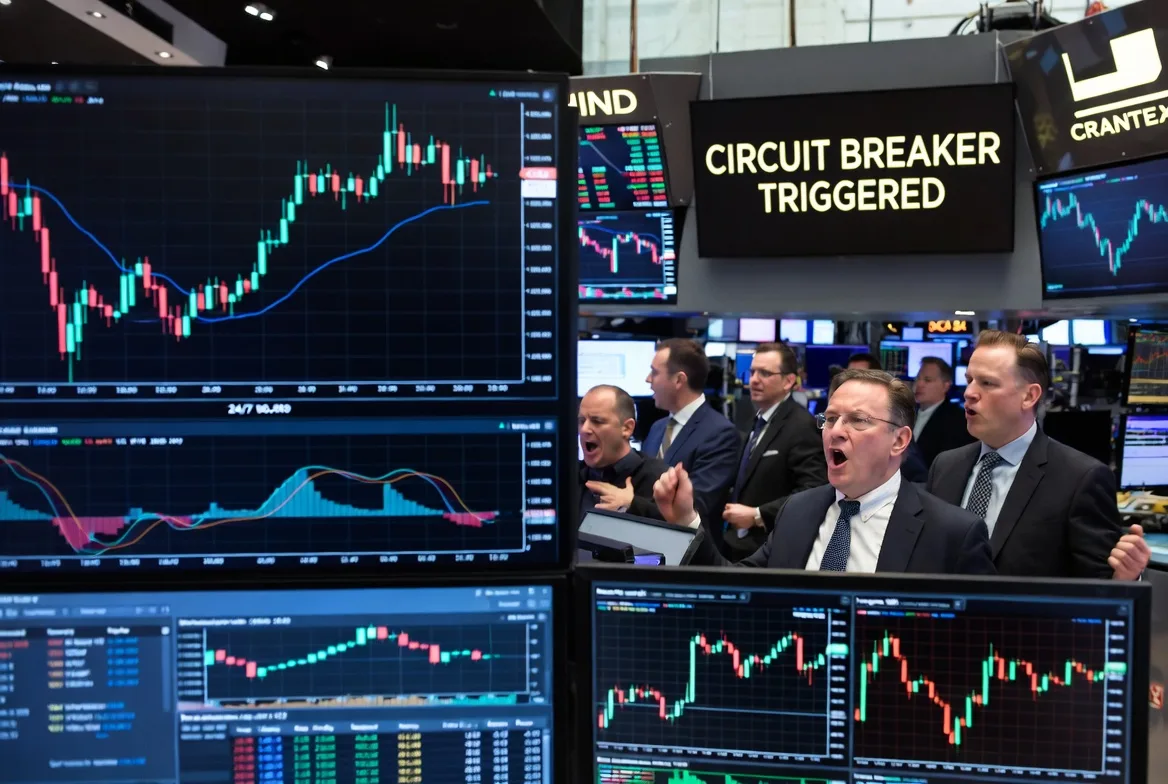
Crypto Market Crash vs. Market Correction
Corrections are just the market taking a breather. Prices pull back 10-30%, shake out traders who bought on emotion, then usually resume climbing. Happens several times each year in crypto. Think of Bitcoin at $70,000 dipping to $55,000 for a few weeks before pushing higher again.
Crashes are different animals entirely. They smash through every support level technical analysts drew on their charts. The whole narrative flips—nobody’s talking about “buying the dip” anymore. Instead, everyone’s trying to figure out if this thing’s going to zero. A correction feels temporary. Crashes feel apocalyptic.
Why does this distinction matter for your money? During corrections, patient buyers usually profit within weeks. Crashes demand a different playbook: protect capital first, maybe look for opportunities second, but only after you’re absolutely certain the knife has stopped falling (not just bouncing mid-air).
Understanding Crypto Bear Markets
Bear markets stretch out over many months—sometimes years—where prices keep grinding lower despite the occasional fake-out rally. When analysts talk about crypto bear market meaning, they’re describing both the numbers (20%+ down from peak) and the mental shift where everyone stops believing prices will recover.
Historical cryptocurrency bear cycles have lasted 12-18 months on average, though the 2018 nightmare dragged on nearly two full years. Watch what happens during these periods: trading volume dries up as regular folks leave. Media coverage turns nasty. Companies that raised $50 million selling tokens quietly disappear. Crypto conferences go from packed stadiums to hotel conference rooms. Even Twitter gets quiet—engagement drops 70% or more.
But here’s the thing: bear markets actually serve a purpose. They flush out garbage projects that never had real products. Valuations reset to levels where serious investors start accumulating. Infrastructure gets built. Ethereum spent its bear market years developing the proof-of-stake transition that eventually launched during the next cycle.
What Causes Crypto Market Crashes

Major crashes rarely spring from a single event. Instead, vulnerabilities pile up beneath the surface until one trigger breaks everything.
Government crackdowns have tanked markets repeatedly. Remember when China banned crypto mining in 2021? Bitcoin’s hash rate got cut in half within weeks, dragging prices down with it. Then you’ve got the SEC spending 2023-2024 dropping enforcement actions on exchanges and token projects, creating constant sell pressure as companies settled cases and investors worried their holdings might suddenly become illegal securities.
Exchange collapses destroy trust instantly. Mt. Gox in 2014, QuadrigaCX in 2019, FTX in 2022—each one triggered massive crashes as users realized their money was simply gone. The contagion spreads fast. If this major exchange failed, what about the others holding your coins?
Traditional economic forces now push crypto markets around. When the Federal Reserve hikes interest rates, investors dump risky assets. Early inflation fears sometimes boost Bitcoin as “digital gold,” but when liquidity gets tight, people sell everything—including crypto—to cover margin calls or pay bills. During 2022’s bear market, Bitcoin moved almost identically to tech stocks, with correlation hitting 0.8+.
Leverage wipeouts create those stomach-dropping flash crashes. Bitcoin dips 5%, which doesn’t sound terrible. But traders using 10x or 20x leverage get automatically liquidated, forcing platforms to dump their positions immediately. Exchanges like BitMEX and Binance Futures have liquidated multiple billions within minutes, accelerating crashes way past what fundamentals would justify.
Narrative collapses in one sector can poison the entire market. When algorithmic stablecoins spectacularly imploded in 2022, investors started questioning all DeFi mechanisms. NFT trading volume collapsed in 2023, making people doubt whether crypto had any real use beyond pure speculation.
Technology breaking reminds everyone this space remains experimental. The DAO hack in 2016, Poly Network exploit in 2021, various bridge hacks—these incidents prove that smart contract bugs can vaporize billions before breakfast. Code vulnerabilities aren’t theoretical risks.
Biggest Cryptocurrency Crashes in History
Looking at crypto crash history gives you perspective. Each cycle feels unique while it’s happening, but patterns repeat.
Historical Comparison of Major Crypto Crashes
| Crash Event | Peak Month | Bottom Month | BTC Peak | BTC Bottom | % Drop | What Triggered It | Months to Recover |
|---|---|---|---|---|---|---|---|
| 2018 Bear | Dec 2017 | Dec 2018 | $19,783 | $3,191 | -84% | ICO bubble popped, regulators circled | 36 months |
| COVID Panic | Feb 2020 | Mar 2020 | $10,415 | $3,858 | -63% | Pandemic fear, global liquidity crunch | 5 months |
| China Mining Ban | Apr 2021 | Jul 2021 | $64,895 | $29,796 | -54% | Chinese mining prohibition, leverage purge | 6 months |
| 2022 Meltdown | Nov 2021 | Nov 2022 | $69,000 | $15,479 | -78% | Rate hikes, Terra/Luna death spiral, FTX fraud | 14 months |
| ETF Hangover | Mar 2024 | Aug 2024 | $73,750 | $49,217 | -33% | Profit-taking after ETF launch, Mt. Gox payouts | 7 months |
The 2018 crash followed absolute mania in the ICO market. Thousands of projects raised billions by publishing whitepapers with zero working products. When regulators started paying attention and investors realized most tokens were worthless, everything collapsed. Bitcoin dropped 84%. Most altcoins? Down 95% or worse.
The March 2020 COVID crash proved crypto still moves with traditional markets during real panic. As stocks worldwide tanked, Bitcoin fell 63% in days. This turned out to be the shortest bear market ever recorded, though—institutional interest and massive government stimulus drove prices back up fast.
May 2021’s crash combined China’s mining ban with an overleveraged market sitting on $25+ billion in futures open interest. Prices started falling, cascading liquidations accelerated everything, and the ban made people question whether governments could actually kill decentralized networks.
The 2022 bear market compounded disaster upon disaster. Terra/Luna vaporized $40 billion in May. Celsius, Voyager, and Three Arrows Capital all failed over summer. Then FTX imploded in November, destroying another $8 billion while its founder got arrested for fraud. Trust in centralized exchanges basically evaporated.
The 2024 correction followed Bitcoin ETF approvals—which many people assumed would prevent future crashes. Instead, after initial inflows pushed prices to all-time highs, profit-taking started. Then Mt. Gox creditors finally received their Bitcoin after waiting a decade, adding sell pressure that exposed overleveraged positions once again.
Warning Signs of an Incoming Crypto Crash
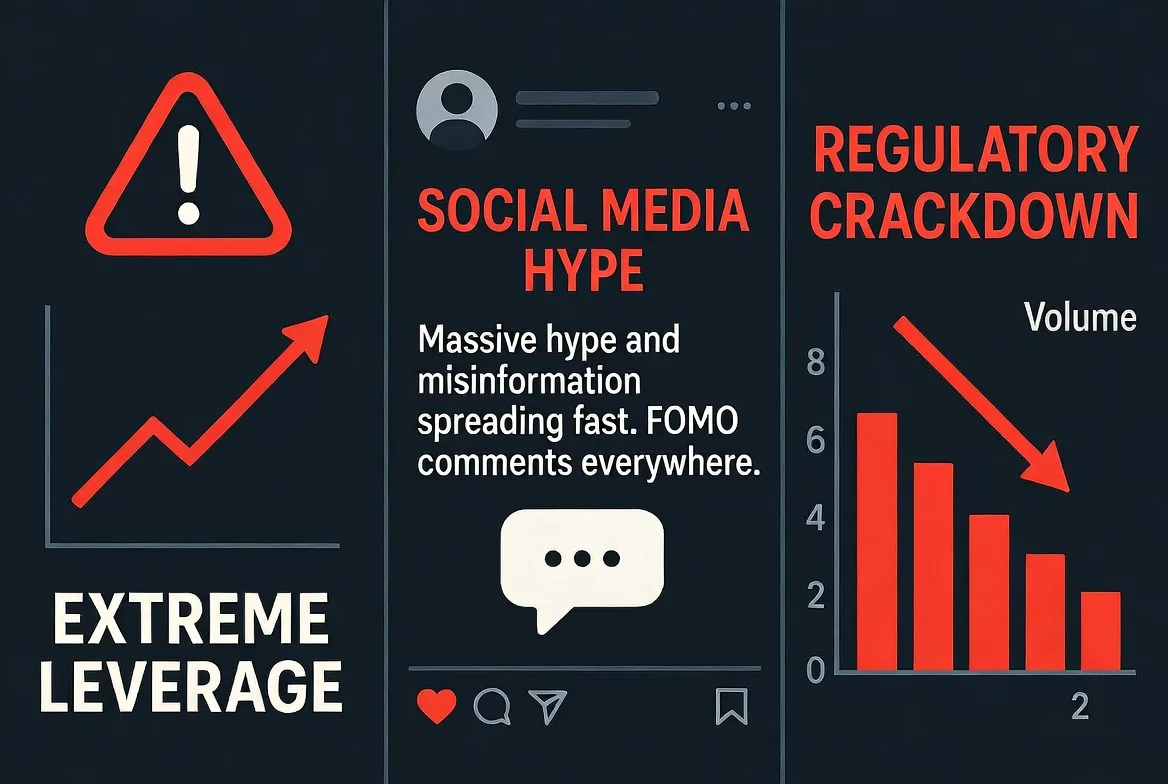
You can’t time crashes perfectly. But certain crypto crash warning signs show up before most major downturns.
Extreme leverage appears in futures data. When open interest climbs above 30% of Bitcoin’s total market cap and funding rates stay elevated for weeks straight, a liquidation cascade becomes probable. Traders paying 50-100% annually just to keep long positions open? That’s unsustainable speculation.
Absurd price predictions flood your Twitter feed at market tops. When analysts with millions of followers confidently guarantee “$500K Bitcoin by December” based on models that ignore changing conditions, retail FOMO has peaked. The shift from cautious optimism to absolute certainty signals danger ahead.
Regulatory noise intensifies when crypto gets too visible. Politicians don’t notice crypto during quiet bear markets. They schedule hearings, propose new laws, and launch enforcement actions when prices soar and their constituents start asking questions. This timing often coincides with market peaks.
Volume declining while prices stay flat or rise suggests weakening conviction. If Bitcoin hovers around $60,000 but daily volume drops 40% over several weeks, fewer participants are willing to support current prices. Small sell orders can suddenly move the market.
Moving with stocks eliminates crypto’s appeal as an uncorrelated asset. When Bitcoin tracks Nasdaq tick for tick, what’s the point? If traditional markets enter a downturn, crypto typically amplifies the damage.
Social media shifts from discussing technology and real-world adoption to pure price talk and get-rich-quick schemes. When your uncle asks how to buy Dogecoin at Thanksgiving dinner, the top’s probably in. Conversely, when crypto Twitter goes silent and engagement craters, bottoms are forming.
Here’s a practical rule: if taking profits feels impossible because prices “obviously can’t go down from here,” that feeling IS the warning sign. Markets crash when selling feels unthinkable.
How to Protect Your Portfolio During a Crypto Crash
Surviving downturns requires preparation before crashes happen, not improvising during them.
Risk Management Strategies
Position sizing trumps everything else. The cardinal rule in crypto? Only put in what won’t ruin your life if it goes to zero. A reasonable framework for moderate risk tolerance: 5-10% of net worth. Conservative investors might do 1-3%. Aggressive younger investors with decades ahead could push 15-20%.
Diversification within crypto means holding Bitcoin, established altcoins with actual usage (Ethereum, Solana), and stablecoins—not gambling on 20 microcap tokens. Real diversification means maintaining stocks, bonds, real estate, and cash outside crypto entirely.
Stop-losses work fine in traditional markets but can backfire in crypto’s nonstop trading environment. A 20% stop-loss might get triggered by typical weekend volatility, auto-selling your position hours before Monday’s recovery. Mental stops—predetermined prices where you’ll reassess, not auto-dump—often work better.
Keeping stablecoins gives you flexibility. Converting 25-50% of holdings to USDC or USDT when markets feel euphoric preserves buying power for crashes. The tradeoff? You might exit too early and miss gains. The benefit? You’ve got ammunition when assets go on sale.
Resisting panic sales requires mental preparation. Write down your investment thesis and target prices when you’re calm. During crashes, review those notes instead of obsessively checking prices. If the thesis still holds and you don’t urgently need the cash, riding out volatility beats selling at the bottom.
The investors who survive crypto bear markets aren’t necessarily the smartest—they’re the ones who sized positions appropriately, maintained liquidity, and had the emotional fortitude to separate price volatility from fundamental value.
Lyn Alden
Dollar-Cost Averaging Through Volatility
DCA means buying fixed dollar amounts on schedule regardless of price. It removes emotion from timing. Buying $500 weekly through a crash automatically gets you more Bitcoin at $20,000 than at $60,000, lowering your average entry price.
This approach demands long-term thinking. DCA through the 2018 bear market set investors up for massive 2021 returns. DCA through 2022 positioned people perfectly for 2024-2025’s recovery. The discipline required is substantial—you’re buying while prices crater and media declares crypto dead.
A hybrid approach combines scheduled DCA with tactical additions. Maintain your weekly $500 buys, but keep extra capital ready for extreme dips. Bitcoin drops 40% in a week? Deploy additional funds. This balances systematic investing with opportunistic flexibility.
Crypto Market Recovery Timelines and Patterns

Historical data shows cryptocurrency bear cycles typically bottom 12-18 months after the peak, with full recovery to previous highs taking 24-36 months total. Each cycle has its own personality, though.
The 2018 bear market bottomed in December 2018, exactly 12 months after the peak. Bitcoin didn’t reclaim its $20,000 high until December 2020—a full 36-month recovery cycle. Investors who bought the $3,200 bottom still needed patience.
The 2020 COVID crash was weird—a 63% collapse that recovered in just five months, fueled by unprecedented money printing and institutional adoption narratives. This abnormally fast bounce created false expectations that future crashes would also reverse quickly.
The 2022 bear market followed more typical patterns. Prices bottomed in November 2022, roughly 12 months after peaking. Recovery to new highs took until early 2024—about 27 months total.
Bitcoin halving cycles offer a framework (not a guarantee) for market timing. Halvings happen roughly every four years, cutting new Bitcoin supply in half. Historically, bull markets have peaked 12-18 months post-halving, followed by bear markets, then accumulation phases building into the next halving.
The 2024 halving happened in April. Following historical patterns (which may not repeat), this suggests a potential peak in late 2025 or early 2026, though macroeconomic factors and institutional adoption could break traditional cycles.
What influences recovery speed:
- Institutional money: More professional investors may reduce volatility and speed recoveries as they deploy capital strategically instead of emotionally.
- Regulatory progress: Clear rules let institutional money enter confidently. The 2024 Bitcoin ETF approvals showed how regulatory progress supports price recovery.
- Economic conditions: Low rates and money printing fuel crypto rallies. Tight monetary policy extends bear markets.
- Technology milestones: Major upgrades like Ethereum’s merge or Bitcoin’s Taproot adoption can spark renewed interest.
When does crypto recover? The frustrating truth: when weak hands have finished selling, when leverage is completely flushed, when all the bad news is priced in, and when new catalysts appear. Bottoms form precisely when selling feels most logical and buying feels insane.
FAQs
The acute selling phase—the actual crash—usually runs 2-6 weeks, though aftershocks and subsequent lows can continue for months. The complete bear market from peak to absolute bottom averages 12-18 months, with recovery to previous all-time highs requiring another 12-24 months. The 2018 bear market lasted 24 months peak-to-peak, while 2020’s COVID crash recovered within five months. You need patience; attempting to catch exact bottoms usually means either buying too early multiple times or sitting in cash forever waiting for perfect entry.
Depends entirely on your circumstances. Did you overextend? Need money for emergencies? Invest rent money? Then selling—even at a loss—might be necessary. But if you sized positions appropriately and your original investment thesis still holds, selling during crashes just locks in losses and usually means missing the eventual recovery. Tax-loss harvesting (selling at a loss to offset taxable gains) can make strategic sense, but emotional panic selling rarely works out. Consider your timeline, personal risk tolerance, and whether fundamentals changed or just the price.
Not quite. A crash is a rapid, severe drop—like Bitcoin plunging 40% in two weeks. A bear market is a prolonged period of declining prices and negative sentiment lasting months or years. Crashes can happen within bull markets (May 2021) or kick off bear markets (November 2021). All bear markets involve major price declines, but not every crash leads to extended bear markets. This distinction matters for strategy: crashes might offer buying opportunities if you’ve got cash ready, while bear markets require patience and capital preservation first.
Timing crashes with precision is impossible, but warning signs can raise your probability estimates. Extreme leverage, parabolic price moves, regulatory threats, and euphoric sentiment frequently precede crashes. However, markets can stay irrational way longer than you can stay solvent—Bitcoin might flash warning signs at $50,000, then rally to $70,000 before finally crashing. Managing risk matters infinitely more than predicting. Reduce exposure when warning signs multiply, but accept you’ll probably miss some upside. Predicting the exact top matters less than surviving the bottom with capital intact.
Scale and duration separate them. Corrections are routine 10-30% pullbacks lasting days to weeks before the uptrend resumes. Markets need corrections to stay healthy. Crashes involve 40-50%+ declines, demolish major support levels, flip sentiment from bullish to bearish, and often signal bull markets ending. Corrections represent normal volatility; crashes represent structural breaks. Practically speaking, corrections reward buying dips. Crashes punish it—until they’re actually over, which you can only confirm in hindsight. The 2024 summer decline of 33% fell somewhere between these categories, showing how the line blurs.
Cryptocurrency market crashes aren’t bugs to eliminate—they’re permanent features of an immature, volatile asset class. Understanding what triggers these downturns, recognizing warning signs early, and implementing robust risk management transforms crashes from portfolio-destroying catastrophes into potential opportunities for prepared investors.
Historical evidence shows crypto markets have recovered from every previous crash, though recovery timelines vary wildly based on economic conditions, regulatory developments, and technological progress. Investors who thrive across multiple cycles share key traits: appropriate position sizing, emotional discipline, genuinely long time horizons, and the ability to separate temporary price action from long-term fundamental value.
Another crash is coming—maybe tomorrow, maybe in 2027 after another euphoric bull run. Your portfolio’s survival won’t depend on predicting when. It depends on preparing how. Keep some liquidity available. Avoid excessive leverage like your financial life depends on it (because it does). Diversify appropriately across and beyond crypto. Remember that in markets running 24/7 without breaks, fortunes get built by those who withstand the volatility that washes everyone else out.