
Cryptocurrency exchanges depend entirely on market makers. Take them away, and you’re left with order books that look like Swiss cheese—gaping holes where traders expect liquidity, spreads wide enough to drive a truck through, and price swings that scare away everyone except the most risk-hungry speculators.
Here’s what a crypto market making strategy actually entails: You’re placing limit orders on both the buy and sell sides, creating a two-way market. Your profit? The gap between what you’ll pay and what you’ll sell for. Unlike traders betting on Bitcoin hitting $100K or crashing to $20K, market makers don’t care much about direction. They’re after transaction volume, making pennies per trade while others chase dollars.
Bitcoin’s early days featured primitive market making—maybe a few enthusiasts manually entering orders. Fast-forward to today, and you’ll find algorithmic systems firing off thousands of orders per second, managing positions across a dozen exchanges simultaneously, adjusting prices faster than you can blink. Yet strip away the technology, and the core idea hasn’t changed: stand ready to trade when nobody else will, keep your inventory balanced, and extract value from the spread.
What Is Market Making in Crypto
Think of market makers as the liquidity layer between buyers and sellers. They’re simultaneously posting buy orders below market price and sell orders above it. Someone wants to dump 50 ETH immediately? The market maker steps in. Another trader wants to buy 100 ETH right now? Same story—the market maker sells to them.
Traditional stock markets formalized this role decades ago. The New York Stock Exchange assigned designated market makers to specific stocks, giving them obligations and privileges. Crypto borrowed the concept but stripped away most formal requirements. Most crypto market makers choose their own assets, set their own spreads, and pull liquidity whenever they want. Exchanges sweeten the deal by offering maker rebates—actually paying you a tiny fee when your order sits in the book waiting for someone else to take it.
What is market making in crypto at its most fundamental? It’s the gap between the bid (highest buying price) and ask (lowest selling price). Say Ethereum shows $3,000 bid and $3,008 ask. That $8 spread is where market makers live. Buy at $3,000, sell at $3,008, pocket the difference. Repeat this a few hundred times daily, and those $8 increments add up.
Liquidity provision crypto style varies wildly depending on venue type. Centralized platforms like Coinbase work with professional market making firms under formal arrangements. Decentralized exchanges? They’ve invented automated market makers—smart contracts replacing human decision-making—or incentivize regular users to deposit token pairs. Different mechanics, same goal: ensuring someone can always execute a trade without the price cratering or spiking.
Where market makers differ from typical traders: they’re quoting both sides constantly. A normal trader might place one buy order at $3,000 and call it a day. Market makers simultaneously maintain that $3,000 buy order AND a $3,008 sell order, updating both every few seconds as prices shift. This non-stop presence creates the order book depth that prevents whale trades from causing 5% price moves.

How Crypto Market Makers Work
Picture this: You’ve got capital spread across five exchange accounts. Your software is monitoring price feeds, analyzing volatility, checking order book depth, calculating optimal bid and ask prices twenty times per second. When Bitcoin ticks up $10 on Binance, your algorithm immediately reprices quotes on Kraken, Coinbase, Bitfinex, and everywhere else you operate. Fall behind even 200 milliseconds, and arbitrage traders will pick off your stale orders for easy profit.
Modern operations run almost entirely on automation. How crypto market makers work today involves connecting to exchange APIs—think of them as direct phone lines to the trading engine—receiving microsecond-level order book updates, and executing decisions before human reaction time even registers what happened.
Here’s the liquidity provision process broken down: Your system identifies BTC/USDT on Binance showing reasonable volume and acceptable volatility. It calculates you can profitably quote $49,995 bid and $50,005 ask—a $10 spread. Orders go live. Someone sells 0.5 BTC into your bid at $49,995. Now you’re long 0.5 BTC. Your system immediately adjusts, maybe tightening the ask to $50,003 to encourage someone to buy from you quickly and flatten your position. Maybe ten seconds later, someone does. You’ve captured most of that spread, and you’re back to neutral inventory.
The nightmare scenario? You sell 10 BTC at $50,005, but only manage to buy back 6 BTC before the price jumps to $51,000. You’re short 4 BTC, and that position just cost you $4,000 in paper losses—probably wiping out a week of spread profits. Managing inventory represents the single biggest operational challenge in this business.
Understanding Bid-Ask Spreads and Profit Models
Spread width in crypto markets varies more than you’d expect. BTC/USDT on Binance during normal New York trading hours? You might see 0.02% spreads—that’s $10 on a $50,000 Bitcoin. Switch to some random altcoin with $100K daily volume, and spreads can blow out to 2% or wider. Market makers gravitate toward assets where that spread width compensates for the headaches and risks involved.
The basic math looks simple: buy at $50,000, sell at $50,010, bank $10 per coin. Reality gets messy fast. Sometimes you buy but can’t find a seller at your ask before the market drops $20. Exchange fees nibble at every transaction. And you’re holding inventory—actual Bitcoin sitting in your account—that can appreciate or depreciate while you’re trying to stay neutral.
Exchange rebates change the profitability equation dramatically. Plenty of venues will pay you 0.02% for every limit order that another trader executes against. You’re already earning $10 from the bid-ask spread crypto transactions. Now add another $10 in rebates. That’s a 100% improvement in gross profit per trade. These incentive programs explain why professional firms maintain operations on pairs where spread profits alone wouldn’t justify the effort.
Market conditions dictate spread strategy. Calm Tuesday afternoon? Tighten spreads to 0.03%, accept smaller per-trade margins, chase higher volume. Then Thursday afternoon, Elon tweets something stupid about Bitcoin, volatility doubles in five minutes, and you’re immediately widening to 0.15% spreads. That wider buffer protects you when prices swing $500 in thirty seconds.
Market Depth and Order Book Dynamics
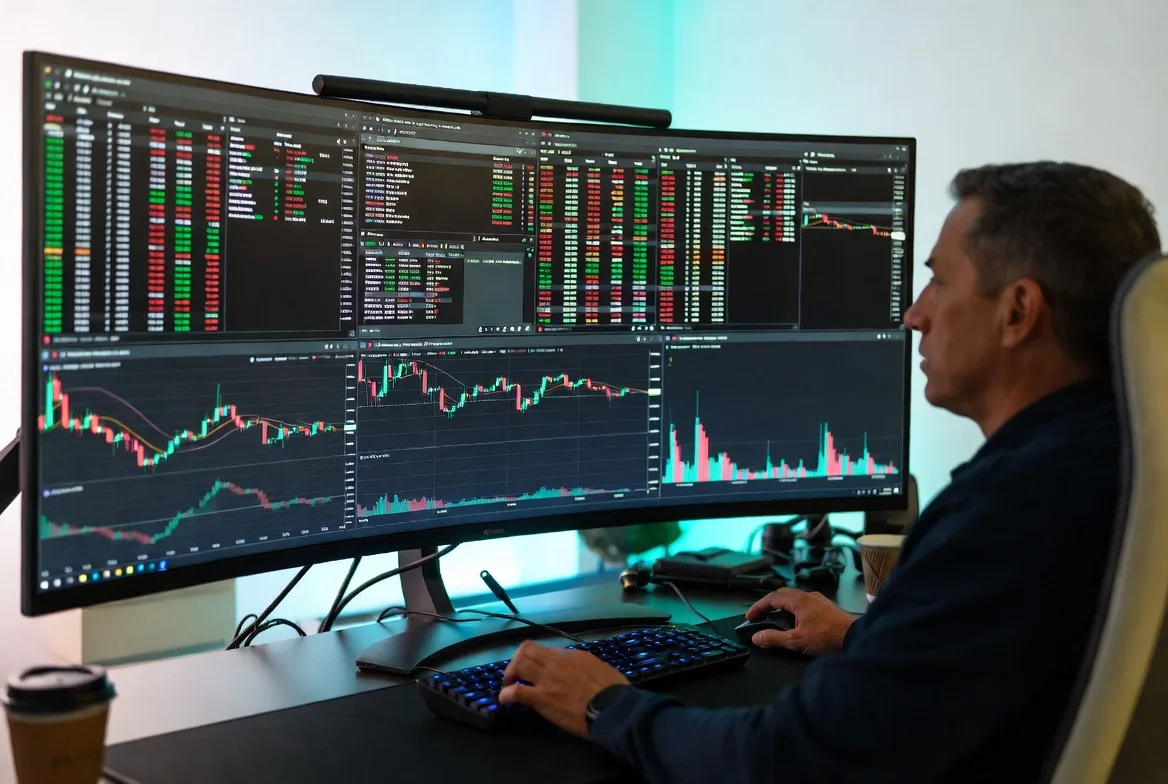
Crypto market depth measures how much trading volume the order book can absorb without prices going haywire. Deep markets let institutions dump $10 million in Bitcoin without causing more than a 0.5% price move. Shallow markets? Someone selling $500K might crater the price 3%. Market makers build that depth by layering orders at multiple price points, not just the best bid and ask.
Real-world example: You might place 0.5 BTC bid at $50,000, another 1.0 BTC at $49,975, and 2.5 BTC at $49,950. Your asks mirror this—0.5 BTC at $50,010, 1.0 BTC at $50,035, 2.5 BTC at $50,060. Someone comes in and sells 4 BTC into your bids? You’re acquiring inventory, sure, but at progressively more favorable prices as they chew through your levels. Your average purchase price might be $49,970 instead of paying $50,000 for everything.
Order books shift every second as market makers react to new information. Large buy order fills on Coinbase? Everyone reprices within milliseconds. Fed chairman mentions inflation in a press conference? Spreads widen across every exchange as market makers protect themselves against informed traders who might know something they don’t.
Balancing depth against volatility creates constant tension. Posting size at ten different price levels provides excellent liquidity and stabilizes markets—but you’ve got a ton of capital at risk. Pull most of that liquidity to reduce exposure, and you’re safer but less competitive and earning less. Most operations adjust this dial continuously, adding depth when markets calm down and yanking it during chaos.
Types of Crypto Market Making Strategies
Passive versus active, manual versus algorithmic—crypto market making strategies span a wide range. Your capital, risk tolerance, technical skills, and target markets determine where you fit. Professional firms often run multiple strategies simultaneously, treating crypto market making like a portfolio approach.
| Strategy Type | Approach | Risk Level | Capital Requirements | Profit Potential | Best For |
|---|---|---|---|---|---|
| Passive Market Making | Set wide spreads, rarely adjust orders, avoid inventory risk | Low | Moderate ($50K-$500K) | Steady but limited | Newcomers, lower-risk appetite, illiquid tokens |
| Active Market Making | Tight spreads, constant rebalancing, high trade frequency | Medium-High | Substantial ($500K-$5M+) | Better but inconsistent | Experienced operators, liquid pairs, competitive markets |
| Algorithmic Market Making | Fully automated, multi-exchange, statistical models | Medium-High | High ($1M-$10M+) | Maximum potential | Professional teams, tech infrastructure, HFT operations |
Passive Market Making Strategy
Passive market making strategy prioritizes not losing money over maximizing returns. You’re setting spreads maybe 1-3% on each side—comfortably wide—and leaving orders alone for hours or even days at a time. Inventory imbalances don’t trigger immediate panic and rebalancing. It’s a more relaxed approach.
This works beautifully on smaller altcoins where natural spreads already run wide. Some DeFi token trades with typical 3% spreads? You can comfortably sit at 1.5% on each side, capturing decent value per fill while maintaining substantial price buffers. Plus, fewer competitors are fighting for those orders compared to BTC/USDT on Binance.
Capital efficiency takes a hit with passive approaches. Wide spreads mean you’re not filling orders constantly. You might allocate $100K but only execute fifteen trades in a day, whereas active market makers with the same capital hit triple-digit daily volume. The tradeoff: you’re sleeping better at night and not chained to your monitoring screens.
Risk management becomes almost trivial. Those wide spreads naturally protect against small-to-medium price moves. You cap inventory at reasonable levels—say, never more than 20% of your capital in any single asset. Manual oversight works fine since you’re adjusting orders maybe once an hour, not ten times per second. This accessibility makes passive strategies attractive for individuals testing the waters without quitting their day jobs.
Active Market Making and Algorithmic Approaches

Active market making crypto operations are competitive warfare. You’re maintaining spreads of 0.05% or tighter, updating quotes multiple times per second, fighting for every order against a dozen other firms doing exactly the same thing. High-volume pairs become the battleground—BTC/USDT, ETH/USDT, major stablecoin pairs—where thin margins get multiplied across massive daily volume.
Algorithmic market making deploys quantitative models for everything. Machine learning algorithms try predicting price movement in the next five seconds. Statistical models identify when related assets drift apart, letting you capture additional alpha beyond basic spread collection. These aren’t simple “if-then” rules—they’re sophisticated mathematical frameworks continuously learning and adapting.
Technology demands escalate exponentially. Co-located servers sitting physically next to exchange infrastructure, minimizing network latency to sub-millisecond levels. Custom software monitoring forty data feeds at once, making complex decisions in microseconds. Redundant internet connections, backup servers, failsafe mechanisms—because a crashed system can hemorrhage money faster than you’d believe. One firm’s server goes down for sixty seconds? They might face $50K in adverse selection losses as the market moves against their orphaned orders.
Competition intensity on major pairs has crushed margins. Twenty professional firms competing to show the tightest BTC/USDT spread creates situations where you’re earning 0.015% per trade—maybe $7.50 per Bitcoin at $50K. Only profitable when you’re trading millions daily. That scale requirement explains the consolidation you see—small operations can’t compete, and active market making becomes the domain of well-funded professional firms with serious technology budgets.
How Market Makers Profit in Crypto Markets
Revenue streams for market maker profit crypto operations extend beyond simply buying low and selling high. Diversifying income sources stabilizes performance when one area underperforms—and different market conditions favor different profit centers.
| Profit Source | How It Works | Typical Margin/Return | Frequency |
|---|---|---|---|
| Spread Capture | Buying low, selling high repeatedly | 0.01%-0.5% each round trip | Every few seconds to minutes |
| Exchange Rebates | Venues pay for posted liquidity | 0.01%-0.03% each fill | Per transaction |
| Statistical Arbitrage | Finding temporary mispricings | 0.1%-0.5% per opportunity | Several times hourly |
| Inventory Appreciation | Holding appreciating assets | Highly variable, sometimes exceeds spread income | Depends on market trends |
| Payment for Order Flow | Exchanges pay for volume commitments | Negotiated rates, significant for large volume | Monthly or quarterly agreements |
Trading spreads forms the bedrock revenue source. Move $100 million in daily volume with an average 0.05% capture rate, and you’re generating $50K gross daily. Subtract exchange fees, infrastructure costs, and operational overhead—figure net margins of 25-35% for tight operations. Volume becomes everything. Double your daily turnover without proportionally increasing costs, and profits nearly double.
Exchange incentive programs add meaningful income. Some platforms offer up to 0.03% rebates on maker orders. You’ve captured $10 from the spread; add another $15 in rebates, and you’ve improved gross profit 150%. Market makers often operate on pairs where spread profits barely justify it, specifically to hit volume thresholds that unlock better rebate tiers across their entire operation.
Arbitrage surfaces from temporary inefficiencies. Bitcoin trades at $50,000 on Binance but $50,060 on Kraken? Simultaneously buy Binance, sell Kraken, lock in $60 per coin with near-zero directional risk. These opportunities evaporate in seconds—you need automated systems and pre-positioned capital on multiple exchanges to capitalize. But they’re essentially free money when you catch them.
Inventory occasionally generates windfalls. Hold 10 BTC through a rally from $50K to $55K, and you’ve pocketed $50K beyond spread income. Of course, that same position loses $50K in the opposite direction. Professional operations treat inventory gains as bonuses rather than reliable income streams, always working back toward neutral positioning.
Most market makers who disappear do so after volatility events, not during normal operations. The survivors aren’t necessarily running the fastest systems or tightest spreads. They’ve built risk frameworks robust enough to keep them in the game when everyone else is blowing up their accounts.
Michael Chen, Head of Trading
Risks and Challenges in Crypto Market Making
Market making risks in cryptocurrency far exceed traditional finance. Why? Markets never close. Volatility makes stock market swings look tame. Liquidity fragments across hundreds of exchanges. Regulations remain murky in most jurisdictions. Understanding what can go wrong helps you prepare safeguards before deploying capital.
Inventory risk towers above everything else. Hold 50 BTC when the price drops 15%? At $50K per Bitcoin, that’s $375K in losses—enough to wipe out six months of spread profits in a single day. Position limits help (maybe cap yourself at holding no more than 10-15% of typical daily volume). Hedging strategies provide some protection. Dynamic inventory management—aggressively rebalancing when positions drift—becomes essential. But eliminating inventory risk entirely while maintaining meaningful operations? Impossible.
Volatility exposure intensifies during stress. You’re running comfortable 0.05% spreads during a quiet Sunday morning. Then some exchange announces they’re insolvent, and Bitcoin drops 8% in ninety seconds. Prices gap straight through your limit orders, leaving you long 100 BTC at $50K when the market’s already at $46K. The solution involves volatility-responsive algorithms that automatically widen spreads when market conditions deteriorate—but this also means earning less during the most active, potentially profitable periods.
Adverse selection happens when informed traders systematically trade against you before price moves. Someone knows Bitcoin’s about to jump because they’ve spotted massive buying pressure on derivatives markets? They’ll buy from your $50,010 ask thirty seconds before the rally starts, leaving you short before Bitcoin hits $50,500. Sophisticated operations use predictive signals to detect suspicious patterns—unusual order flow, correlated activity across markets, execution timing—and widen spreads or reduce size when something feels off.
Technology failures pose existential threats in automated systems. Software bugs might place orders at prices 10% away from the market, losing massive capital instantly. I know a trader whose decimal point error cost $80K in about fifteen seconds. Network connectivity drops can strand orders in the market while preventing position management. Exchange API failures happen more often than anyone admits. DDoS attacks, infrastructure outages, power failures—any of these can blow up a market making operation. Redundant systems, extensive testing, and manual kill-switches provide partial protection, never complete safety.
Regulatory concerns shift depending on where you operate and how you structure operations. Some countries classify market makers as financial institutions, imposing capital requirements and compliance costs that make smaller operations uneconomical. Others maintain ambiguous or rapidly changing rules. Tax treatment varies—high-frequency trading profits face different rates in different jurisdictions. Market makers need legal counsel familiar with crypto regulations in every jurisdiction they touch.
Exchange counterparty risk represents a uniquely crypto problem. Centralized exchanges can freeze withdrawals, suffer hacks, or go bankrupt, trapping your capital. FTX’s collapse in 2022 stranded billions in customer funds, including many market maker positions. Diversifying across venues reduces concentration risk but multiplies operational complexity. Due diligence on exchange security, financial health, and regulatory compliance becomes mandatory for capital preservation.
Getting Started with Market Making in Crypto
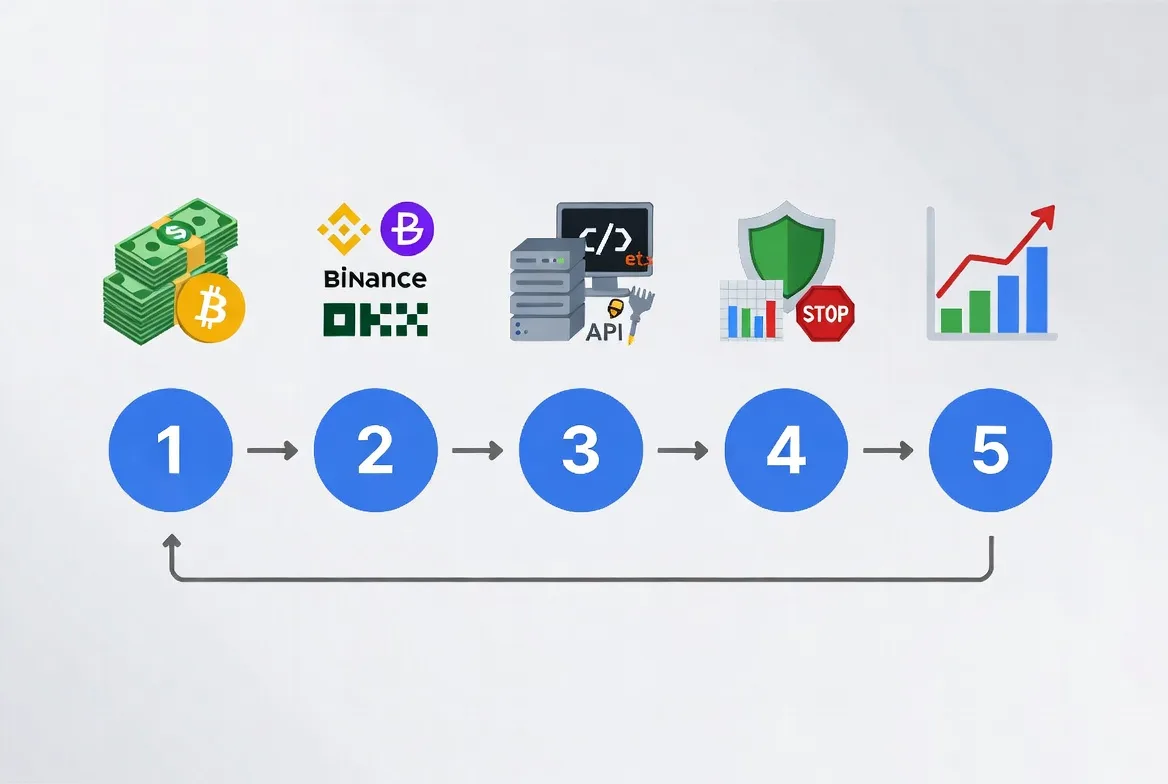
Launching a crypto market making strategy demands preparation across capital, technology, exchange relationships, and risk controls. Jump in unprepared, and experienced participants will exploit every weakness, evaporating your capital faster than seems possible.
How much do you need? Depends entirely on approach and targets. Passive strategies on smaller altcoins might start around $50K-$100K, though returns at this scale won’t replace your salary. Active approaches on major pairs require $500K minimum to achieve meaningful volume and survive inevitable drawdowns. Professional algorithmic operations typically deploy several million dollars to justify technology investments and compete effectively against other firms.
Starting smaller for educational purposes makes perfect sense. Allocate $10K-$25K purely for learning—tuition paid to the market. Experiment with order placement, test inventory management approaches, optimize spread calculations. Expect losses during this phase. You’re buying experience that no amount of reading provides.
Technology spans from simple to complex. Complete beginners might manually enter orders through exchange web interfaces, though you’ll never compete effectively this way. Open-source platforms like Hummingbot deliver algorithmic capabilities without custom development—good middle ground for individuals or small teams. Professional firms build proprietary systems tailored to specific strategies, requiring engineering teams and ongoing development.
Choosing exchanges impacts profitability substantially. Major venues offer deep liquidity and attractive rebates but intense competition from professional firms. Smaller exchanges provide wider spreads and fewer competitors but lower volume and higher counterparty risk. Most market makers operate on three to six exchanges simultaneously, balancing opportunity against complexity. Formal market maker agreements with exchanges can unlock better rebates, dedicated technical support, and preferential API access.
Risk management frameworks must exist before deploying meaningful capital. Position limits prevent overexposure—common rules cap inventory at 10-20% of that asset’s daily trading volume on the exchange. Stop-loss mechanisms automatically flatten positions when losses exceed predetermined thresholds. Daily profit/loss limits pause trading after hitting targets (either positive or negative) to prevent emotional decisions from compounding problems.
Ongoing monitoring separates survivors from casualties. Review fill rates daily—are you executing often enough to justify your capital deployment? Check spread capture—are you actually earning what you expected? Analyze inventory turnover—how long does capital sit in positions versus actively trading? Market conditions change constantly. Spreads that worked three months ago might be completely uncompetitive today. Continuous optimization based on actual results drives long-term success.
FAQs
Depends where you live and how you structure operations. United States? Market makers operating as businesses often register as money services businesses (MSBs) with FinCEN. Some states require money transmitter licenses depending on your specific activities. Individuals trading personal capital face fewer regulatory requirements, though tax obligations apply universally to all profits. Europe operates under MiFID II frameworks—you might need authorization depending on scale and whether you’re servicing clients. Singapore requires capital markets services licenses for professional operations. Countries like China have essentially prohibited crypto trading, making market making legally problematic. Consult legal counsel familiar with crypto regulations in your specific jurisdiction before starting operations, because the wrong structure can create massive liability.
Depends on your goals and strategy type. Want to experiment and learn? You can start with $5K-$10K, though profitability at this scale is basically impossible. Passive market making strategy approaches on smaller altcoins become realistic around $50K-$100K, generating maybe $500-$2,000 monthly if you execute competently. Active strategies on major pairs need $500K-$1M minimum to compete effectively against professional firms and survive volatility. Professional algorithmic operations typically require $5M or more to justify technology investments and achieve institutional returns. Starting with insufficient capital for your chosen strategy typically results in poor diversification, inability to weather normal drawdowns, and competitive disadvantages that prevent profitability. Better to start small with appropriate strategies than undercapitalize an approach that demands more.
Market makers provide two-sided liquidity continuously, earning from transaction flow regardless of price direction. Traditional traders take directional bets—buying when they expect appreciation, selling when they anticipate declines. Inventory positioning differs fundamentally: market makers aim for neutral exposure, while traders intentionally build long or short positions. Profit sources diverge—market makers earn from spreads and rebates, traders from correctly predicting price movements. Risk profiles are completely different. Market makers face inventory risk and adverse selection; traders face directional market risk. Many market makers incorporate some directional positioning, but the core difference remains between facilitating transactions versus speculating on outcomes.
Absolutely, though it’s gotten tougher as the industry matures. Barriers have dropped significantly—you’ve got accessible technology platforms and lower capital requirements on many exchanges. But you’re competing against well-funded firms with faster systems, lower costs, and years of experience. Realistic expectations matter enormously. Individual market makers typically focus on smaller altcoins or niche pairs where professional firms don’t bother competing. Returns might be modest initially—figure a few percentage points monthly on deployed capital if you’re doing well. Many successful individual operators start part-time while maintaining other income, gradually scaling as expertise and capital grow. Can you compete on BTC/USDT spreads against Jump Trading or Jane Street? No. Can you carve out profitable niches on smaller pairs? Definitely possible with preparation and persistence.
Technology stack varies by sophistication level. Exchange APIs provide automated order placement and real-time data access—essentially direct connections to trading engines. Market making software ranges from platforms like Hummingbot (open-source, accessible) to proprietary systems custom-built for specific strategies. Real-time data feeds deliver order book information, trade history, and analytics. Risk management platforms monitor positions, calculate exposures, enforce limits before you blow up your account. Charting and analysis tools help identify opportunities and optimize approaches. Communication tools coordinate with exchange support and sometimes other market participants. Infrastructure includes co-located servers for minimal latency (if you’re competing on speed), redundant internet connections, backup systems for when primary infrastructure fails. Professional operations often build entire custom technology stacks tailored to their specific requirements and strategies.
Running a successful crypto market making strategy combines financial knowledge, technical execution, and operational discipline. You’re providing essential liquidity while capturing bid-ask spreads—sounds simple until you’re managing inventory through 20% price swings at 3 AM on a Sunday.
The field has professionalized dramatically. What started as individuals manually entering orders has evolved into algorithmic systems executing thousands of trades per second across global venues. Success requires more than understanding buy-low-sell-high mechanics. Effective inventory management prevents catastrophic losses. Robust risk controls keep you alive during volatility spikes. Appropriate technology infrastructure maintains competitiveness. Continuous optimization responds to changing market conditions.
Aspiring market makers should expect a learning curve measured in months, not weeks. Start modestly on less competitive pairs—some DeFi token with $200K daily volume beats jumping straight into BTC/USDT against professional firms. Scale gradually as expertise develops and capital grows. Whether you’re testing this individually or building a professional operation, core principles remain constant: provide liquidity where others won’t, manage risks obsessively, and extract value from willing buyers meeting willing sellers.
Crypto market making will keep evolving as markets mature, regulations clarify, and technology advances. Those who adapt while maintaining disciplined risk management will find ongoing opportunities in digital asset market growth. Those who don’t will become cautionary tales about what happens when you underestimate the complexity.