
Picture this: You’re controlling $100,000 worth of Bitcoin exposure while risking just $5,000 of actual capital. That’s the power—and peril—of crypto futures, a market where derivatives trading now regularly hits triple-digit billions in daily turnover across platforms worldwide.
Back in December 2017, when CME and Cboe launched the first regulated Bitcoin futures, most people thought derivatives were just Wall Street games. Fast forward to today, and you’ll find perpetual swaps dominating crypto trading volume, sometimes eclipsing spot market activity. Retail traders in Thailand, hedge funds in Connecticut, and mining operations in Kazakhstan all use these instruments for wildly different purposes.
Here’s what catches newcomers off guard: futures aren’t just “Bitcoin with leverage.” You’re dealing with margin calls that can hit at 3 AM. You’re paying funding rates three times daily. Your position can get liquidated while you’re in the shower if volatility spikes unexpectedly. Get these mechanics wrong, and a promising 15% price move in your favor still leaves you with an empty account.
This guide unpacks exactly how crypto futures actually operate—not the sanitized marketing version, but what really happens when you’re managing leveraged exposure in 24/7 markets that never sleep.
What Are Crypto Futures and How Do They Work?
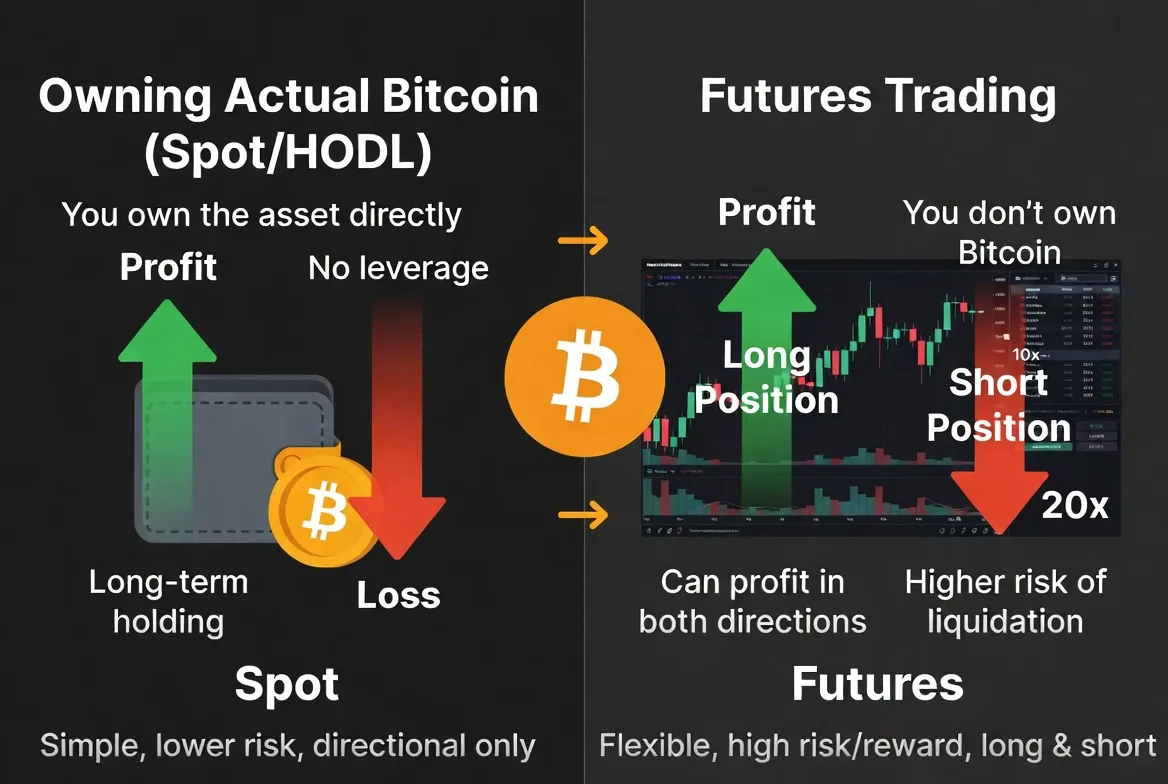
Think of crypto futures as a bet on where Bitcoin’s price will be tomorrow, next week, or three months out—except you’re making this bet with borrowed money, and you never actually touch any Bitcoin.
Here’s the deal: you’re entering an agreement to buy or sell cryptocurrency at a specific price on a future date (or continuously with perpetuals). But unlike walking into a store and buying Bitcoin outright, you’re simply speculating on price movements. Going long? You’re betting prices climb. Going short? You profit when things crash.
Let’s work through real numbers. Say Bitcoin’s at $65,000 right now. You’ve got conviction it’s heading to $70,000 within days. Instead of dropping $65,000 to buy one full coin, you post $6,500 as collateral (we call this margin) and control one Bitcoin’s worth of price exposure using 10x leverage. Bitcoin hits $70,000 like you predicted. That $5,000 gain on your $6,500 margin? That’s roughly 77% profit. Compare that to the 7.7% you’d make buying Bitcoin outright.
Sounds fantastic, right? Here’s the harsh flip side: Bitcoin drops to $60,000 instead. Your position hits the liquidation threshold automatically. Exchange computers close your position without asking permission. Your $6,500? Gone entirely. That’s not a hypothetical scare tactic—during May 2021’s crash, exchanges liquidated over $10 billion in positions within 24 hours as prices cascaded downward.
Who makes this system work? You’ve got traders taking positions, exchanges running the matching engines and infrastructure, and clearinghouses (usually the exchange itself in crypto) guaranteeing that winners actually get paid. Unlike pork belly futures where someone might deliver actual frozen pork, crypto futures settle in cash—profits show up as USDT or USD in your account, losses get deducted.
Every contract comes with specific terms that standardize everything. One platform’s Bitcoin futures might represent 1 BTC, another’s just 0.01 BTC. Ethereum contracts range from 1 ETH to 10 ETH depending where you’re trading. These details matter hugely when calculating position sizes and potential losses.
Types of Crypto Futures Contracts
Crypto derivatives split into two main categories, and picking the wrong type for your strategy can cost you real money.
Traditional Futures Contracts
These work exactly like the wheat or crude oil futures that have traded since the 1800s—they expire on specific dates. Most commonly you’ll see quarterly cycles: contracts settling on the last Friday of March, June, September, and December. Some venues offer monthly expirations too.
Something interesting happens as expiration approaches. The futures price converges toward Bitcoin’s actual spot price through arbitrage. Smart traders simultaneously buy whichever market’s cheaper and sell the expensive one, pocketing the difference until the gap disappears completely.
When settlement day arrives, you’re not getting Bitcoin delivered to your wallet. Instead, the exchange calculates your profit or loss by comparing your contract price against an index that aggregates prices from multiple spot exchanges. Winners get credits, losers see debits.
CME’s Bitcoin futures illustrate this perfectly. They settle against the CME CF Bitcoin Reference Rate—an index built from Bitcoin trading on several major spot platforms during a specific calculation window on settlement day. This methodology prevents someone from manipulating a single exchange to distort the final settlement value.
If you’re holding a position as expiration nears, you’ve got two choices: close it outright, or “roll” by selling the expiring contract while simultaneously buying the next quarter’s contract. Depending whether the market’s in contango (later months cost more) or backwardation (they’re cheaper), rolling itself can produce gains or losses independent of Bitcoin’s actual price.
Perpetual Futures Contracts
BitMEX changed everything in 2016 by introducing contracts that never expire. Today, perpetuals absolutely dominate—we’re talking 70-80% of all crypto futures volume across the industry.
Without expiration forcing prices together, perpetuals use funding rates to keep contract prices tethered to spot markets. Three times daily—usually at midnight, 8 AM, and 4 PM UTC, though each exchange sets its own schedule—traders holding positions exchange small payments based on the gap between perpetual and spot prices.
When perpetuals trade above spot (indicating bullish overcrowding), longs pay shorts. This payment structure makes additional long positions less attractive while encouraging new shorts, naturally pushing the perpetual price back toward spot. The whole thing reverses when perpetuals trade below spot: shorts compensate longs, incentivizing buying activity.
During calm markets, funding rates typically fluctuate between -0.01% and +0.01% per eight-hour period. But during mania or panic? Rates can spike to ±0.5% or higher. Don’t be fooled by the small percentages—a sustained 0.03% rate every eight hours compounds to roughly 33% annually. That’s real money leaking from your position.
Active traders love perpetuals because you get continuous exposure without managing rollovers. They’ve also become crucial hedging tools—miners can lock in sales prices indefinitely, large holders can hedge downside risk without tracking expiration calendars.
Key Mechanics of Crypto Futures Trading
Master these operational systems or get wrecked. It’s honestly that simple.
Margin and Leverage
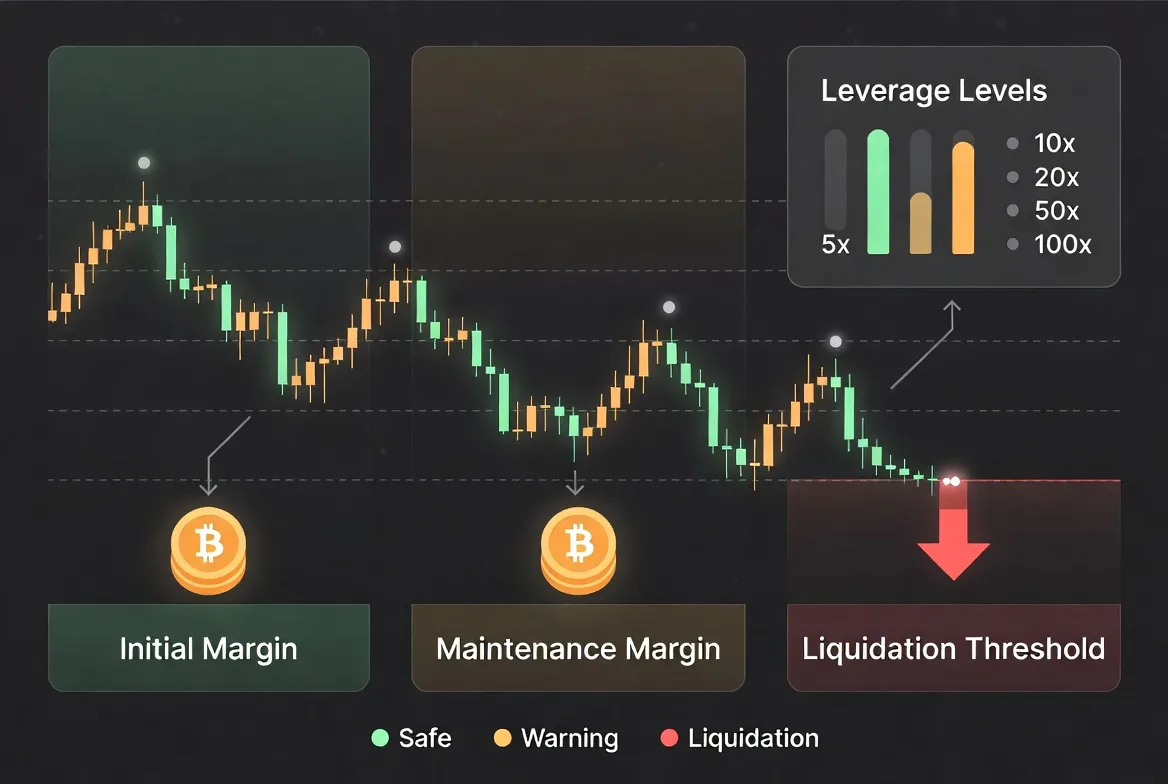
Margin is the collateral you post to open and maintain positions. Unlike buying Bitcoin where you pay full price, futures require posting just a fraction of total exposure as security—that’s where leverage comes from.
Your initial margin is the upfront deposit needed to open a position. Want to control $100,000 in Bitcoin exposure at 10x leverage? Post $10,000 initially. The exchange effectively extends you the remaining $90,000 in notional value.
There’s a second threshold called maintenance margin—the minimum equity required to keep positions alive. Exchanges typically set this at 50-80% of initial margin. Once your account value drops below this line from unfavorable price action, automatic liquidation kicks in and terminates your position.
Leverage multiplies outcomes proportionally in both directions. Using 10x leverage means a 5% favorable price move delivers 50% profit on your margin. That same 5% move against you? 50% of your collateral vanishes. A 10% adverse move triggers complete liquidation.
Crypto exchanges offer leverage from conservative 2x all the way to insane 125x, though regulators in various jurisdictions have clamped down. Platforms serving U.S. customers typically cap things at 20x or lower. Higher leverage requires less capital but creates paper-thin liquidation margins—at 125x leverage, merely 0.8% price movement against you triggers liquidation.
You’ve also got two collateral models: cross margin pledges your entire account balance across all positions, letting profitable trades offset losers. Isolated margin dedicates specific collateral to individual positions, capping your maximum loss at the isolated amount but preventing positions from supporting each other during drawdowns.
Funding Rates Explained
This is perpetual futures’ signature feature—completely absent from traditional expiring contracts. Funding rates are periodic settlements between long and short traders that keep perpetual contract pricing aligned with spot markets despite never expiring.
Exchanges calculate funding rates using formulas that incorporate the premium or discount between perpetuals and spot indexes, plus an interest rate component representing capital costs. Exact formulas vary by platform, but the core principle stays constant: funding flows from whichever side’s more popular toward the less popular side.
Payment intervals happen on fixed schedules—typically three times daily at midnight, 8 AM, and 4 PM UTC, though precise timing differs across exchanges. Critical detail: you only pay or receive funding if you’re holding an active position at the exact payment moment. Close one minute before funding? You skip the charge entirely.
Bull markets typically maintain positive funding as long demand exceeds short interest. Traders holding bullish positions pay these costs every eight hours, expenses that compound into substantial sums over weeks. An apparently modest 0.05% every eight hours multiplies to approximately 55% annually through compounding effects.
Bear markets reverse everything. When shorts outnumber longs, funding turns negative. Short sellers then compensate long holders each interval, rewarding those providing liquidity to the bearish side. Savvy traders sometimes establish long positions purely to harvest funding income when negative rates spike during market panics.
Some sophisticated participants run funding rate arbitrage: holding equal but opposite positions in perpetual futures and spot markets simultaneously, collecting funding payments while maintaining delta-neutral exposure to price movements. Works best during periods of elevated funding rates but demands careful position sizing and constant risk monitoring.
Settlement Process
Settlement determines how contracts get finalized and positions closed. Procedures differ substantially between traditional expiring contracts and perpetual instruments.
Traditional futures undergo final settlement at expiration, with the settlement price determined through the exchange’s reference methodology. This price typically derives from volume-weighted averaging across multiple spot platforms during a defined calculation window, protecting against manipulation through isolated trades on one exchange.
Cash settlement means participants receive or pay profit/loss differences in fiat currency or stablecoins rather than receiving actual cryptocurrency. Your long Bitcoin futures position settled at $68,000 after entering at $65,000? You get a $3,000-per-contract credit (minus fees) deposited to your account.
Mark price plays a crucial protective role. Rather than using the last traded price—which can spike or plunge temporarily due to thin order books—exchanges calculate mark price from the spot index plus a smoothed funding basis component. Your unrealized P&L and liquidation threshold use mark price rather than last traded price, protecting against manipulative trades and unnecessary liquidations from momentary price wicks.
Some platforms implement daily settlement procedures that don’t close positions but realize gains and losses to account balances each day. This approach adjusts margin requirements regularly and prevents losses from accumulating invisibly until a sudden liquidation event.
Crypto Futures vs Spot Trading
Choosing between derivatives and direct cryptocurrency purchases depends on your timeframe, risk tolerance, and whether you need capital efficiency.
| Feature | Futures Trading | Spot Trading |
|---|---|---|
| Asset Ownership | You’re trading contracts only—zero cryptocurrency custody | You own the actual crypto and control private keys |
| Leverage Availability | Ranges from 2x to 125x depending on jurisdiction and platform | Typically limited to 2x-5x through margin accounts |
| Margin Requirements | Anywhere from 0.8% to 50% of notional exposure | 100% for standard purchases; 20-50% for margin |
| Trading Costs | Trading commissions plus funding rate payments | Trading commissions plus bid-ask spreads |
| Settlement | Cash-settled at expiration or when you close | Immediate cryptocurrency transfer |
| Complexity Level | High—demands understanding of liquidation mechanics | Low to moderate; much simpler for beginners |
| Ideal Use Case | Short-term speculation, hedging exposure, capital efficiency | Long-term accumulation, network participation, actual usage |
Consider a practical scenario: You’re bullish on Bitcoin but have limited capital available. Futures let you control $100,000 in exposure by posting just $5,000 margin at 20x leverage. You capture full upside from price appreciation without tying up $100,000 in capital. But you’re exposed to liquidation risk, paying ongoing funding costs, and you never actually possess Bitcoin to transfer to cold storage, stake, or use in transactions.
Direct spot purchases suit investors planning multi-year holds, those wanting to participate in staking or governance, or anyone preferring to avoid derivative complexity and ongoing costs. You face zero liquidation risk holding coins in your personal wallet, and you’re not bleeding funding charges or tracking contract expirations.
Investment horizon often determines the right choice. Short-term speculators and active traders gravitate toward futures for the leverage and ability to profit from bearish moves. Long-term investors typically favor spot acquisitions, accepting lower capital efficiency in exchange for straightforward ownership and simplicity.
Tax implications differ too. U.S. taxpayers may benefit from Section 1256 treatment on certain futures with favorable 60/40 long-term/short-term capital gains splits, while spot cryptocurrency receives property treatment with capital gains based on actual holding periods.
Risks and Challenges in Crypto Futures Trading
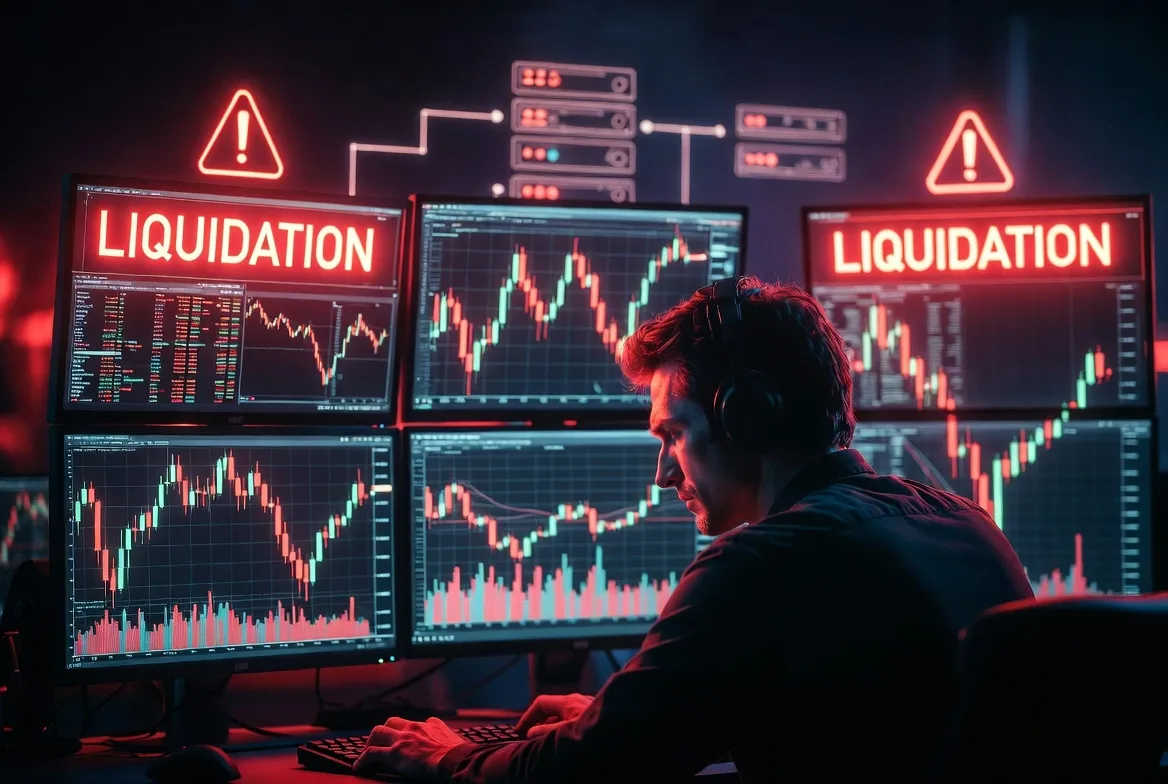
Crypto futures’ dangers extend well beyond Bitcoin’s notorious price swings. You’re combining high leverage with complex mechanics in markets that never close—creating a uniquely hazardous environment.
Forced liquidation tops the immediate threat list. When adverse price action reduces your equity below the maintenance threshold, the exchange’s liquidation engine automatically terminates your position at current market prices. Your entire margin allocation for that trade? Gone. With aggressive leverage, even modest price fluctuations trigger liquidations. May 2021’s crash saw exchanges liquidate over $10 billion in leveraged positions within 24 hours as cascading failures amplified the downturn.
Cryptocurrency’s extreme volatility magnifies leverage-related dangers exponentially. Bitcoin routinely swings 5-10% daily, with 20-30% moves during major events. These fluctuations remain manageable when holding spot assets but prove devastating under leverage. Ten percent adverse movement completely erases a 10x position. The 24/7 nature means volatility can strike while you’re asleep, leaving zero opportunity to add collateral or exit before liquidation.
Funding charges erode profitability in ways traders often overlook when focused purely on price direction. Maintaining a leveraged long position through a month-long bull market might cost 10-15% in accumulated funding payments, substantially impacting overall returns even when your price predictions prove correct.
Using leverage in cryptocurrency markets resembles handling fire while standing in gasoline-soaked surroundings. The smallest unexpected event—a flash crash, platform outage, or cascading deleveraging wave—can incinerate your entire position faster than you can react.
Michael Egorov
Exchange counterparty risk persists despite industry maturation. Unlike regulated futures markets with independent clearinghouses and strictly segregated customer deposits, many crypto platforms operate with minimal oversight. Exchange insolvency, security breaches, or outright fraud can result in permanent loss of all deposited funds. FTX’s 2022 implosion demonstrated how even seemingly reputable large platforms can fail catastrophically with customer assets misappropriated.
Execution challenges during volatile periods can prove severe. When markets move violently, order book depth evaporates, bid-ask spreads balloon, and market order slippage can be staggering. Stop-loss orders may execute at prices far worse than your trigger, while during peak volatility some exchanges have suffered complete outages preventing position management entirely.
The steep learning curve creates substantial risk for inexperienced participants. Misunderstanding funding mechanics, selecting inappropriate leverage levels, or failing to monitor margin thresholds leads to preventable losses. The intense psychological pressure of leveraged trading—where positions can move dramatically within minutes—triggers emotional decisions that compound initial errors.
Evolving regulatory frameworks add another dimension of uncertainty. Rules governing crypto derivatives vary dramatically by jurisdiction and continue shifting. Platforms accessible today might restrict your region tomorrow, positions could face unexpected tax treatment, and regulatory enforcement actions can impact market liquidity and pricing.
FAQs
Most cryptocurrency exchanges cap your losses at your account balance through automatic liquidation systems. When positions move against you and equity falls below the maintenance threshold, the platform forcibly closes your position. Your maximum loss typically stays limited to deposited margin. However, during extreme volatility or price gaps, liquidation might not execute at the calculated bankruptcy price, potentially creating negative balances. Most exchanges maintain insurance funds to absorb these losses rather than pursuing traders for additional funds, though specific terms vary by platform and jurisdiction.
Perpetual contracts trade indefinitely without expiration dates, using funding rate payments to maintain price alignment with spot markets. You can hold positions continuously without ever rolling to new contracts. Quarterly futures expire on specific dates (typically the final Friday of March, June, September, and December), requiring settlement or rolling to subsequent contracts. Quarterly contracts don’t involve funding rates but often trade at premiums or discounts reflecting market expectations about future spot prices. Perpetuals dominate trading volume due to operational convenience, while quarterly contracts serve longer-term hedging with predictable cost structures.
Most exchanges settle funding payments three times daily on fixed schedules—midnight, 8 AM, and 4 PM UTC represents the most common timing, though specific intervals vary across platforms. Payments apply only if you’re holding an open position at the exact funding timestamp. Rates fluctuate between positive (longs pay shorts) and negative (shorts pay longs) based on whether perpetual prices exceed or trail spot indexes. Individual payments often appear small (typically 0.01% to 0.1%) but accumulate substantially over extended holding periods through compounding effects.
Capital requirements vary widely across exchanges and depend heavily on your chosen leverage. Some platforms permit futures trading with deposits as low as $100, particularly when using maximum leverage options. However, beginning with minimal capital proves extremely dangerous—small account sizes combined with high leverage create positions vulnerable to liquidation from minor price fluctuations. A more prudent approach involves starting with at least $1,000-$5,000 and employing conservative leverage (2x to 5x maximum) to withstand normal market volatility without immediate liquidation. Professional risk managers typically recommend limiting individual trade risk to 1-2% of total trading capital.
Crypto futures deliver powerful capabilities for speculation, risk hedging, and achieving capital-efficient exposure to digital asset price movements. Leverage, the ability to profit from declining markets, and access to deep liquidity pools makes futures compelling for sophisticated market participants. Perpetual contracts with their innovative funding mechanisms have become the instrument of choice for most traders, while traditional quarterly futures continue serving specific longer-term hedging applications.
Understanding operational mechanics—margin systems, funding payments, settlement procedures—opens opportunities but demands comprehensive education. The distinctions between derivatives and spot purchases extend far beyond simple leverage to encompass ownership rights, cost structures, operational complexity, and fundamentally different risk exposures. Strategies appropriate for active traders pursuing short-term profits may prove completely unsuitable for investors building long-term cryptocurrency positions.
The risk landscape in crypto futures trading is both substantial and multidimensional. Liquidation can eliminate positions within minutes during volatile swings. Funding costs accumulate quietly in the background. Exchange counterparty risk persists despite industry progress. High leverage magnifies outcomes to degrees that can overwhelm even seasoned traders during unexpected market dislocations.
Success with crypto futures requires more than mechanical knowledge—it demands rigorous risk management discipline, emotional control during high-pressure situations, and honest assessment of your experience and skill level. Beginning with conservative leverage, implementing stop-loss protection, monitoring positions actively, and never wagering more than you can comfortably lose aren’t empty clichés but essential survival practices in leveraged cryptocurrency markets.
For those committed to thoroughly learning these instruments and managing their substantial risks, crypto futures provide access to sophisticated strategies unavailable through simple spot purchases. For those seeking straightforward long-term cryptocurrency exposure without operational complexity, direct spot acquisitions remain the wiser path.