
- What Shorting Means in Cryptocurrency Markets
- How to Short Cryptocurrency Using Different Methods
- Shorting Bitcoin and Other Cryptocurrencies Explained
- Risks and Downsides of Crypto Short Positions
- Crypto Short Selling Strategies for Different Market Conditions
- Choosing Platforms and Tools for Shorting Crypto
Yes, you can absolutely short cryptocurrency—and this strategy has evolved from something only derivatives experts attempted to a tool millions of traders now use when they expect Bitcoin, Ethereum, or other digital assets to drop in value. The approach flips traditional investing on its head. Instead of the classic “buy low, sell high,” you’re essentially betting that prices will fall, then profiting from that decline. How it actually works differs quite a bit from shorting stocks, and if you’re based in the US, you’ll run into specific regulatory roadblocks that narrow your platform options and limit how much leverage you can use.
What started as a niche tactic has become pretty mainstream. Exchanges have rolled out everything from straightforward margin trades to sophisticated derivatives that let you bet against crypto prices. The real skill isn’t just understanding these tools exist—it’s knowing which method fits your situation, what could go wrong, and how to execute properly so you don’t end up liquidated when the market inevitably goes haywire.
What Shorting Means in Cryptocurrency Markets
When traders talk about shorting or taking a short position, they mean opening a trade that makes money when an asset’s price falls. In stock markets, the classic version involves borrowing shares from your broker, selling them immediately at today’s price, then buying them back cheaper later to return to whoever lent them. You pocket whatever’s left over. What is shorting in crypto? Well, the mechanics work a bit differently because you’re typically not borrowing actual coins—at least not in the traditional sense.
Let’s say Bitcoin’s trading at $65,000 and you think it’s headed down. You short it at that price. Bitcoin drops to $60,000? You just made money on that $5,000 difference multiplied by however much you shorted. Your position size determines your profit, after the exchange takes its fees. But here’s where it gets uncomfortable: if Bitcoin climbs instead, you’re losing money with every dollar it rises.
This sits in stark contrast to the “buy the dip” approach you’ve probably heard about a thousand times—that strategy where people scoop up crypto during selloffs and hope prices recover. Shorting demands constant attention because your losses can pile up fast when prices move against you. Think about the risk profile difference: someone who buys Bitcoin at $60,000 can only lose their initial investment if it somehow crashes to zero. A short seller? There’s technically no ceiling on losses since Bitcoin could theoretically keep climbing forever.
How do you actually make money? It’s purely about which direction price moves. Short 0.5 BTC at $65,000 (that’s a $32,500 position value), and Bitcoin slides down to $60,000. You’ve just netted $2,500. Close out the position and that profit’s yours to keep. Bitcoin jumps to $70,000 instead? Now you’re down $2,500 and watching losses grow with each uptick.
Crypto short selling mechanics differ from traditional markets in some crucial ways: trading never stops (24/7/365), volatility regularly hits levels that would trigger circuit breakers in stock markets, and leverage is everywhere. A 20% overnight swing would be front-page news for equities. In crypto? That’s just Tuesday. This creates opportunities, sure—but it also amplifies how badly things can go wrong.

How to Short Cryptocurrency Using Different Methods
Several different paths let you short cryptocurrency, and they vary wildly in how complex they are, how much money you need upfront, and what kind of risks you’re taking on. Which one makes sense depends on your experience level, stomach for risk, and available trading capital.
Margin Trading on Exchanges
Margin trading gives you the most straightforward path to shorting. You’re borrowing funds directly from the exchange, selling crypto at whatever price it’s trading at right now, then buying it back later to repay what you borrowed. The exchange hangs onto some collateral (usually stablecoins or Bitcoin) and charges you interest on the borrowed amount the whole time.
Here’s how this looks in practice: You deposit $5,000 in USDT as collateral on a platform that offers margin trading. With 3x leverage, you can borrow $10,000 worth of Bitcoin and immediately sell it into the market. Bitcoin’s price falls 10%? You buy back that same amount of Bitcoin for just $9,000, return it to the exchange, and keep the $1,000 difference as profit—minus whatever borrowing fees accumulated. Your original $5,000 collateral stays intact.
But what happens when your bet goes sideways? Bitcoin rises 10% and now you need $11,000 to buy back and return the borrowed coins. Your $5,000 collateral takes a $1,000 hit plus fees. Let it rise too far, and the exchange doesn’t wait for you to fix it—they automatically liquidate your position to protect the money they lent you.
Most exchanges serving US customers cap leverage at 3x-5x, nowhere near the 100x leverage you’ll see advertised on offshore platforms. This regulatory ceiling prevents absolute catastrophic wipeouts but also limits how much you can potentially gain.
Crypto Futures Contracts
Futures contracts lock you into buying or selling crypto at a price you agree on today, but the actual transaction happens later on a specific date. When you take a crypto futures short position, you’re agreeing to sell Bitcoin at, say, $65,000 in 30 days. Price drops to $60,000 by expiration? You’ve made $5,000 per contract. It climbs to $70,000? You’ve lost $5,000.
Perpetual futures—contracts without expiration dates—have basically taken over crypto derivatives markets. They use something called funding rates (basically periodic payments that flow between traders on the long side and traders on the short side) to keep contract prices tracking reasonably close to what the actual asset is trading for on spot markets. When the crowd’s leaning heavily long, shorts get paid funding. Sentiment turns bearish and everyone piles into shorts? Now you’re paying longs every few hours.
Trading futures means wrapping your head around contract specs, margin calculations, and how mark price works. One Bitcoin futures contract might represent a full BTC or just 0.1 BTC depending which exchange you’re using. Mess up your position sizing here and it gets expensive fast.
The upside compared to margin trading? Better capital efficiency. You’re not actually borrowing and selling real coins—you’re entering into a derivative contract, which requires less money upfront. The downside? More complexity, plus those funding rates can quietly eat into your profits even when the trade’s working exactly how you predicted.
Put Options and Derivatives
Put options on crypto hand you the right—but importantly, not the obligation—to sell cryptocurrency at a specific strike price before the option expires. Unlike futures, the absolute most you can lose equals whatever premium you paid to buy that put option.
Say you buy a Bitcoin put option with a $60,000 strike price that expires in 30 days, and it costs you $1,200 upfront. Bitcoin absolutely tanks to $50,000. Now your option is worth $10,000 (because you have the right to sell at $60,000 when everyone else has to sell at $50,000). Subtract that $1,200 premium you paid, and you’ve netted $8,800. Bitcoin stays above $60,000 the whole time? You’re only out that initial $1,200 premium.
This defined-risk setup makes options attractive for hedging your portfolio or making speculative plays where you know exactly what you’re risking upfront. The catch is something called time decay—options bleed value as they approach expiration, even when the underlying asset is moving your direction.
Derivatives for shorting crypto extend well beyond just puts and futures into structured products, synthetic short positions, and more exotic option strategies. These instruments demand substantial knowledge and definitely aren’t beginner territory. Liquidity can dry up, bid-ask spreads can get uncomfortably wide, and the pricing models get genuinely complicated.
Inverse Crypto ETFs and Tokens
Inverse crypto positions through exchange-traded products give you a way to bet on falling crypto prices without juggling margin accounts or derivatives yourself. These inverse ETFs and tokens are designed to move opposite to Bitcoin or Ethereum’s daily performance, handling all the shorting complexity behind the scenes.
Bitcoin drops 5% today? An inverse Bitcoin token should theoretically rise roughly 5%. You just buy the token and hold it—no liquidation risk hanging over your head, no margin calls waking you up at 3 AM, no funding rates bleeding your account. Sounds perfect, right?
Here’s the big problem: daily rebalancing creates weird compounding effects over time. These products track daily returns, not what happens over weeks or months. Hold an inverse Bitcoin token for several weeks while Bitcoin chops sideways in a range, and you’ll probably lose money even if Bitcoin ends up exactly where it started. Volatility decay just eats your returns.
These work best for short-term tactical plays measured in days, not positions you hold for weeks. US investors have fewer options for crypto inverse ETFs compared to what’s available offshore, though availability has gotten better since 2025 as regulators clarified some of the framework.
Shorting Bitcoin and Other Cryptocurrencies Explained

Bitcoin absolutely dominates short selling activity, and that’s no accident—superior liquidity, tighter spreads, and every platform under the sun offers some way to short it. Shorting bitcoin explained in the simplest terms: more traders, more volume, and more derivatives products floating around means you can get in and out at predictable prices even when you’re moving decent-sized positions.
Short Bitcoin on any major exchange and your order fills instantly at the prices you’re seeing on screen, even if you’re working with a substantial position. Try shorting something like Chainlink or Avalanche—mid-cap altcoins with less activity—and you might experience slippage. Your order fills, sure, but at worse prices than you expected because there aren’t as many traders on the other side.
Altcoin shorting brings extra risks beyond what you face with Bitcoin. Thinner liquidity means wider gaps between bid and ask prices and more slippage eating into your profits. Smaller market caps make these coins more vulnerable to manipulation—a whale with deep pockets buying aggressively can trigger a short squeeze that liquidates your position before you know what hit you. Platform availability gets spotty too; lots of exchanges let you short Bitcoin and Ethereum but offer limited or zero options for altcoins.
That said, altcoins frequently move way more dramatically than Bitcoin when markets turn south. Bitcoin might drop 10% during a selloff while altcoins crater 20-30%. This volatility attracts traders willing to stomach the liquidity risks for potentially bigger payoffs.
Ethereum sits somewhere in the middle—liquid enough to short comfortably on major platforms but still not as deep as Bitcoin’s markets. Ethereum shorts work fine on established exchanges, but you need to stay aware of network-specific events like protocol upgrades or changes to staking mechanics that can spark unexpected price action.
Think about correlation when you’re shorting multiple cryptocurrencies at once. During broad market crashes, Bitcoin, Ethereum, and altcoins typically fall together like dominoes. Shorting all three doesn’t spread your risk around—it concentrates it. One surprise rally can liquidate every position simultaneously.
Risks and Downsides of Crypto Short Positions
Crypto short position risks go way beyond the simple concept of “price rises, you lose money.” The combination of absolutely wild volatility, widespread leverage, and markets that never sleep creates a uniquely dangerous environment for short sellers.
Unlimited loss potential sits at the top of the risk pyramid. Buy Bitcoin and the worst that can happen is a 100% loss—Bitcoin goes to zero, you lose whatever you invested. Short Bitcoin? There’s no theoretical ceiling on losses. Bitcoin at $65,000 could climb to $650,000 (stranger things have happened in crypto), creating losses worth 10 times your original position. Leverage multiplies this danger to truly scary levels.
Liquidation risk means exchanges will automatically force-close your position when losses approach your collateral amount. Short Bitcoin at $65,000 with $5,000 in collateral and 5x leverage, and a move up to roughly $66,300 liquidates everything. You lose your entire stake, and the exchange keeps liquidation fees on top of that. There’s no chance to add more collateral or ride out the volatility—your position just evaporates.
Funding rates on perpetual futures create this sneaky ongoing cost that adds up over time. During bull runs when most traders are betting on higher prices, shorts actually receive funding payments—a nice bonus. But during consolidation or those sharp rallies you get in bear markets when shorts pile up, you’re paying funding every 8 hours. A 0.05% funding rate sounds harmless until you calculate that it compounds to over 50% annually.
Volatility spikes happen all the time in crypto. Bitcoin can swing 15% in a matter of hours on news like regulatory announcements, exchange hacks, or macro surprises nobody saw coming. These moves trigger cascading liquidations—short squeezes where forced buying from liquidated shorts pushes prices even higher, triggering more liquidations in this vicious feedback loop.
Regulatory concerns hit especially hard for US traders. Platforms available to Americans provide lower leverage and fewer instruments compared to what’s available offshore. Regulatory changes can force you to close positions or exit platforms entirely with barely any notice. The CFTC and SEC keep evolving how they regulate crypto derivatives, creating this constant cloud of uncertainty.
Platform counterparty risk means you’re trusting exchanges with your collateral. Exchange hacks, insolvencies, or outright fraud can wipe out your funds regardless of whether your trades were profitable. Unlike FDIC insurance on bank accounts or SIPC protection for traditional brokerage accounts, crypto exchange deposits don’t come with robust insurance. Platform goes under? Your collateral probably goes with it.
Crypto Short Selling Strategies for Different Market Conditions
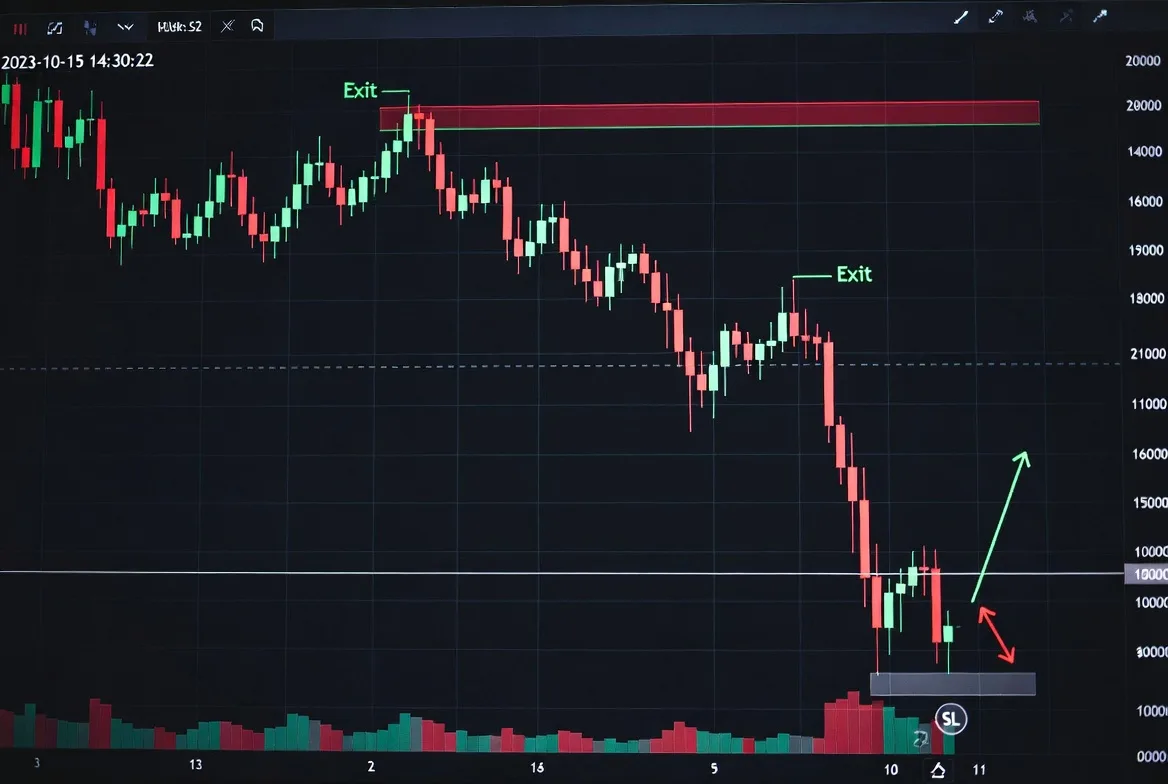
Effective crypto short selling strategies shift based on what the market’s actually doing rather than trying to force one approach on every situation. Different environments demand different tactics and risk controls.
Trend-following shorts work beautifully during established downtrends. Wait for Bitcoin to break below important support levels, then enter shorts with tight stop-losses placed just above recent highs. You’re trying to catch momentum as selling pressure builds. Don’t fight established trends—if Bitcoin keeps making higher highs and higher lows, shorting is like swimming against a riptide.
Here’s a practical approach: Bitcoin breaks below its 200-day moving average with volume picking up noticeably. Enter a short position with your stop-loss set 3% above that moving average. Target the next major support level sitting 10-15% lower. Get stopped out? Your loss stays controlled and manageable. Trade works out? You’re looking at a 3:1 or better reward-to-risk ratio.
Hedge strategies use shorts to protect long-term holdings without actually selling anything. Maybe you hold Bitcoin for the long haul (tax reasons, conviction, whatever) but you’re expecting a near-term pullback. Shorting futures or buying puts hedges your downside risk. Bitcoin drops 20%, your long position bleeds, but your short gains offset those losses.
Get the math right here. Hedge 50% of your holdings if you’re moderately worried, 100% if you’re bracing for a nasty drop. Over-hedging (shorting more than you actually hold) transforms a protective hedge into straight speculation. Under-hedging leaves you exposed to the exact risk you were trying to avoid.
Range-bound approaches exploit Bitcoin’s habit of trading in defined channels for weeks at a stretch. Short near the top of the range, cover near the bottom, rinse and repeat. This demands real discipline to actually close positions at your targets instead of getting greedy and hoping for breakouts. Set strict profit targets and stop-losses at range boundaries, then stick to them.
Risk management separates traders who survive from those who get liquidated. Never risk more than 2-3% of your capital on any single short position—no exceptions. Place stop-losses on every single trade, always. Avoid shorting around high-impact news when volatility can spike unpredictably. Size positions based on current volatility—smaller when Bitcoin’s average true range expands.
Position sizing deserves extra attention here. Calculate how far Bitcoin can move against you before hitting liquidation, then size your position so that a worst-case realistic scenario doesn’t blow up your account. Working with $10,000 in capital and 3x leverage? Size positions to survive a 15% move against you, which keeps you safe during normal volatility. Position yourself for only 5% of wiggle room and you’re basically inviting liquidation during routine swings.

Choosing Platforms and Tools for Shorting Crypto
Which platform you choose determines what shorting methods you can actually access, what fees you’ll pay, and how much regulatory protection you get. US traders face narrower choices than international users thanks to compliance requirements.
Established derivatives exchanges like CME offer regulated Bitcoin and Ethereum futures with proper oversight and institutional-grade infrastructure. Fees run higher than crypto-native platforms, but you’re getting regulatory certainty and professional tools. Minimum account sizes and contract specs tend to suit experienced traders better than people just starting out.
Crypto-native exchanges serving US customers include Coinbase Advanced (limited margin trading available), Kraken (margin and futures both), and Gemini (limited derivatives). Each platform comes with different leverage limits (usually 3x-5x for US users), varying fee structures, and different numbers of supported assets. Kraken provides the broadest shorting toolkit for Americans—futures on multiple cryptocurrencies plus margin trading pairs.
| Platform | Shorting Methods Available | Max Leverage (US) | Maker/Taker Fees | Supported Assets |
|---|---|---|---|---|
| Kraken | Margin, Futures | 5x | 0.16% / 0.26% | BTC, ETH, 10+ alts |
| Coinbase Advanced | Margin (limited) | 3x | 0.40% / 0.60% | BTC, ETH, select alts |
| CME | Futures | Varies | $6-10 per contract | BTC, ETH |
| Gemini | Derivatives (limited) | 3x | 0.20% / 0.40% | BTC, ETH |
Fee structures matter way more than most traders appreciate. A 0.60% taker fee on a $10,000 position costs you $60 right off the bat. Open and close that position, you’ve paid $120 before price even moves. Make 10 round trips monthly and fees eat up $1,200—enough to completely wipe out modest profits. Maker fees (paid when you add liquidity using limit orders) run lower than taker fees (paid when you remove liquidity with market orders).
Leverage limits reflect both regulatory protection and platform risk management. Offshore exchanges advertising 100x leverage let you potentially make massive gains but also get liquidated instantly on 1% moves against you. The 3x-5x leverage caps for US traders force bigger capital commitments but dramatically cut liquidation risk.
Security considerations include basics like two-factor authentication, withdrawal whitelists, and cold storage for funds you’re not actively trading. Never park more capital on an exchange than you absolutely need for your open positions and near-term trades. Hardware wallet storage for long-term holdings completely eliminates exchange counterparty risk.
Regulatory compliance varies platform to platform. US-registered exchanges follow KYC/AML requirements, report to tax authorities, and maintain regulatory capital buffers. This oversight gives you some recourse if disputes come up, but it also means less privacy and more paperwork. Offshore platforms offer more instruments and higher leverage but provide exactly zero regulatory protection if things go wrong.
Shorting cryptocurrency without proper risk controls is like driving a sports car at top speed in a rainstorm—the power feels thrilling right up until you lose control. I’ve watched countless traders get liquidated not because their market analysis was wrong, but because they sized positions for the gains they wanted rather than the losses they could actually survive. In crypto markets, staying solvent long enough to be right matters more than being right immediately.
Michael Chen, CFA
FAQs
Coinbase offers some margin trading through Coinbase Advanced (what used to be called Coinbase Pro) for eligible US customers. You can short Bitcoin and Ethereum with up to 3x leverage there. Catch is, availability depends heavily on which state you live in—several US states flat-out prohibit margin trading. The platform doesn’t offer futures or options, so margin trading’s your only path to shorting. Most serious short sellers find Coinbase too restrictive and migrate to Kraken or look at offshore alternatives instead.
Shorting cryptocurrency is completely legal in the United States, though regulatory restrictions definitely limit how and where Americans can do it. The CFTC handles crypto derivatives regulation, while the SEC oversees certain crypto securities. US traders can legally short through registered domestic exchanges (with leverage typically capped at 3x-5x) or via regulated futures markets like CME. Using offshore exchanges that ignore US regulations creates legal gray areas and potentially messy tax reporting situations. Some individual states layer on additional restrictions beyond federal rules.
You can lose more than your initial investment when shorting crypto, particularly with leverage involved. Without leverage, maximum loss equals your position size plus fees if the cryptocurrency doubles in price. With 5x leverage, just a 20% price increase liquidates your position and wipes out your collateral completely. Theoretically, there’s no cap on losses since cryptocurrency prices could keep climbing indefinitely. Proper risk management using stop-losses and appropriate position sizing prevents catastrophic losses, but the potential to lose everything you’ve deposited as collateral is absolutely real.
Shorting (whether through margin or futures) exposes you to potentially unlimited losses and demands active management to dodge liquidation. Put options cap your maximum loss at whatever premium you paid upfront, making them safer for defined-risk approaches. Short Bitcoin at $65,000 and watch it climb to $75,000? You’re down $10,000 per coin plus fees. Buy a put option for $1,200 and Bitcoin rockets to $75,000? You’re only out that $1,200 premium. Trade-off is that options cost money upfront and lose value as time passes, even when you’re directionally correct. Shorting costs nothing to enter but charges funding rates or borrowing fees while your position stays open.
You definitely need a margin account or derivatives account—your standard spot trading account won’t cut it. Setting up margin trading involves extra verification steps, agreeing to leverage terms, and often maintaining minimum account balances. Futures and options trading require separate account approvals with additional risk disclosures you’ll need to acknowledge. The application process typically asks about your trading experience, financial situation, and whether you actually understand leveraged products. Some platforms will straight-up reject applicants who don’t meet their experience thresholds. This gatekeeping exists to protect inexperienced traders from tools they’re not ready to handle safely.
Beginners can short cryptocurrency, but whether they should is another question entirely. Start with paper trading (simulated trading with fake money) to understand the mechanics and emotional rollercoaster without risking actual capital. When you’re ready for real money, stick to minimal leverage (2x maximum initially), tiny position sizes (1% of your capital per trade), and stop-losses on absolutely every trade. Expect to lose money while you’re learning—treat it as tuition. Most beginners benefit from gaining 6-12 months of spot trading experience before attempting shorts. The combination of leverage, markets that never close, and absolutely insane volatility punishes inexperience brutally. Plenty of profitable long-term traders avoid shorting completely because the risk-reward profile doesn’t match their personality.
Shorting cryptocurrency provides legitimate ways to profit when markets turn bearish or to hedge positions you already hold, but the risks demand serious respect and thorough preparation. You can short crypto through margin trading, futures contracts, put options, or inverse products—each method brings distinct advantages and drawbacks. Bitcoin offers the most liquid and accessible shorting opportunities, while altcoins dangle higher potential returns alongside considerably greater risks.
The potential for unlimited losses, liquidation risk, and absolutely wild volatility that defines crypto markets make shorting especially dangerous for traders who aren’t properly prepared. Success requires more than just getting market direction right—you need disciplined position sizing, rigorous risk management, and emotional control when prices swing violently. The difference between using 3x and 10x leverage might look small on paper, but it determines whether you survive a 15% move against you or get liquidated instantly.
US traders work under regulatory constraints that cap leverage and narrow platform choices compared to international markets. These restrictions frustrate some traders but provide important guardrails preventing the catastrophic losses common on unregulated offshore exchanges. Choose platforms carefully, understanding fee structures, security measures, and regulatory compliance before depositing a single dollar.
Whether shorting makes sense for your situation depends on your experience level, risk tolerance, and ability to actively monitor positions. Beginners should get completely comfortable with spot trading fundamentals before layering on leverage and shorting complexity. Even experienced traders should start with conservative position sizes and moderate leverage until they’re genuinely comfortable with crypto short selling’s unique dynamics. The market will always serve up another opportunity—protecting your capital ensures you’ll still be around to take it.