
The crypto markets don’t sleep, and frankly, most of us need to. That’s where automated trading enters the picture—software handling your buy and sell decisions while you’re doing literally anything else. Since 2023, retail adoption of these tools has jumped 340%, with platforms like Pionex and 3Commas reporting user bases exceeding 2 million accounts each.
Here’s the thing: bots aren’t magic profit machines. They’re execution tools. The algorithmic logic behind them processes market data faster than any human could—we’re talking milliseconds versus the seconds you’d need just to click a mouse. But speed without strategy? That’s just losing money efficiently.
This guide walks through what these systems actually do, which types work for different goals, and where they typically fail. Because understanding both the capabilities and limitations determines whether automation helps or hurts your trading results.
What Is Automated Crypto Trading
Think of automated crypto trading as hiring a tireless assistant who follows instructions exactly. You set the rules—maybe “buy Ethereum every time it drops 3% in an hour”—and software monitors prices 24/7, executing trades when conditions match your criteria.
The technical setup involves API keys. You generate these through your exchange (Binance, Coinbase, Kraken, whatever you use), which gives the bot permission to read your account data and place orders. Importantly, you can restrict withdrawal permissions, meaning the bot can trade but can’t move funds off the exchange.
Algorithmic crypto trading applies the same principles Wall Street’s been using since the 1980s, just tailored for markets that operate continuously. Traditional stock markets close at 4 PM Eastern. Crypto? Bitcoin doesn’t care if it’s Christmas morning—it’s trading. That 24/7 reality makes automation particularly valuable since manually monitoring positions at 3 AM isn’t sustainable.
Who’s actually using this? Day traders running multiple strategies across 15-20 trading pairs couldn’t possibly track everything manually. You’ve also got long-term investors setting up systematic buying schedules—$200 into Bitcoin every Monday for two years, zero emotions involved. And institutions? They’re running complex operations capturing tiny price differences across exchanges, executing hundreds of trades hourly.
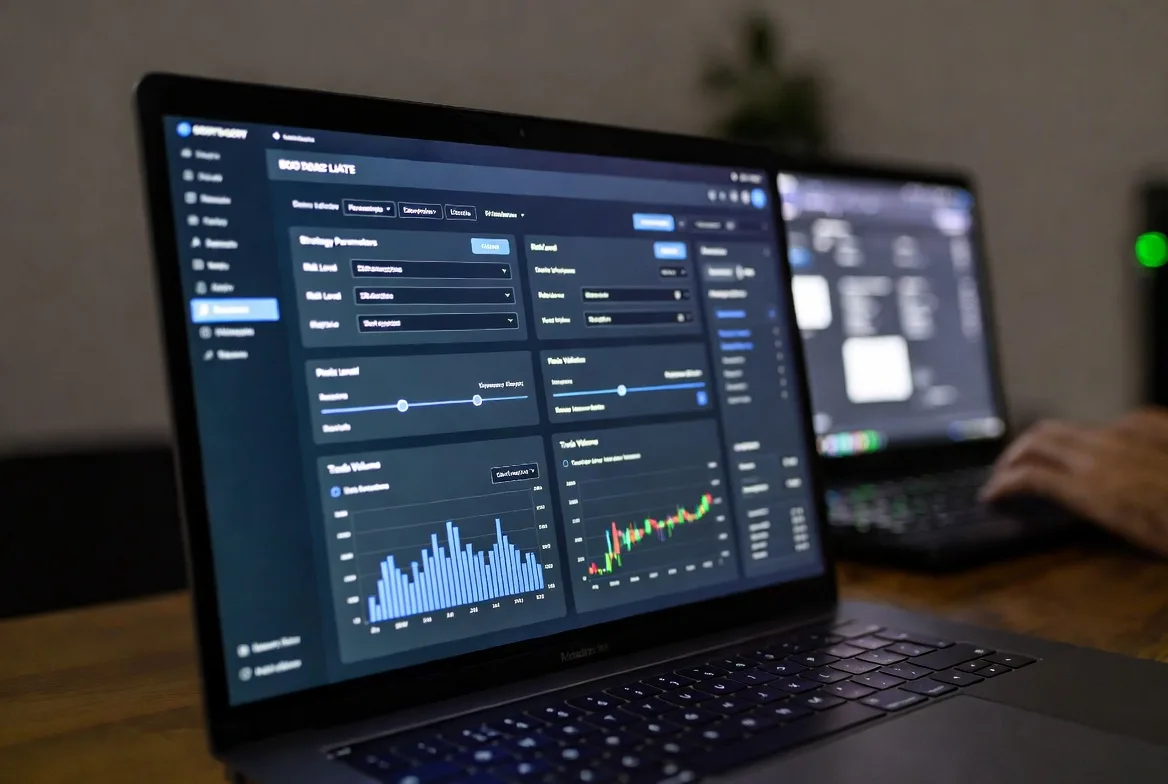
Most platforms now offer no-code interfaces. You’re not writing Python scripts unless you want to. Services like Bitsgap provide templates: click “Grid Bot,” set your price range, choose how many grid levels you want, done. The barrier to entry has dropped substantially since 2022 when coding knowledge was practically mandatory.
The appeal boils down to consistency. Humans get tired, anxious, greedy, fearful. Bots just follow their programming. They won’t panic-sell during a 15% dip because they don’t panic. They also won’t deviate from the strategy when they’re “feeling confident” about a hunch. That emotional neutrality cuts both ways, though—more on that in the risks section.
How Crypto Trading Bots Work
Under the hood, these systems aren’t particularly mystical. They’re software applications running on either your computer, a cloud server, or the platform provider’s infrastructure.
First step: API integration. When you create API keys on Binance (or wherever), you’re giving the bot a secure way to communicate with the exchange. Modern exchanges let you set permission levels. Smart configuration enables “read info” and “create orders” but disables “withdraw funds.” That way, even if someone steals your API key, they can’t drain your account—just potentially execute bad trades.
Once connected, the bot starts pulling market data continuously. Current price, obviously, but also order book depth (how many buy/sell orders exist at different price levels), recent trading volume, and historical candlestick data. This information streams into the decision engine—the part where strategy logic lives.
Let’s say you’ve set up a simple moving average crossover strategy. The bot calculates a 10-period average and a 50-period average constantly. When the faster 10-period line crosses above the slower 50-period line, the algorithm interprets that as a buy signal and immediately submits a market order. When it crosses back down, sell signal triggers.
Execution speed creates real advantages. From signal identification to order placement, quality bots complete the cycle in under 200 milliseconds. You manually clicking through an exchange interface? That’s 3-5 seconds minimum. In fast-moving markets, prices shift meaningfully during that delay. High-frequency operations use co-located servers physically near exchange data centers, shaving response times to microseconds, though that’s institutional-level infrastructure.
Risk controls determine whether a bot is useful or dangerous. Maximum drawdown limits pause trading if losses hit, say, 15% of starting capital. Trailing stops adjust sell orders upward as prices rise, locking in gains without capping upside. Position sizing ensures no single trade risks more than 2-3% of your total account—basic risk management that surprisingly many retail traders ignore.
Deployment models split into cloud-based and local. Cloud-based bots run on the provider’s servers, executing strategies even when your laptop’s closed. You’re depending on their uptime and security, but you’re not tethered to keeping a computer running 24/7. Local bots require your machine powered on with stable internet—more control, but if your power goes out during a crucial trade, tough luck.

Types of Crypto Trading Bots and Strategies
Market conditions determine which bot type makes sense. Using grid trading during a strong uptrend? You’ll capture tiny profits while missing the major move. Running a trend-following bot in a sideways market? Prepare for death by a thousand small losses.
Grid Trading Bots
Grid strategies place layered buy and sell orders across a price range, profiting from back-and-forth movement. Picture this: Ethereum’s bouncing between $2,600 and $3,000. You set up 20 grid levels with orders every $20. The bot buys at $2,780, $2,760, $2,740 as price dips, then sells those same quantities at $2,800, $2,820, $2,840 when it bounces back up.
Each complete cycle (buy at one level, sell at a higher level) captures the spread between grid intervals. These small gains accumulate surprisingly fast in choppy markets. A properly configured grid might complete 50-80 cycles monthly during volatile periods, with each cycle netting 1-2% after fees.
The strategy absolutely thrives in range-bound conditions. When Bitcoin’s stuck between $58,000-$62,000 for three months, grid bots are printing consistent returns while directional traders are tearing their hair out waiting for a breakout. Conversely, strong trends wreck grid performance. If Ethereum blasts from $2,800 to $4,200 in six weeks, your grid bot sold everything by $3,000 and just watched $1,200 of upside pass by.
Configuration mistakes kill results. Setting your grid range too narrow means the entire range fills on one side during a moderate move. Too wide? Orders rarely execute, and capital sits idle. Realistic grid placement requires analyzing recent volatility—checking 30-day high-low ranges and setting boundaries with 10-15% buffer beyond those levels.
DCA Bots
Dollar-cost averaging removes timing decisions entirely. A DCA crypto bot strategy might purchase $150 of Bitcoin every Tuesday at noon, regardless of whether Bitcoin’s at $50,000 or $70,000. Over months and years, you’re averaging your entry price across market cycles.
The psychological benefit matters more than most people expect. When Bitcoin tanks 25% in a week, manual investors freeze up. “Should I buy? What if it drops more?” The DCA bot doesn’t care—it executes its scheduled purchase automatically. That discipline during downturns typically produces better average costs than trying to catch exact bottoms.
Smarter DCA bots layer in conditional logic. Instead of blind weekly purchases, they might double the normal amount when price drops below the 200-day moving average, or skip purchases when RSI indicates extreme overbought conditions. This “value DCA” approach keeps the systematic benefit while adding basic opportunistic timing.
Where does DCA struggle? Prolonged bear markets test your commitment. If you DCA’d $500 monthly into Bitcoin throughout 2022, you accumulated a large position at declining prices, watching your total value drop month after month. The strategy pays off during subsequent recovery, but living through extended drawdowns requires conviction. You’re looking at 18-24 month time horizons minimum, not quarter-to-quarter results.
Arbitrage Bots
Arbitrage captures price mismatches across different venues. Bitcoin might trade at $61,200 on Gemini while simultaneously at $60,980 on Kraken. An arbitrage bot buys the cheaper Kraken Bitcoin and sells the pricier Gemini Bitcoin instantly, pocketing $220 minus trading fees.
Spatial arbitrage (cross-exchange) sounds simpler than it is. You need capital pre-positioned on multiple exchanges because transfer times kill opportunities. That $220 spread will disappear within 30-90 seconds as other arbitrageurs jump on it. Waiting 20 minutes for a Bitcoin transfer from Kraken to Gemini means you’re watching the opportunity evaporate in real-time.
Triangular arbitrage works within single exchanges, cycling through currency pairs to exploit pricing imbalances. Start with $10,000 USDT, convert to Bitcoin, then Bitcoin to Ethereum, then Ethereum back to USDT. If the three exchange rates aren’t perfectly aligned, you might end up with $10,035 USDT after the loop. That’s $35 profit in maybe five seconds of execution time.
Reality check: arbitrage bots crypto opportunities have narrowed dramatically since 2021-2022. Institutional traders with fiber-optic connections positioned in exchange data centers capture obvious spreads in microseconds. Retail arbitrage now focuses on smaller exchanges, newer token listings, or cross-chain opportunities where inefficiencies persist longer. Competition is fierce, and net returns after fees might hit 0.5-2% monthly rather than the 10-15% figures from early crypto years.
Signal-Based Bots
Signal bots execute trades based on external alerts from technical analysis platforms, sentiment trackers, or subscription services. You might follow a trader who posts “LONG SOL $142” to their Discord. Your signal bot sees that message and immediately places a buy order for Solana at market price.
Crypto signal automation removes execution delay from third-party recommendations. When a popular analyst tweets an entry signal, thousands of followers try buying simultaneously. Being among the first 5% to execute means getting better prices before order flow pushes the market. Manual traders clicking through interfaces arrive late to the party.
Quality varies wildly with signal providers. Plenty show cherry-picked past calls or impressive backtests that don’t translate to live performance. Premium signal services charge $80-200 monthly, and that fee needs to come out of profits. The approach makes most sense when you’ve vetted a provider’s methodology and understand why their signals work (or don’t).
Latency determines signal bot effectiveness. If 8,000 people subscribe to the same Telegram channel, receiving identical signals, the resulting stampede moves prices before slower bots execute. You need fast automation, reliable exchange API connections, and ideally some filtering logic—not every signal from even good providers deserves following.
| Strategy Type | Works Best When… | Setup Difficulty | Monthly Returns (Realistic) | Risk Profile | Hands-On Time Needed |
|---|---|---|---|---|---|
| Grid Trading | Markets range-bound with clear support/resistance | Moderate—requires volatility analysis | 3-7% in sideways markets | Moderate—vulnerable to breakouts | Minimal after initial config |
| DCA Bots | Building long-term position across cycles | Low—mostly just scheduling | Variable—measured over 12-24 months | Low to Moderate—steady accumulation | Nearly zero |
| Arbitrage | High liquidity with persistent price gaps | High—multi-exchange coordination | 0.5-2% (post-2023 competition) | Low to Moderate—execution risk | Moderate—monitoring spreads |
| Signal-Based | You trust the signal source completely | Low to Moderate—depends on integration | Highly variable—source-dependent | Moderate to High—blind trust risk | Moderate—evaluating signal quality |
Backtesting and Setting Up Your Bot
Launching a bot with real money before testing its logic on historical data? That’s like skipping brake tests on a new car. Backtesting crypto strategies shows how your approach would’ve handled past market conditions—bull runs, crashes, sideways grinds—before capital’s actually at stake.
Quality backtesting needs clean historical data spanning multiple market cycles. Most bot platforms include backtesting tools that simulate trades using past price data. You input strategy parameters: entry rules, exit conditions, position sizing. The software calculates hypothetical performance including trading fees and realistic slippage (the difference between expected and actual execution prices).
The trap is over-optimization. When traders obsessively tweak parameters until backtest results look phenomenal, they’re usually tailoring the strategy to past data instead of discovering genuinely robust patterns. A strategy showing 92% win rate across 2022-2024 data after trying 63 different parameter combinations? That’s curve-fitting. It’ll likely faceplant in 2025-2026 when market structure shifts.
Realistic backtests include transaction costs. A strategy generating 150 trades monthly might show 8% returns before accounting for exchange fees. After 0.1% maker/taker fees on each trade, net returns might drop to 2.3%. Slippage hits harder with larger orders or less liquid pairs—your backtest might assume you bought at $2,500, but market orders of $50,000 push the price to $2,507 before filling completely.
Paper trading fills the gap between backtesting and live deployment. Demo modes execute trades in real-time with current market data but using fake money. This exposes issues like API connection failures, unexpected order rejections, or strategy behaviors historical data didn’t reveal. Running paper trades for 3-4 weeks catches most configuration bugs before they cost real money.
Common setup mistakes include missing risk limits. A bot without maximum drawdown protection might continue trading after losing 35% of starting capital, converting a manageable loss into a catastrophic one. Position sizing errors are equally dangerous—allocating 40% of capital to a single trade exposes your account to unacceptable risk regardless of how solid the strategy looks.
Exchange API permissions deserve paranoid attention. Bots should almost never receive withdrawal permissions unless you’re running arbitrage requiring fund transfers. Trading and reading permissions handle most strategies fine. Store API keys using environment variables or encrypted key managers, not hardcoded in scripts where anyone with file access can steal them.
Start small. Deploying $300-500 initially tests strategy viability without major financial risk. It also tests your psychology—watching actual money fluctuate reveals whether you can tolerate the strategy’s drawdown profile. Scaling up should happen gradually after consistent results over several months, not after one lucky week.
Risks and Limitations of Bot Trading
Automation eliminates certain risks while introducing brand new ones. Security vulnerabilities top the worry list. Phishing attacks targeting bot users try stealing API keys through fake platform emails or compromised third-party tools. Once attackers get API access, they execute trades manipulating prices or drain funds through coordinated sell-offs.
Reputable platforms use encryption and two-factor authentication, but users remain the weakest link. Reusing passwords across services, clicking suspicious links, downloading unverified scripts from Telegram groups—these behaviors create exposure. Remember the August 2024 incident when a popular Discord bot channel got compromised? Attackers posted fake “update required” messages containing malware, resulting in $2.3 million stolen from roughly 400 users.
Market volatility presents challenges no bot fully solves. The March 2025 flash crash—Bitcoin dropping 18% in 37 minutes before recovering most losses—triggered stop-losses across thousands of automated accounts, locking in losses at the absolute worst prices. Bots follow their programming whether price movements represent genuine trend changes or temporary liquidity events.
Technical failures range from annoying to financially painful. Exchange API outages prevent bots from executing trades during crucial moments. Your internet going down disables locally-run bots. Cloud service disruptions affect hosted bots. The May 2024 AWS outage took multiple major bot platforms offline for six hours, leaving strategies unable to respond while Ethereum moved 11%.
The biggest mistake I see is traders assuming bots provide passive income. Successful automation requires active oversight—monitoring performance metrics, adjusting to regime changes, knowing when to pause strategies. Bots amplify your decision-making. They don’t replace understanding markets.
Michael Rodriguez
Over-optimization creates brittle strategies performing beautifully on historical data but failing when market dynamics shift. A grid bot optimized for 2023’s volatility patterns might underperform badly in 2026’s different conditions. Strategies need periodic re-evaluation, contradicting the “set and forget” fantasy many beginners hold.
Scam bots and fraudulent platforms exploit automation’s appeal ruthlessly. Promises of “guaranteed 12% monthly returns” or “AI-powered bots with 95% win rate” signal fraud. Legitimate trading involves risk and variability—any service claiming otherwise is lying or operating a Ponzi scheme paying early users with new depositors’ funds until collapse.
Regulatory uncertainty affects bot trading legality and tax obligations. While automated trading itself is legal throughout the US, every transaction generates potential taxable events. A grid bot making 180 trades monthly creates 180 tax reporting requirements. Proper record-keeping becomes essential, and some jurisdictions are developing specific algorithmic trading regulations that may impose additional compliance burdens.
Bot Trading vs Manual Trading
Choosing between automation and manual trading isn’t either/or—many successful traders use both approaches for different purposes. Understanding the trade-offs helps allocate capital and attention effectively.
Speed advantage obviously favors bots. A manual trader needs 3-5 seconds recognizing a signal, deciding to act, and executing the order. Bots complete the same process in under 200 milliseconds. For high-frequency strategies or arbitrage, this gap makes manual execution completely unviable. Even with slower strategies, automation ensures immediate execution without hesitation or second-guessing.
Emotional discipline represents automation’s strongest psychological benefit. Fear and greed drive terrible manual trading decisions—holding losing positions hoping for miraculous recovery, exiting winning trades prematurely to secure small gains. Bots execute programmed logic regardless of market panic or euphoria. That said, bots also can’t recognize when their underlying assumptions have become invalid and human discretion would suggest pausing.
Cost considerations extend beyond software subscriptions. Manual trading requires substantial time investment—hours spent analyzing charts, monitoring positions, executing trades. If your professional time is worth $60-100 hourly, spending 12 hours weekly on manual trading costs $2,880-4,800 monthly in opportunity cost. A $40 monthly bot subscription looks pretty attractive by comparison.
Conversely, manual trading has zero software costs and avoids the learning curve of configuring automation. Someone making 2-3 swing trades monthly doesn’t need sophisticated automation—the time saved doesn’t justify the setup effort and ongoing monitoring automation actually requires.
Learning curve steepness differs significantly. Manual trading demands market knowledge, chart reading skills, and psychological discipline, but concepts are straightforward. Bot trading adds technical complexity layers: understanding API connections, debugging configuration errors, interpreting backtest statistics, recognizing when automation is malfunctioning versus when strategy is experiencing normal drawdown periods.
Control and flexibility favor manual approaches for discretionary decisions. When unexpected news breaks—major exchange hack, regulatory announcement, protocol exploit—experienced manual traders immediately assess implications and adjust positions accordingly. Bots continue executing programmed strategies unless manually paused, potentially trading straight into deteriorating conditions.
The optimal approach for many traders combines both methods. Use bots for systematic strategies benefiting from consistency: DCA accumulation, range-bound grid trading, portfolio rebalancing. Reserve manual trading for discretionary opportunities requiring judgment: reacting to major news events, taking positions in newly-launched tokens lacking historical data, managing complex multi-position strategies.
Capital allocation might split 65% to automated strategies with proven track records, keeping 35% for manual discretionary trading. This provides systematic baseline returns while maintaining flexibility for opportunities automation can’t recognize or properly evaluate.
FAQs
Yes, using bots to execute trades on your own behalf is legal throughout the United States. The SEC and CFTC regulate certain crypto activities and platforms, but automated trading itself doesn’t violate federal law. That said, every trade remains subject to capital gains taxation, and you must report transactions to the IRS. Some states impose additional regulations around crypto platforms, so check local requirements. Also, using bots to manipulate markets (spoofing, wash trading) is illegal regardless of whether it’s automated.
Most platforms accept users starting with $100-500, though effectiveness improves substantially with larger capital. Grid bots need sufficient funds to place multiple orders across price ranges—$1,000 minimum makes sense for most practical configurations. DCA bots work with literally any amount since they invest incrementally over time. Arbitrage requires larger capital ($5,000+) to make profits meaningful after fees eat into small spreads. Starting small to test strategies makes sense before committing substantial capital.
No bot can guarantee profits, period. Markets are inherently uncertain, and past performance doesn’t ensure future results will match. Legitimate bot providers clearly state that trading involves risk of loss and show realistic performance ranges. Any service promising guaranteed returns is fraudulent or operating a Ponzi scheme. Well-designed bots can improve consistency and remove emotional mistakes, but they experience losing periods just like manual trading does.
Most modern platforms require zero coding knowledge. Services like Pionex, 3Commas, and Bitsgap offer graphical interfaces where you select strategies and adjust parameters using sliders, dropdowns, and forms. Advanced users can code custom strategies using Python or JavaScript for greater flexibility, but pre-built templates handle most common approaches. Basic technical literacy helps troubleshoot issues when they arise, but programming expertise isn’t mandatory for getting started.
Malfunctions can result in unintended positions, missed exits, or orders executing at unexpected prices—potentially costly errors. Reputable platforms include safeguards: maximum loss limits halting trading after specified drawdowns, emergency stop buttons immediately canceling all orders, and alerts when unusual activity occurs. You should monitor bots regularly rather than assuming perfect operation indefinitely. Keeping stop-loss orders on positions provides backup protection if bot logic fails or behaves unexpectedly.
Free bots range from legitimate limited-feature versions of paid services to outright dangerous scams. Reputable companies like Pionex offer free built-in bots funded by slightly higher trading fees instead of subscription charges. Open-source bots like Freqtrade are safe if downloaded from official repositories and you understand the code you’re running. Avoid free bots from unknown developers requesting full API permissions—these often steal credentials or execute manipulative trades benefiting the bot creator. Basic rule: if you can’t identify how a free service makes money, you’re probably the product being sold.
Automated crypto trading offers legitimate advantages for investors willing to invest time understanding its mechanics and accepting its limitations. The technology genuinely excels at executing systematic strategies with speed and consistency manual trading can’t match. Grid bots capture profits from volatility, DCA bots build positions without emotional interference, and arbitrage bots exploit pricing inefficiencies across markets.
But success requires realistic expectations going in. Bots aren’t passive income generators—they’re tools requiring configuration, monitoring, and periodic adjustment as market conditions evolve. Traders seeing consistent results combine solid strategy design with proper risk management and ongoing oversight. They backtest thoroughly before deploying capital, start with conservative position sizing, and maintain healthy skepticism toward promises of extraordinary returns.
The decision to automate should align with your trading style, time availability, and technical comfort level. Someone making occasional long-term investments gains little from complex automation, while active traders managing multiple strategies across different assets find bots increasingly indispensable. Starting with simple approaches like DCA or basic grid trading builds familiarity before progressing to sophisticated multi-strategy systems.
As crypto markets mature and institutional participation increases, the performance gap between automated and manual trading will likely widen further. The efficiency advantages of well-designed algorithms compound over thousands of trades, making automation increasingly essential for serious market participants. However, human elements of judgment, creativity, and adaptation to unprecedented situations ensure manual trading retains value for discretionary opportunities.
Whether you choose full automation, manual trading, or a hybrid approach, the foundation remains unchanged: understanding market dynamics, managing risk appropriately, and maintaining discipline through inevitable periods of underperformance. Bots can execute your strategy flawlessly, but they can’t create profitable strategies from flawed assumptions. The most powerful automation amplifies good decision-making—it can’t compensate for its absence.